Welcome to your first lesson! We'll begin our journey into the advanced mathematical tools that are fundamental to mechanics and fluid dynamics. This lesson will focus on a concept that bridges your existing knowledge of mechanics with the new realm of multivariable calculus: the line integral.
Our goal today is to define what a vector field is and learn how to compute its line integral along a given path. You're already familiar with the idea of work done by a force. We will build directly on that foundation, generalizing it from the simple case of a constant force to the much more powerful and realistic scenario of a variable force field acting along a curved trajectory. This is the first essential step towards tackling the complex problems in sources like Irodov and JEE Advanced.
1. Vector Fields: Describing Forces in Space
Before we can calculate the work done by a variable force, we need a way to describe such a force. This is done using a vector field. A vector field is a function that assigns a vector (with both magnitude and direction) to every point in a given space.
Imagine the flow of water in a river. At every point, the water has a certain velocity—a speed and a direction. This is a perfect example of a velocity vector field. Similarly, the gravitational force exerted by the Earth on a satellite is different at every point in space, defining a gravitational force field.
To get a clear picture of this concept, let's start with a short video from Khan Academy.
Line integrals and vector fields | Multivariable Calculus | Khan Academy
Watch the section of this video that introduces and visualizes vector fields.
Please watch from this segment to understand how a vector field is defined as a function that associates a vector with every point in a plane.
As the video explained, for a 2D space, a vector field is a function of and that can be written as:
Here, and are scalar functions that determine the x and y components of the vector at each point .
For a deeper dive into the formal definition and some standard physical examples, please read the first section of the provided notes from MIT OpenCourseWare.
[PDF] Line Integrals and Green's Theorem - MIT OpenCourseWare
These notes provide a concise, formal definition of a vector field and list several important examples from physics.
Read the first page, focusing on the definition and examples. Notice the different types of fields shown, such as a constant force field, a radial field (like a source), and a tangential field (like a vortex).
2. The Line Integral: Work Done Along a Path
Now that we understand vector fields, how do we calculate the work done by a force field on a particle that moves along a curved path ?
You'll recall from mechanics that if a constant force moves an object along a straight displacement vector , the work done is . The dot product ensures that we only consider the component of the force that acts along the direction of displacement.
What if the force and the direction of motion are constantly changing? The logic remains the same, but we must apply it to infinitesimally small segments of the path and then sum up the contributions.
This intuitive leap from a simple product to a sum over a path is the very essence of the line integral. The following video provides an excellent explanation of this idea.
Line Integrals of Vector Fields // Big Idea, Definition & Formula
This video builds the concept of a line integral of a vector field starting from the physical idea of work.
Watch the first five minutes of the video, from the introduction to the definition. Pay close attention to how the work done on a small segment of the path, ds, is determined by the dot product of the force field \mathbf{F} and the unit tangent vector \mathbf{T}, leading to the integral W = \int_C (\mathbf{F} \cdot \mathbf{T}) ds.
The key insight is that for any tiny displacement along the curve, the small amount of work done is . The total work is the sum—or integral—of these small contributions over the entire path :
This is the line integral of the vector field along the curve .
The sign of the dot product at each point tells us whether the field is helping (positive work), hindering (negative work), or having no effect on the motion (zero work) at that point.
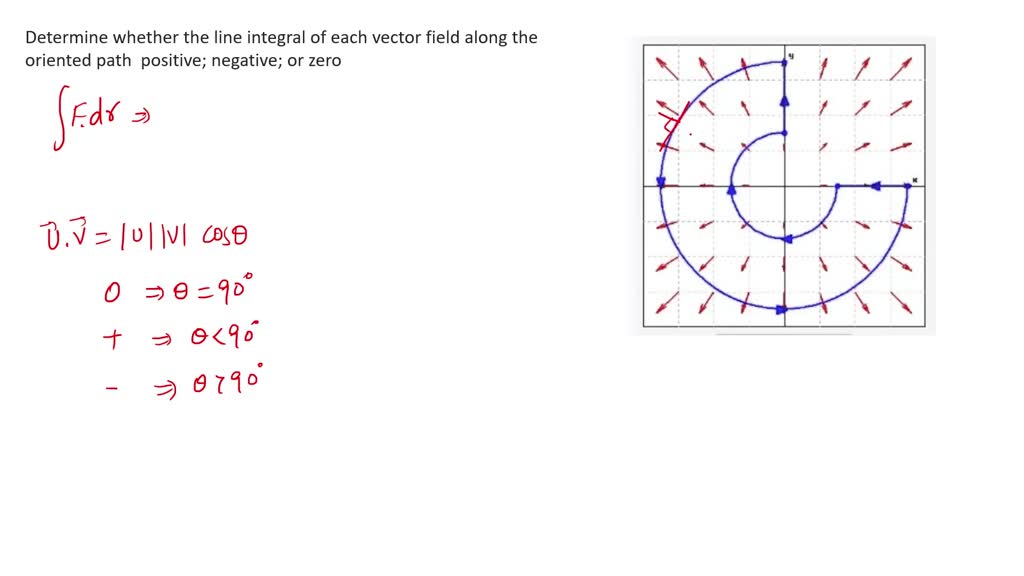
The sign of the line integral's contribution at any point depends on the angle between the vector field and the path's tangent vector . If , the contribution is positive. If , it's negative. If , it's zero.
3. How to Compute a Line Integral
The definition is conceptually clear, but to actually compute it, we need to convert it into a standard single-variable integral. This is done through parametrization.
The process is as follows:
- Parametrize the Path : Describe the curve using a parameter, usually . This means expressing the coordinates and as functions of , for a certain range of , say from to . The position vector along the path is then .
- Express Everything in Terms of :
- Substitute and into the vector field to get .
- Find the differential displacement vector . Since is the position vector, .
- Set up and Evaluate the Integral: The line integral transforms into a definite integral with respect to : The dot product will result in a scalar function of , which you can then integrate from to .
Let's see this procedure in action. Please read the following section from the MIT notes, which walks through a concrete calculation.
[PDF] Line Integrals and Green's Theorem - MIT OpenCourseWare
This section formally defines the line integral and demonstrates the full computational procedure with a clear example.
Start reading from the section titled "Definition and computation". Follow Example GT.3 carefully. Note how they first parametrize the parabolic curve, then substitute this parametrization into both the vector field \mathbf{F} and the differential d\mathbf{r}, and finally compute the resulting integral.
An important property of line integrals is that, in general, their value depends on the path taken between two points. A different path will usually result in a different amount of work done. This is a key distinction from conservative forces (like gravity), where the work done is path-independent. We will explore this distinction in great detail later in the course.
4. Test Your Understanding: A JEE Advanced Problem
Let's apply what you've learned to a problem from a past JEE Advanced paper. This problem requires you to calculate the work done by a given force field along a closed path made of several straight segments.

A particle is moved along the path AB-BC-CD-DE-EF-FA in the presence of a force N, where and are in meters and . The work done on the particle by this force will be ___ Joule.
Your Task:
Calculate the total work done by the force along the closed path shown in the image.
Strategy:
- Break it down: The total work is the sum of the work done along each of the six segments: .
- Calculate one by one: For each segment, parametrize the path, compute , and integrate.
- Parametrization hint: For straight line segments parallel to the axes, parametrization is very simple. For example, along segment AB:
- The path is from to .
- Here, is constant, so . The variable goes from 0 to 1.
- The position vector can be written as , so .
- The force field along this path is .
- The work is J.
Now, apply this method to the remaining five segments (BC, CD, DE, EF, FA) and sum the results to find the total work. Take your time with the coordinates and integration limits for each segment.
Click here to see the final answer and full solution.
Final Answer: The total work done is 0.75 J.
Full Solution:
- Path AB: J (as calculated above).
- Path BC: From to . Here, . goes from 1 to 0.5.
. .
. J. - Path CD: From to . Here, . goes from 1 to 0.5.
. .
. J. - Path DE: From to . Here, . goes from 0.5 to 0.
. .
. J. - Path EF: From to . Here, . goes from 0.5 to 0.
. .
. J. - Path FA: From to . Here, . goes from 0 to 1.
. .
. J.
Total Work:
J.
Conclusion
In this lesson, we have taken a familiar concept from mechanics—work—and elevated it into a powerful mathematical tool. You now have a solid foundation for understanding and working with vector fields and line integrals.
Here are the key takeaways:
- A vector field is a function that assigns a vector to each point in space, providing a way to model variable forces, fluid flows, and more.
- The line integral of a vector field along a path , written as , calculates the cumulative effect of the field's component tangent to the path. Its most direct physical interpretation is the work done by the field.
- The computation of a line integral involves three steps: parametrizing the path, substituting to express the integrand in terms of the parameter, and evaluating the resulting standard definite integral.
We have now mastered integration along a one-dimensional path embedded in a higher-dimensional space. In our next lesson, we will expand our toolkit by learning to integrate over two-dimensional areas. We will define and compute double integrals, which will enable us to find properties like the mass and center of mass for two-dimensional objects, another essential skill for advanced mechanics.