Hello! Welcome back to your course on building your brand.
In our last lesson, we broke down the Marketing Mix—the 4 Ps of Product, Price, Place, and Promotion. You learned that these are the core ingredients you can control to shape your brand. But your brand doesn't exist in a bubble. To create a successful mix, you first need to understand the competitive environment.
Today, we'll learn how to conduct a basic competitive analysis to identify market positioning opportunities. This means we'll be looking at how other furniture makers—your competitors—are using their 4 Ps. By understanding their strengths and weaknesses, you can find a unique and valuable space in the market for your premium woodworking brand.
What is Competitive Analysis?
Competitive analysis is the process of identifying your competitors and evaluating their strategies to determine their strengths and weaknesses relative to your own business. It's not about copying what others do; it's about finding gaps they've missed and understanding what customers in your market already expect.
To get a clear overview, let's start with a short video.
7 Easy Steps on How to Perform a Competitor Analysis
This video from LYFE Marketing gives a great introduction to what a competitor analysis is and why it's so important for any new business or marketing strategy.
Watch from the beginning until 01:52. Pay attention to the three main reasons for doing an analysis: identifying what competitors do right, what they do wrong (market gaps), and how to establish your unique value.
As the video explains, this process is fundamental to:
- Identifying gaps in the market.
- Understanding customer needs that aren't being met.
- Defining what makes your brand different and better.
For your woodworking studio, this means looking at other premium furniture sellers in Tanzania and Kenya to find an opportunity where your unique combination of CNC precision, local materials, and modern design can shine.
A Framework for Your Analysis
A good analysis is systematic. We'll use a structured approach to gather information. For a business like yours, a great way to structure this is by using the 4 Ps framework we learned in the last lesson.
Step 1: Identify Your Competitors
First, you need to know who you're up against. Competitors come in two main types:
- Direct Competitors: These businesses offer a similar product to a similar audience. For you, this would be other companies selling high-end furniture in Tanzania and Kenya. Think of established furniture showrooms in Nairobi or Dar es Salaam, or other high-end independent carpenters.
- Indirect Competitors: These businesses solve the same problem for the customer but with a different product or service. This could include interior designers who source or design custom furniture for their clients, or even international brands that ship to the region.
To find them, think like a customer.
7 Easy Steps on How to Perform a Competitor Analysis
This next clip from the same video explains a simple but effective way to start finding your direct competitors.
Watch from 02:11 to 02:56. The key takeaway is to search online (Google, Instagram, Pinterest) using the same keywords your potential customers would use, like 'luxury furniture Kenya' or 'custom wood dining table Tanzania'.
Make a list of 3-5 key competitors to start with.
Step 2: Analyze Their Marketing Mix (The 4 Ps)
Now, for each competitor on your list, investigate their 4 Ps. The article "How to Perform Competitor Analysis" from Coursera provides an excellent set of questions to guide you. While you don't need to read the full article now, we'll be using its core ideas.
Your goal is to fill out a framework like the one below for each competitor.
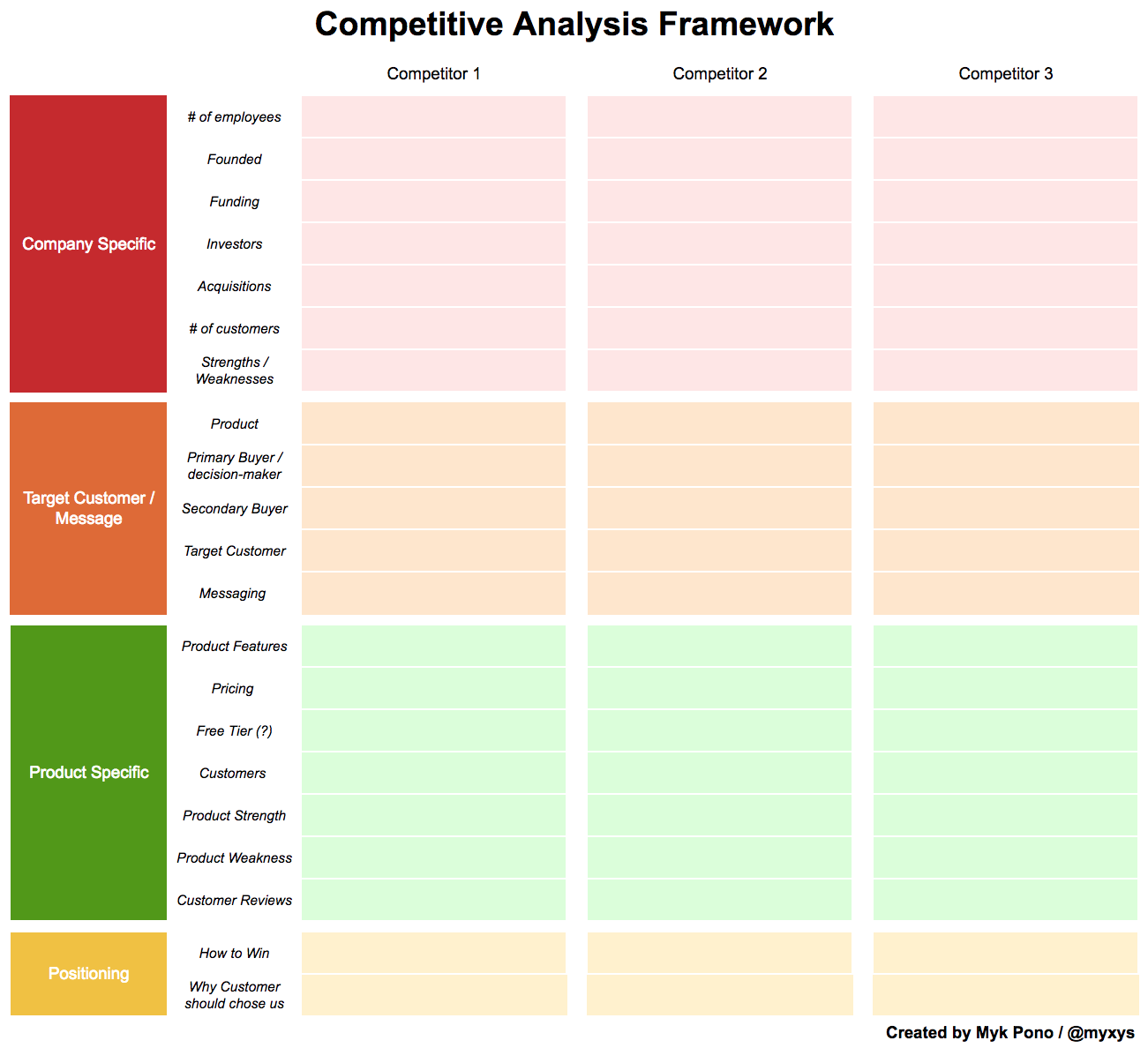
Let's break down what to look for, using the 4 Ps as our guide:
-
Product:
- What is the style of their furniture (e.g., traditional, rustic, minimalist)?
- What materials do they use? Are they local or imported?
- What is the perceived quality and craftsmanship?
- Do they offer customization?
-
Price:
- What are their price points (premium, mid-range)?
- Is their pricing transparent online, or is it "price on request"?
- How does their price reflect their brand position?
-
Place:
- Where do they sell? Through a physical showroom, an e-commerce website, social media, or partner interior designers?
- What is the experience of shopping with them like?
-
Promotion:
- What is their brand message? Do they focus on heritage, luxury, or affordability?
- What channels do they use for marketing (e.g., Instagram, Pinterest, Facebook)?
- What is the style of their photography and visual branding?
- What are customers saying about them in reviews and comments?
The article Furniture Marketing Guide reinforces this, noting that a good analysis looks at "furniture offerings, pricing strategies, marketing tactics, and reviews" to "uncover gaps in the market."
To see how to gather this information practically, let's return to the LYFE Marketing video.
7 Easy Steps on How to Perform a Competitor Analysis
This longer segment walks you through the process of investigating a competitor's products, sales process, pricing, and digital marketing. It provides a practical guide for the 'data gathering' phase of your analysis.
Watch from 02:56 to 07:20. Don't worry about memorizing every detail. Just focus on the types of information they are looking for: product pages, pricing, social media activity, and customer reviews.
Step 3: Synthesize and Find Opportunities
This is the most important step. Once you've gathered the data, you need to analyze it to find your opening in the market. Two powerful tools for this are the SWOT Analysis and Perceptual Mapping.
SWOT Analysis
SWOT stands for Strengths, Weaknesses, Opportunities, and Threats. For each competitor, and for the market as a whole, ask:
- Strengths: What are competitors very good at? (e.g., A strong reputation for traditional Swahili-style furniture).
- Weaknesses: Where are they lacking? (e.g., They have an outdated website and poor social media presence; their designs are not modern).
- Opportunities: Based on their weaknesses, what gaps can you fill? (e.g., The market lacks a provider of minimalist, high-tech furniture using local woods).
- Threats: What could pose a challenge to you? (e.g., An established player starts offering a modern collection).
Your opportunity lies in capitalizing on competitor weaknesses.
Perceptual Mapping (or Positioning Maps)
This is a fantastic visual tool for identifying gaps. A perceptual map is a simple 2x2 grid where you plot your competitors based on two key criteria.

To understand how to build and use one, let's watch one final video.
Perceptual Mapping & Product Positioning Explained
This video from Wolters World offers a clear, practical explanation of perceptual mapping. It shows how changing the criteria (the axes of the map) can reveal different kinds of market gaps.
Watch from the beginning until 06:39. Pay close attention to how he first plots brands on a 'Price vs. Quality' map, and then changes the axes to 'Quality vs. Kid-Friendliness' to uncover a new opportunity. This demonstrates the power of choosing the right criteria for your analysis.
For your premium furniture business, the axes could be anything that is important to your customers. For example:
- Axis 1: Traditional Design vs. Modern/Contemporary Design
- Axis 2: High Price vs. Mid-Range Premium Price
Or:
- Axis 1: Hand-Crafted Aesthetic vs. Precision/Engineered Aesthetic
- Axis 2: Locally Sourced Materials vs. Imported Materials
By plotting your competitors on this map, you will visually see where the clusters are and, more importantly, where the empty spaces are. Those empty spaces are your potential market positioning opportunities.
Test your understanding!
Imagine you've analyzed the premium furniture market in Nairobi. You create a perceptual map with the axes "Style" (from Traditional to Contemporary) and "Origin" (from Imported to Locally Made).
You plot your competitors and find that the top-right quadrant (Contemporary style, Locally Made) is almost empty. Most competitors are either selling traditional, locally made furniture or contemporary, imported furniture.
What does this "empty space" tell you? What is the potential market positioning opportunity here?
Show answer
The empty space indicates a significant market opportunity. It suggests there is a gap in the market for a brand that offers furniture with a contemporary design aesthetic that is also proudly and transparently made in Kenya.
This is a powerful positioning opportunity. Your brand could appeal to customers who want modern, high-quality furniture but also value supporting local craftsmanship and the local economy. You could position your brand as "the future of East African design"—modern, precise, and locally rooted.
Conclusion
Conducting a competitive analysis is a critical step in building a strong brand strategy. It moves you from simply having an idea to understanding exactly where that idea fits in the real world.
Key Takeaways:
- Competitive analysis involves identifying competitors and systematically evaluating their strategies, particularly their 4 Ps.
- The goal is not to copy but to find unmet needs and market gaps.
- SWOT Analysis helps you summarize competitor strengths and weaknesses to find opportunities.
- Perceptual Maps are a powerful visual tool to plot the competitive landscape and identify a unique position for your brand.
You now have the tools to analyze the market. In our next lesson, we'll shift our focus from the competition to the customer. We will learn how to create a target customer profile, drilling down into the specific demographics, behaviors, and motivations of the premium furniture buyers you want to reach.