Welcome to your first lesson! I'm excited to start this journey with you to build a powerful brand for your woodworking studio.
Our main goal in this course is to move from core marketing principles to a complete, professional brand guidelines document that you can hand off to a designer or use yourself. We'll cover everything from understanding your customers to defining your brand's visual and verbal identity.
In this first lesson, we'll start with the most fundamental building block: what a brand is. It's a term people use all the time, but often incorrectly. By the end of our session, you'll be able to clearly define what a brand is and distinguish it from the more tangible elements like a logo or a visual identity. This foundation is crucial because it shapes every strategic decision we'll make from here on out.
Let's begin.
What a Brand Isn't
One of the biggest hurdles in branding is clearing up common misconceptions. People often say "I need a new brand" when they mean "I need a new logo." While a logo is important, it's only one small piece of a much larger puzzle.
To get us on the same page, let's watch a short clip that does an excellent job of debunking these myths.
What Is Branding? 4 Minute Crash Course.
This video from The Futur, a well-regarded design education channel, starts by explaining what a brand is not. This will help us clear away the common, but inaccurate, definitions right from the start.
Please watch from the beginning until 01:11. Pay attention to the four things the speaker, Marty Neumeier (a renowned branding expert), explicitly states are not a brand.
As you just saw, a brand isn't:
- A logo: A logo is just a symbol for the brand.
- A product: The product is what you sell; the brand is how people feel about what you sell.
- A promise: While a brand can feel like a promise, that's a result of the brand, not the brand itself.
- The sum of all impressions: This is closer, but still misses the core of what a brand is from a business strategy perspective.
So, What IS a Brand?
Now that we know what a brand isn't, let's define what it is. The most powerful and useful definition is that a brand is an intangible concept—it's the perception that exists in your audience's mind.
Let's continue with the same video to get a clear definition.
What Is Branding? 4 Minute Crash Course.
The next segment of the video provides a concise and powerful definition of a brand.
Watch from 01:11 to 02:24. Focus on the core definition provided: 'a customer's gut feeling'.
Marty Neumeier defines a brand as "a customer's gut feeling about a product, a service, or a company." He also describes it as your business reputation.
This is the single most important concept in this lesson. Your brand doesn't live in your workshop, on your website, or in your logo files. It lives in the minds and hearts of your customers.
Your background in sales and account management gives you a practical understanding of this. You've actively worked to shape a client's perception and build a positive reputation. That's branding in action—managing that "gut feeling."
To visualize how these concepts fit together, look at the following diagram.
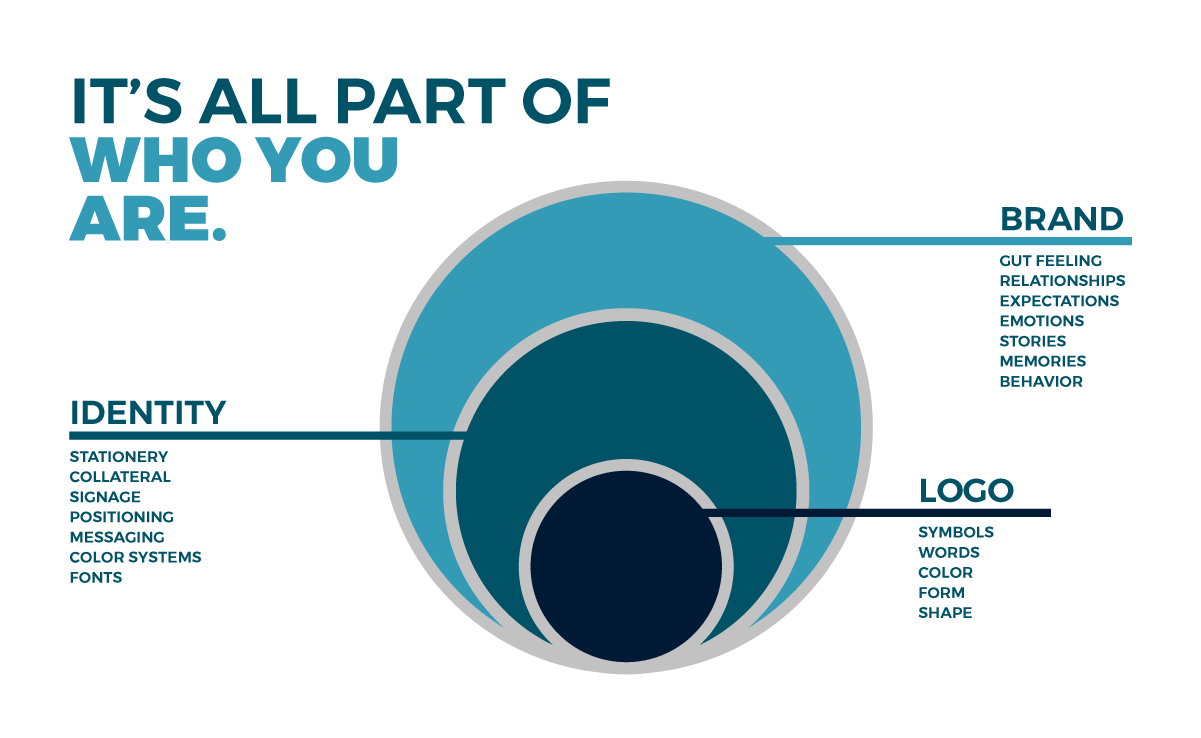
As you can see, the brand is the all-encompassing result of the more concrete elements within it.
Brand vs. Brand Identity vs. Logo
Now we can make the distinctions crystal clear.
- Logo: A single graphic mark or symbol that identifies your business.
- Visual Identity (or Brand Identity): The entire system of tangible, visual elements you use to communicate. This includes your logo, color palette, typography, photography style, and more. It's the toolkit you use to build the brand.
- Brand: The final result of using that toolkit. It's the intangible "gut feeling" or reputation that your customers have about your woodworking studio.
This next video provides a great analogy to help remember the difference.
DIFFERENCE BETWEEN LOGO DESIGN & BRAND IDENTITY
This video from BRANDEM™ Strategy does an excellent job of distinguishing a logo from the broader brand identity system, using a simple analogy of a person's name versus their personality.
Watch from the beginning to 02:10. Notice the list of elements that make up a brand identity—we will be creating many of these throughout this course.
The analogy is perfect: a logo is like your name, but your brand identity is your entire personality—your style, your voice, and your quirks. The video lists several components of a brand identity system:
- Primary and secondary logos
- Color palettes
- Typography
- Brand patterns or textures
- Tone of voice

For your woodworking business:
- Your logo might be a mark inspired by a specific wood grain or a symbol with cultural relevance in Tanzania or Kenya.
- Your visual identity would include that logo, plus the warm color palette you choose, the elegant font on your website, and the style of photography showcasing your furniture.
- Your brand will be the feeling a customer in Nairobi or Dar es Salaam gets: "This is premium, authentic East African craftsmanship. I trust this company to build something beautiful and lasting for my home."
Why This Distinction Matters for Your Business
Understanding this hierarchy isn't just academic. It has direct, practical benefits, especially for a premium business like yours. Building a strong brand, not just a nice logo, is what allows you to thrive.
How To Build A Furniture Brand
This article, 'How To Build A Furniture Brand,' connects our discussion directly to your industry. It explains the tangible business value of moving beyond just selling products to building a true brand.
Please read the section titled 'Why Build a Furniture Brand?'. Focus on the five key benefits listed.
As the article notes, a strong brand helps you:
- Command higher prices: This is the core of a premium strategy. Customers pay more for the trust and status a brand represents.
- Foster customer loyalty: People become repeat customers because they connect emotionally with your brand's values and aesthetic.
- Stand out in a crowded market: A unique brand identity makes you memorable.
- Expand your reach: A strong reputation opens doors to partnerships with interior designers, architects, and retailers.
- Create a valuable asset: A respected brand has financial value and makes your business more attractive to future investors or buyers.
Test your understanding!
Imagine you meet a potential client at a gallery in Nairobi. They have seen your work online. Which of the following statements from the client best describes your brand (the 'gut feeling'), and which describes your visual identity?
- "I love the deep earth tones and the elegant, clean font you use on your website. It all feels very cohesive."
- "Looking at your work, I just get a sense of quiet confidence and timeless quality. It feels like something my family would cherish for generations."
Show answer
Statement 1 describes your visual identity. The client is commenting on specific, tangible design elements: the color palette ("deep earth tones") and typography ("elegant, clean font").
Statement 2 describes your brand. The client is expressing their "gut feeling"—their perception of intangible qualities like "quiet confidence," "timeless quality," and "cherished." This is the emotional and psychological impact your work and its presentation have had on them.
Conclusion
This lesson set the stage for everything to come. We've established a clear and strategic understanding of branding that goes far beyond surface-level aesthetics.
Key Takeaways:
- A brand is your customer's gut feeling or your business's reputation. It's an intangible asset that lives in their minds.
- A logo is a simple visual identifier.
- A visual identity is the complete toolkit of tangible assets (colors, fonts, imagery, logo) that you use to shape your customers' perception.
- Focusing on building a strong brand, not just a logo, is what creates long-term value, enables premium pricing, and fosters customer loyalty.
In our next lesson, we will move on to the next learning outcome: Identify the key components of a marketing strategy (product, price, place, promotion). We'll explore the classic "4 Ps of Marketing" and begin to frame how your woodworking products will be positioned in the East African market.