Welcome back. The previous lesson established why the Lateran is a cathedral: its cathedra expresses the Pope’s role as Bishop of Rome. This lesson separates that fact from two others that can make St. Peter’s seem like the obvious candidate: its association with Peter’s tomb and its proximity to the place where popes have lived and worked.
Allow about 30–35 minutes, including the short video, reading, and comparison of the two photographs.
Cathedral and basilica describe different things
A cathedral is the church that serves as a bishop’s seat in a diocese. A basilica is a designation that does not, by itself, identify a bishop’s cathedral. The Lateran is both Rome’s cathedral and a major papal basilica. St. Peter’s is also a major papal basilica, but it is not Rome’s cathedral.
Watch this brief comparison of the churches’ distinct roles.
Saint John Lateran - PART 1; The Cathedral of Rome, Aurelian Walls
“Saint John Lateran – PART 1,” from ExcitingEurope, contrasts St. Peter’s association with the apostle’s burial place and the Lateran’s role as the Pope’s episcopal church.
In the opening discussion of the major papal basilicas, watch the comparison. Focus on the different reasons given for the importance of St. Peter’s and the Lateran; stop as the discussion turns to other basilicas.
St. Peter’s stands at the site traditionally identified with the apostle Peter’s tomb. That association makes it a major place of pilgrimage and papal worship. It does not make the building the cathedral of the Bishop of Rome. A church’s connection to an apostle’s burial place and its role as a bishop’s cathedral are distinct claims.
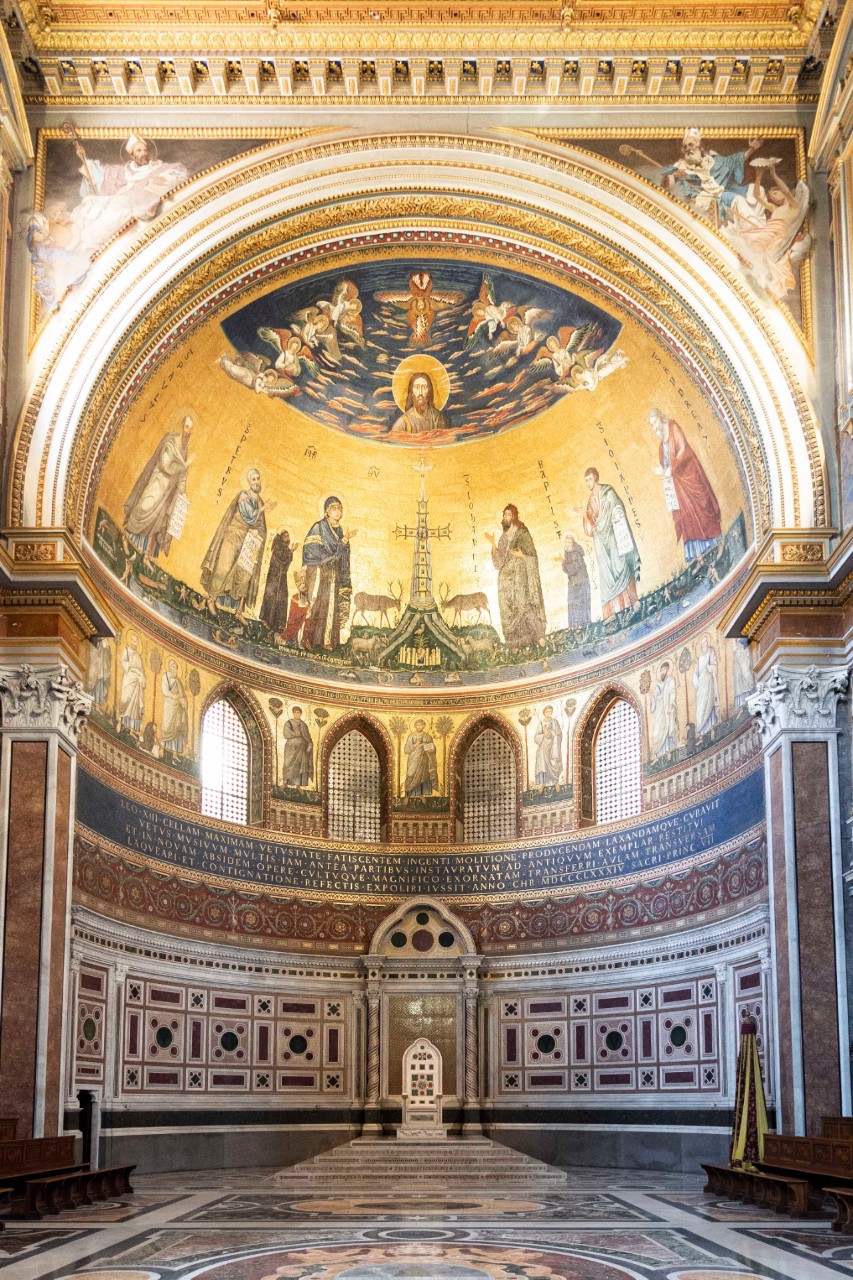
The photographs make the distinction easier to hold in mind. At the far end of the Lateran apse, below the mosaics, is the papal cathedra discussed in the previous lesson.
In the St. Peter’s photograph, Bernini’s great bronze canopy stands over the high altar. At the distant end is another prominent work associated with a chair: the Cathedra Petri, a monument honoring the Chair of Peter.

The name Cathedra Petri can understandably cause confusion. It evokes Peter’s teaching and apostolic ministry. But the presence of a monument to Peter’s chair at St. Peter’s does not relocate the diocesan cathedra from the Lateran. The images show two ways a church can express papal significance, not two interchangeable cathedral seats.
A residence is not a cathedral
For many centuries, the popes lived and worked in a palace beside the Lateran. That historical closeness helped make the Lateran complex a center of papal activity, but it was not what defined the church as a cathedral. Read this short account of the palace’s earlier role.
St. John Lateran: The Pope's Cathedral | Salt + Light Media
Salt + Light Media’s “St. John Lateran: The Pope’s Cathedral” places the former papal residence alongside the cathedral. Read it to distinguish the palace’s function from the church’s.
Below the article’s introductory discussion and photograph of the Lateran apse, find the paragraph beginning “The site, originally owned by the Laterani family.” Read the palace paragraph, stopping before the next paragraph, which begins “In the 14th century.” Notice that the residence and the cathedral belonged to the same complex but served different purposes.
Following the medieval period when popes lived at Avignon, the Vatican became the customary center of papal residence and administration. St. Peter’s was close to that center. Yet moving a residence did not move Rome’s cathedral: the Pope remained Bishop of Rome, and the Lateran remained his cathedral church. A pope can also celebrate an important liturgy at St. Peter’s without changing which church is his cathedral.
It helps to keep the descriptions precise:
- The Lateran: the Pope’s cathedral as Bishop of Rome.
- St. Peter’s: a major papal basilica associated with Peter’s tomb and a setting for major papal liturgies.
- The papal residence: the place a pope lives and works; historically at the Lateran complex and, in later centuries, associated with the Vatican.
These roles can be close together, as they once were at the Lateran, or geographically separate. They answer different questions about a place.
The distinction to carry forward
St. Peter’s importance does not need to be diminished to explain the Lateran’s distinctive place. The Lateran’s cathedral status concerns the Pope’s enduring office as Bishop of Rome. St. Peter’s significance concerns, above all, its association with Peter’s tomb and its place in Catholic pilgrimage and worship. Papal residence is a third matter, and its relocation did not transfer the cathedral’s status.
The next lesson turns back to the fourth century to examine how Constantine’s patronage made a monumental cathedral for Rome’s Christian community possible.