The last lesson distinguished the Lateran’s role as the Pope’s cathedral from St. Peter’s association with Peter’s tomb and from the location of the papal residence. The next question is historical: how did Rome acquire a cathedral built on the scale of a public monument?
This lesson follows the change in Christians’ legal position in 313, Constantine’s provision of a site, and the kind of gathering place built there. Allow about 30–40 minutes for the video, readings, and lesson.
A new possibility after 313
Christians gathered for worship in Rome before Constantine. The Lateran was not the beginning of Christian worship in the city. What changed in Constantine’s time was the possibility of establishing a large, publicly supported church for the community gathered around its bishop.
After defeating his rival Maxentius in 312, Constantine joined the emperor Licinius in the agreement conventionally called the Edict of Milan in 313. It granted freedom of worship to Christians as part of a broader policy of religious toleration. This did not make Christianity the empire’s official religion. It did, however, give Constantine room to support Christian communities openly, including through land and construction.
THE BASILICA OF SAINT JOHN LATERAN | Faith Exposed with Cardinal Tagle
In “The Basilica of Saint John Lateran,” Faith Exposed with Cardinal Tagle on JesComTV briefly connects the change in religious policy with Constantine’s gift of a Lateran site.
Watch the 313 context for the account of religious freedom, then the Lateran gift for its connection to a church serving Rome’s bishop. Treat the description of an estate being “transformed” as a short summary of a more complex building history, rather than as a claim that an existing palace room simply became the basilica.
The sequence matters. Legal toleration made open construction possible; imperial patronage made construction on a monumental scale possible. Neither fact alone explains why the resulting church became Rome’s cathedral. That depends on its purpose as the church of the Bishop of Rome, whose cathedra you encountered earlier.
Why the site matters
“Lateran” was already a name associated with this area of Rome before the basilica was built. The site had a layered history: residences and military buildings occupied parts of the area. The basilica’s own accounts emphasize both land associated with Constantine’s wife, Fausta, and the presence of barracks linked to Maxentius’s forces. These details establish the larger point without requiring us to imagine a single empty plot handed over intact: imperial control of this substantial urban site enabled a new Christian building project.
Excavations - Archbasilica of Saint John Lateran
Read the basilica’s “Excavations” account for the site beneath and around the church. Its archaeological perspective helps distinguish the older Lateran area from the church Constantine commissioned there.
In the “Excavations” section, under “Beneath the Basilica and the houses of the Laterans,” begin with the paragraph about Fausta. Read the site account through the end of that paragraph, which names the Domus Faustae. Then read the excavation evidence through the name of the cavalry barracks. Stop before the final sentence about the military corps; focus on the earlier structures found beneath the basilica.
The reading calls Constantine’s foundation the Basilica of the Holy Saviour. That earlier dedication helps prevent an easy misunderstanding: although the church is now commonly called St. John Lateran, its Constantinian origins concern a newly established church for Rome’s Christian community, not a building originally erected as a shrine to either St. John.
A church built for an assembled community
Land was only part of Constantine’s contribution. His patronage also supported the construction of a basilica large enough to give Christian worship a prominent, enduring setting. The building was designed to gather the city’s community around its bishop. That purpose explains its significance better than a claim that it was the first place Christians had ever worshipped.
The basilica’s official history makes this distinction explicitly. It also describes how the building’s spacious interior and orientation served a Christian congregation rather than simply reproducing the use of an older Roman temple.
Basilica - Archbasilica of Saint John Lateran
Read the archbasilica’s historical account to connect Constantine’s gift with the building’s purpose: a place where Rome’s Christian community could gather around its bishop.
In “Basilica of Saint John Lateran. Historical details,” read the opening paragraph for the distinction between earlier Christian activity and this new basilica. Continue from the paragraph beginning “Entering in the Basilica” through the architectural comparison; focus on where the congregation gathers and on the altar’s place inside the church. Finally, near the end of the page, read the patronage account about Constantine’s construction and the site’s name.
Imagine the difference between a small meeting place and a building conceived for a citywide assembly. The basilica provided room for worshippers to gather inside, with the altar and the bishop’s place integrated into a shared setting for worship. Its scale made the Christian community publicly visible; its function made it the church serving that community under its bishop. Monumental size did not create cathedral status by itself, but Constantine’s patronage gave Rome’s bishop a monumental cathedral church.
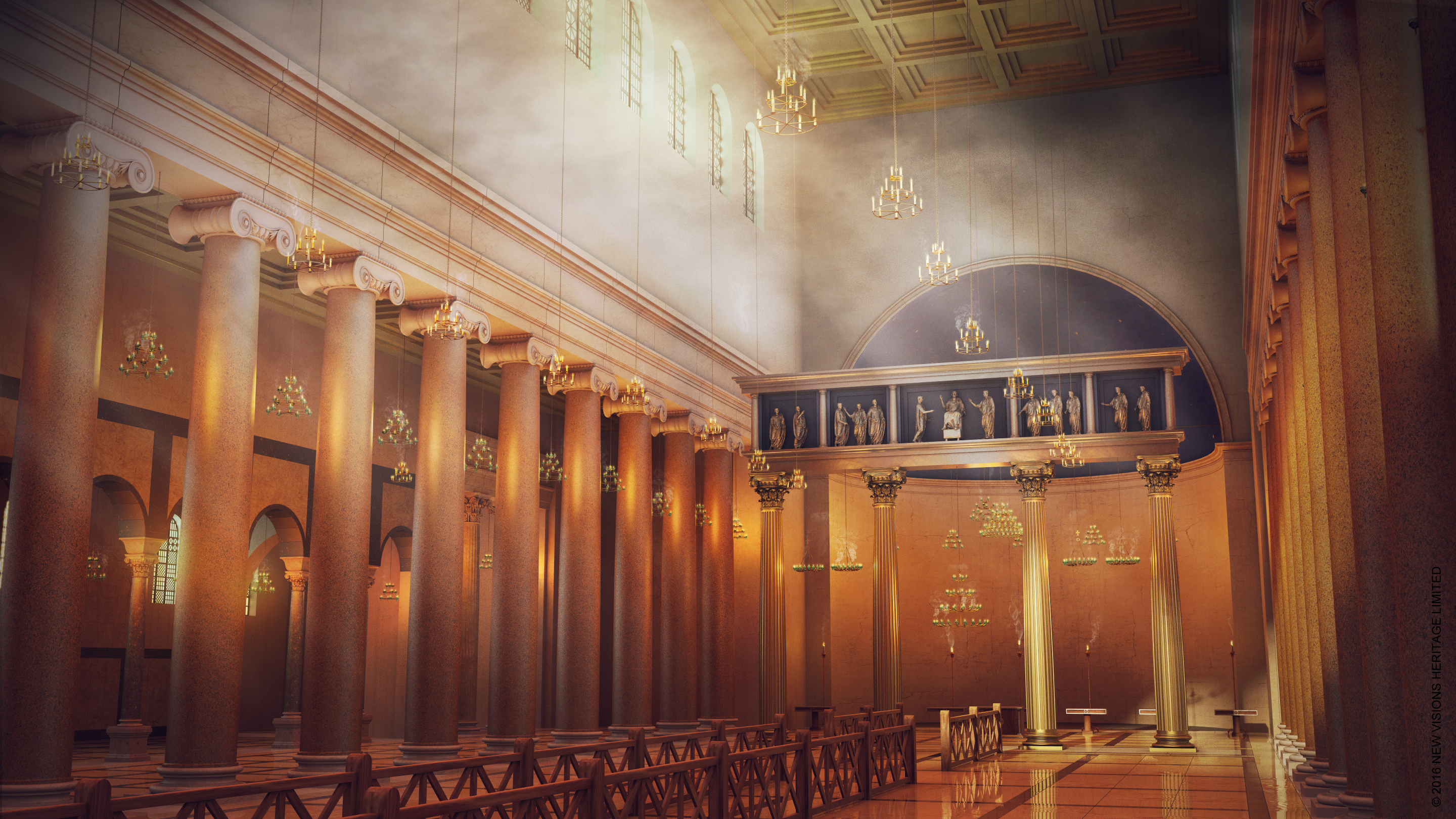
The reconstruction below helps visualize that scale. It is an interpretation of the Constantinian interior, not a photograph of a surviving fourth-century room. Notice the long, column-lined space and the apse at its far end. The next lesson will use a simple floor plan to examine more precisely how such spaces organize worship.
What Constantine’s patronage established
The Lateran’s origins bring together three distinct facts. Christians already worshipped in Rome before Constantine. The change associated with 313 allowed Christian worship and church-building to become public. Constantine then made an imperial site and construction support available for a substantial basilica intended to gather Rome’s community around its bishop.
That is why the Lateran’s Constantinian beginning matters to its cathedral history. It was not merely an impressive building donated by an emperor: it was a monumental setting for the worship of the Church of Rome, whose bishop’s cathedra gives the church its cathedral identity. Next, you will read a basilican floor plan to see how the nave, altar, and apse shape that gathered worship.