The Lateran’s place in Catholic worship begins with a chair. This course will go on to trace the basilica’s origins, its rebuilding, and the meaning of its dedication feast. First, though, it helps to establish why the building is a cathedral: it is the church of the Pope as Bishop of Rome. The papal cathedra, or bishop’s chair, makes that relationship visible.
Allow about 30–40 minutes for this lesson, including the brief viewing and a close look at the two photographs.
What makes a church a cathedral?
A bishop is responsible for a local church, commonly called a diocese. The bishop’s cathedral is the church that serves as the principal seat of that ministry. Its defining feature is not its size or beauty. It is the cathedra: a chair set apart as the sign of the bishop’s office. The word cathedral comes from cathedra.
Watch this short passage for its distinction between the Pope’s role as leader of the worldwide Catholic Church and his role as the bishop of a particular diocese.
THE BASILICA OF SAINT JOHN LATERAN | Faith Exposed with Cardinal Tagle
Watch “THE BASILICA OF SAINT JOHN LATERAN” from JesComTV for its concise explanation of the Lateran as the church of the Bishop of Rome.
Watch the cathedral explanation. Focus on the description of the Lateran as the Roman bishop’s church and of the papal chair as a sign of teaching authority.
The Pope has a ministry to Catholics far beyond Rome, but he is also Rome’s bishop. At the Lateran, those two facts meet: the bishop whose chair is there is the Pope. Calling the Lateran “the Pope’s cathedral” therefore says something more precise than calling it an important papal church. It identifies the church that expresses his office as bishop of Rome.
For a useful definition of the chair’s significance, read just the indicated portion of this article. Its subject is the Chair of Saint Peter as a symbol of episcopal ministry; here, concentrate on the general explanation of what a bishop’s cathedra means.
Feast of the Chair of Saint Peter the Apostle - Vatican News
Read Vatican News’s explanation of the cathedra as the bishop’s fixed seat in the principal church of a diocese.
In the opening paragraph, begin with the sentence starting “The feast originated around the” and read the chair’s meaning through the sentence ending “Christian community.” Notice the connection the article makes between the seat, the cathedral, and the bishop’s responsibilities.
A chair can mark an office without being the source of that office’s authority. An empty cathedra still identifies the cathedral; a bishop does not stop being bishop upon leaving it. Equally, installing an ornate chair in another church would not, by itself, turn that church into the diocese’s cathedral. The chair is a visible sign of an enduring relationship between a bishop and the community entrusted to that bishop’s care.
Reading the Lateran’s cathedra
The Lateran’s own account emphasizes a pastoral meaning of the chair. Read its explanation before looking closely at the photographs.
The Cathedral - Archbasilica of Saint John Lateran
Read the Archbasilica of Saint John Lateran’s account of what its papal cathedra signifies, especially its connection between spoken teaching and pastoral care.
On the page titled “The Cathedral,” start with the opening words “The basilica conserves the Pope” and continue through the page’s explanation, ending with the words “so that it may shine before all.” Pay particular attention to why the author describes the seated Pope as a pastor rather than as someone expressing merely personal opinions.
Here, pastor means shepherd: someone charged with caring for a community. The chair signifies the bishop’s responsibility to teach the faith, to guide the community, and to serve it. The Lateran account insists that the Pope’s teaching is understood as service to the Word of God, not as the elevation of his private views. The chair’s prominence thus points beyond the person occupying it to the ministry that person is meant to carry out.
Now locate the chair in its setting. In the wider photograph, the cathedra is the small, centrally placed seat at the far end of the apse. The close view makes its form and decoration easier to see.
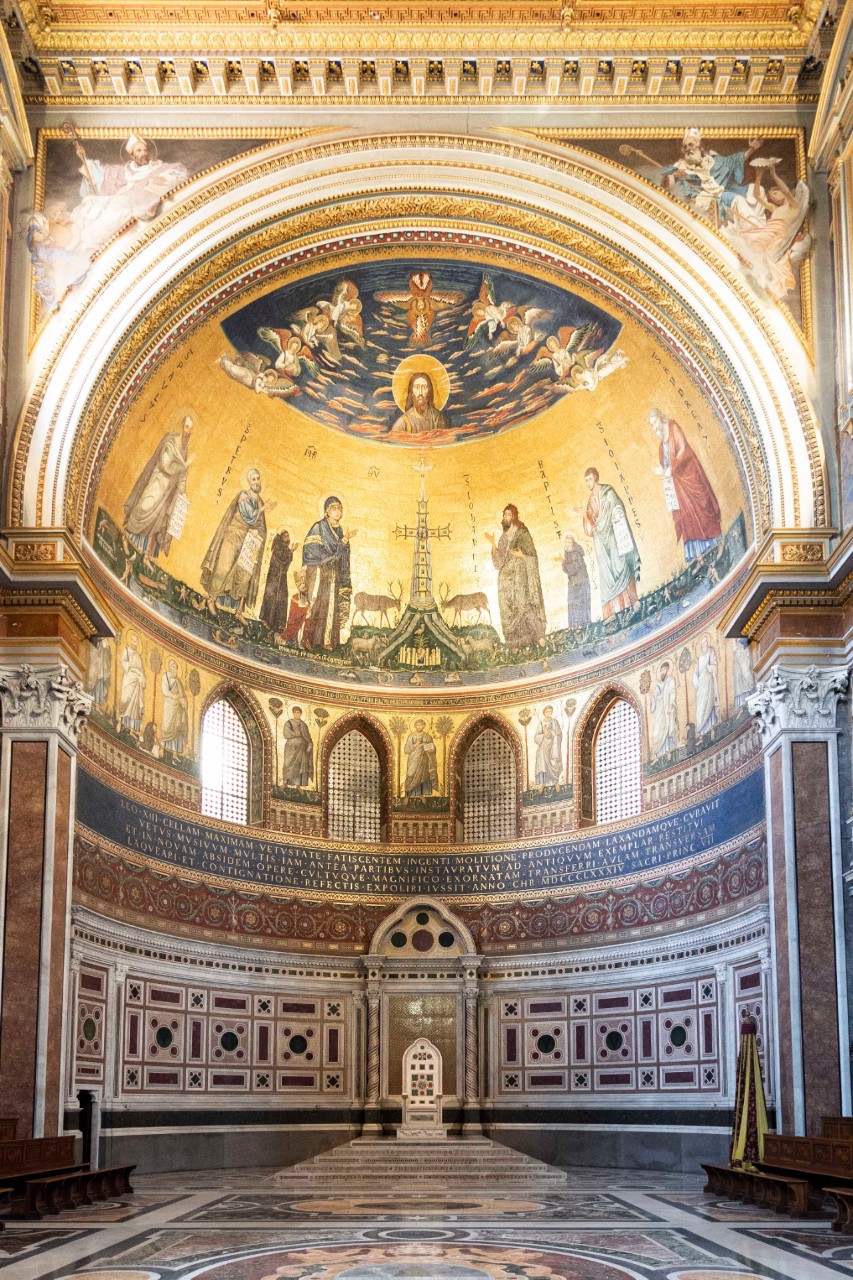
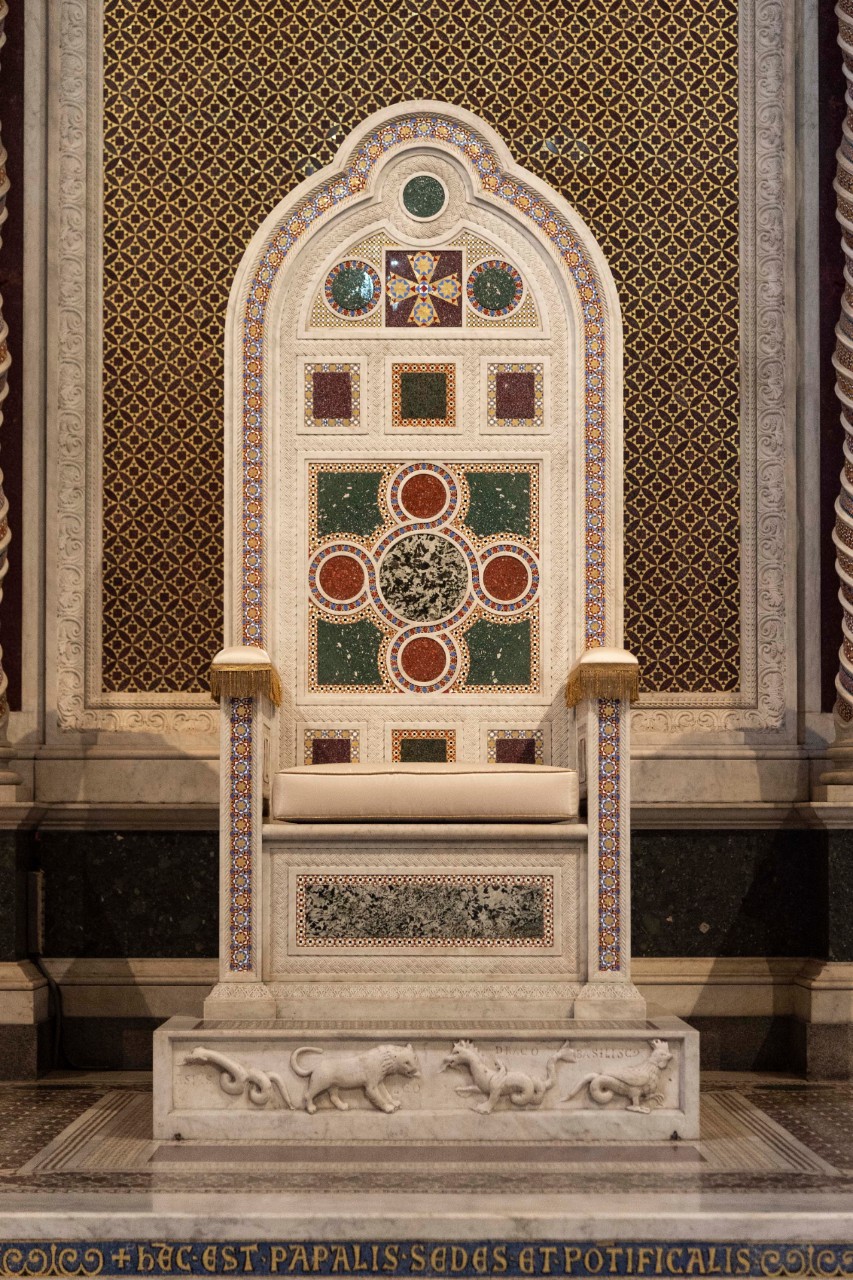
The photographs show why “seat” can mean more than furniture. The chair is unmistakably a physical object, with a location and a history. Yet its importance lies in whom it represents and what that person is called to do. Neither its materials nor its age makes the Pope Bishop of Rome; the cathedra gives his episcopal role a visible place in this church.
The basilica’s account also describes a ceremony in which a new Pope is seated in the Lateran cathedra amid Rome’s clergy. Read the indicated paragraphs for the meaning of that gesture, without treating the chair as if it confers the office by itself.
The Cathedral - Archbasilica of Saint John Lateran
Return to the Lateran’s “The Cathedral” page for the description of the chair’s surviving decoration and the ceremonial seating of a new Pope.
Read the paragraph beginning “Nicholas IV restored the papal cathedra” through the carved imagery. Then move to the final paragraph, beginning “The ritual of the election of every new pope,” and read the seating description to its end. Notice the presence of the clergy of Rome: the action takes place in relation to a local church, not in isolation.
The surviving decoration is a reminder that this chair has its own material history. The ceremonial seating expresses something different: a bishop taking his place among the people and clergy of Rome. It makes an office visible, rather than creating that office through the act of sitting down.
The distinction to carry forward
The most reliable way to explain the Lateran’s cathedral status is to begin with the office, not with a ranking of buildings. The Pope is Bishop of Rome; the Lateran is the cathedral church of that diocese; its papal cathedra visibly expresses that bond. The chair signifies pastoral care and teaching, while its place within the church gives those responsibilities a concrete setting.
This also prepares an important distinction for the next lesson. St. Peter’s Basilica is profoundly significant to Catholics, but significance alone does not make a church the Pope’s cathedral. Next, we will separate the Lateran’s role as Rome’s cathedral from St. Peter’s association with the apostle’s tomb and from the question of where popes live.