Introduction
In our previous lesson, we established a quantitative framework for strong acids and bases, where complete dissociation simplifies pH calculations. We saw that for a strong acid like HCl, the hydrogen ion concentration directly mirrors the acid's initial concentration. However, this is a special case. The vast majority of acids and bases, including many of interest in biological and industrial processes, are weak.
Today, we delve into this more common scenario. Unlike their "strong" counterparts, weak acids and bases do not dissociate completely. Instead, they establish a dynamic equilibrium in solution. This lesson will focus on how to describe this state of partial dissociation. Your goal is to learn how to write the dissociation reaction and the corresponding equilibrium expression (Ka for acids, Kb for bases). This brings together the acid-base concepts from our last lesson with the principles of chemical equilibrium you mastered in Module 10.
The Defining Feature of Weak Acids and Bases: Partial Dissociation
The fundamental difference between strong and weak electrolytes lies in the extent of their dissociation. A strong acid, like HCl, fully dissociates in water. The reaction is essentially a one-way street:
A weak acid, such as acetic acid (the main component of vinegar, CH₃COOH), only partially dissociates. This means that in a solution of acetic acid, most of the molecules remain intact as CH₃COOH, while a small fraction has split into H⁺ and acetate ions (CH₃COO⁻). This process is reversible, creating an equilibrium:
Notice the double arrows (), which signify a system at equilibrium—a concept central to your understanding of reaction dynamics. The forward reaction (dissociation) and the reverse reaction (re-association) occur at the same rate.
To solidify this distinction, please read the introductory section of the following guide.
Weak Acid and Base Equilibria - AP Chem | Fiveable
This text from Fiveable clearly contrasts the behavior of strong and weak acids, emphasizing the concept of incomplete dissociation which is key to today's topic.
Read the section titled Differentiating Strong Acids and Weak Acids. Focus on how the description of a weak acid's behavior in solution differs from that of a strong acid.
The Acid Dissociation Constant (Ka)
Since the dissociation of a weak acid is an equilibrium process, we can describe it mathematically using an equilibrium constant. For a generic weak acid, which we can represent as HA, the dissociation reaction in water is:
Here, HA is the weak acid, and A⁻ is its conjugate base.
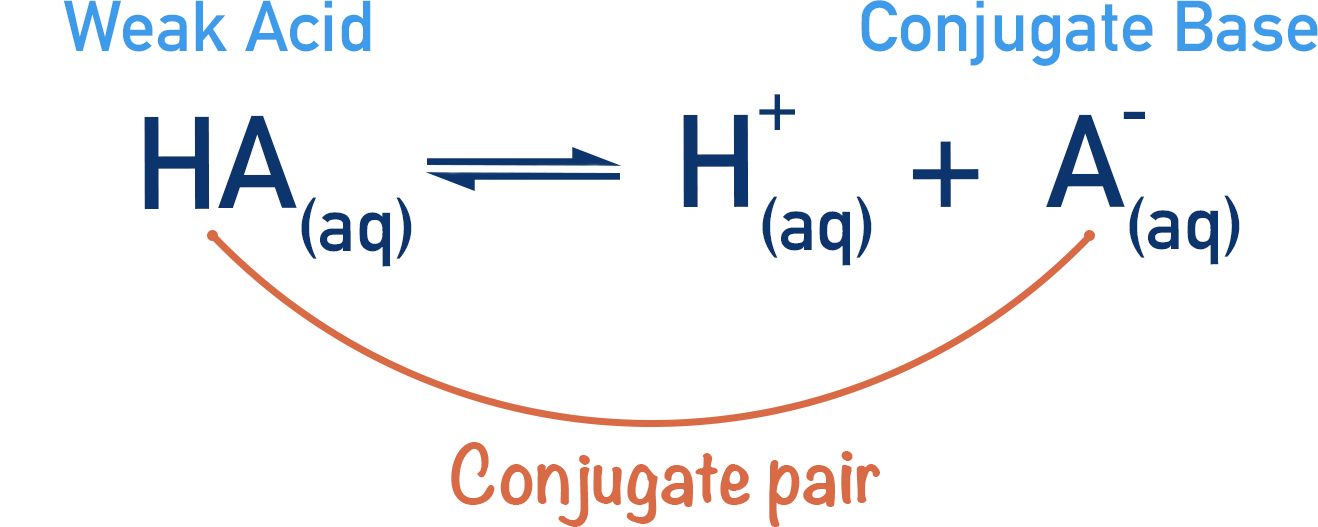
From Module 10, you know that a general equilibrium constant expression is the concentration of products divided by the concentration of reactants. For the dissociation of a weak acid, this constant is given a specific name: the acid dissociation constant, .
The expression for is:
Where:
- is the equilibrium concentration of hydrogen ions.
- is the equilibrium concentration of the conjugate base.
- is the equilibrium concentration of the undissociated weak acid.
You might wonder why water isn't included, especially since the reaction can also be written as . In dilute aqueous solutions, the concentration of water is so large that it remains essentially constant throughout the reaction. Therefore, it is incorporated into the value of and omitted from the expression.
The following resource provides a clear definition of and shows you how to write the expression for specific acids.
16.5 pH Calculations for Weak Acids and Bases - Chad's Prep®
This article from Chad's Prep offers a detailed explanation of the acid dissociation constant, reinforcing how to construct the K_a expression from a given reaction.
Please read the section What Is Ka?. Pay close attention to the generic formula and the specific examples for acetic acid and hydrofluoric acid. The table comparing Ka values is particularly important, as it shows that a larger K_a value signifies a stronger acid because it dissociates to a greater extent.
The Base Dissociation Constant (Kb)
The same principles apply to weak bases. A weak base, which we can represent as B, reacts with water by accepting a proton, establishing an equilibrium. Unlike with acids, including water in the reaction equation is essential to show where the proton comes from.
Here:
- B is the weak base.
- is its conjugate acid.
- is the hydroxide ion produced, which makes the solution basic.
The equilibrium constant for this reaction is the base dissociation constant, .
The expression for is:
Just as with , the concentration of water is omitted. A larger value indicates a stronger base.
The most common example of a weak base is ammonia, . Its reaction with water is:
The corresponding expression is:
To see this explained and demonstrated, let's watch a short video.
R3.1.10 Acid and base dissociation constants Ka and Kb (HL)
This video from MSJ Chem clearly derives the expressions for both Ka and Kb, reinforcing what you've just read.
Please watch these two segments: Ka Expression: This part recaps the derivation of the Ka expression for a weak acid. Kb Expression: This section explains how to write the Kb expression for a weak base. Notice the parallel logic to the Ka derivation.
A Fundamental Connection: Ka, Kb, and Kw
An elegant relationship exists between the acid dissociation constant of a weak acid () and the base dissociation constant of its conjugate base (). When you multiply them together, the result is the ion-product constant for water, .
This equation has a profound implication: the strength of an acid and its conjugate base are inversely related. A stronger acid (larger ) must have a weaker conjugate base (smaller ), and vice versa. This is a powerful quantitative confirmation of the qualitative ideas we discussed in our first lesson on acids and bases. We won't be using this formula for calculations today, but it's a crucial piece of the theoretical puzzle connecting all these concepts.
Conclusion
In this lesson, we have moved from the straightforward world of complete dissociation to the more nuanced reality of chemical equilibrium. You now have the tools to describe the behavior of weak acids and bases, which constitute the majority of these compounds.
Key Takeaways:
- Weak acids and bases only partially dissociate in water, establishing a reversible equilibrium. This is represented by a double arrow () in the chemical equation.
- The acid dissociation constant () is the equilibrium constant for a weak acid's dissociation. For the reaction , the expression is .
- The base dissociation constant () is the equilibrium constant for a weak base's reaction with water. For the reaction , the expression is .
- The magnitude of or is a direct measure of acid or base strength: a larger constant means a stronger (more dissociated) acid or base.
You are now able to write the fundamental expressions that govern these systems. In our next lesson, we will put this knowledge to practical use. We will employ the ICE (Initial, Change, Equilibrium) table method to solve these equilibrium expressions and calculate the pH of weak acid and weak base solutions.