Introduction
In our last lesson, we established the fundamental definitions of acids and bases using the Brønsted-Lowry and Lewis theories. We now understand an acid as a proton donor and a base as a proton acceptor, a framework that is especially useful for reactions in water. Today, we transition from these qualitative descriptions to a quantitative understanding. Our goal is to calculate the acidity or basicity of solutions containing strong acids and bases using the pH and pOH scales.
The term "strong" is key here; it signifies that these substances dissociate completely in water. This simplifying assumption allows us to perform direct calculations. Because these calculations involve logarithms, a concept you've encountered in your previous calculus studies, we will begin with a brief mathematical refresher to ensure you are comfortable with the mechanics before we apply them to chemical systems.
What is pH? A Logarithmic Refresher
The concentration of hydrogen ions, , in aqueous solutions can vary over an enormous range—many orders of magnitude. To make these numbers more manageable, the Danish chemist Søren Sørensen proposed the pH scale in 1909. It compresses this vast range into a more convenient scale, typically from 0 to 14.
The "p" in pH stands for "power of hydrogen," and the scale is logarithmic. This means that a change of one pH unit corresponds to a tenfold change in the hydrogen ion concentration.
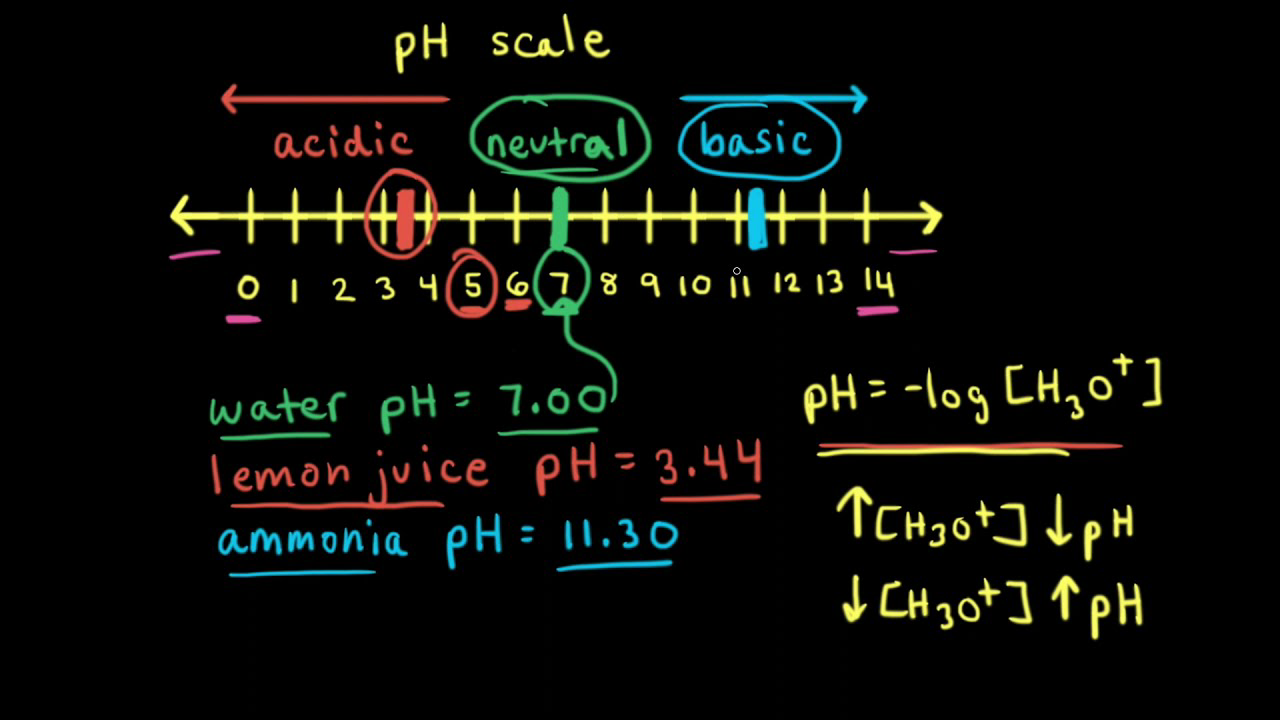
Since your math skills might be a bit "rusty," let's quickly review the mathematics of logarithms before we proceed. The following reading provides a concise and clear explanation.
pH scale. An experimental approach to the math behind the...
This reading explains the relationship between exponents and logarithms, which is the mathematical foundation of the pH scale.
Please read the subsection titled Powers and Logarithms. Focus on understanding that a logarithm is simply an exponent. The key takeaway is that when we write log(p), we are asking: "To what power must we raise 10 to get the number p?" For example, log(1000) is 3, because 10^3 = 1000.
The formal definition of pH is:
The negative sign is a convention to make the pH values of most common dilute solutions positive and intuitive. For example, if M, the log is -3, and the pH is a simple, positive 3.
Water, pOH, and a Fundamental Relationship
It might seem that a solution can only be acidic or basic, but there's a constant, dynamic equilibrium happening in all aqueous solutions, including pure water. Water molecules can react with each other in a process called autoionization:
Or more simply:
This equilibrium is described by the ion-product constant for water, . At 25°C, its value is fixed:
This equation is one of the most important in aqueous chemistry. It means that and are inversely related; if one goes up, the other must go down to keep their product constant.
Just as we have pH for , we can define pOH for the hydroxide ion concentration, :
By taking the negative logarithm of the entire expression, we arrive at another incredibly useful relationship:
This simple equation allows us to easily convert between pH and pOH. The following reading walks through this derivation and introduces the concepts of pOH and .
pH and pOH of Strong Acids and Bases: AP® Chemistry Review | Albert Blog & Resources
This text explains the crucial link between pH, pOH, and the autoionization of water.
Read the section Introducing pOH. Focus on understanding how the constant K_w leads directly to the equation pH + pOH = 14. Memorize this relationship.
Calculations for Strong Acids
A strong acid is one that completely ionizes in water. For a monoprotic strong acid (one that donates a single proton), like HCl, the reaction goes to completion:
This means the concentration of H⁺ ions is equal to the initial concentration of the acid. The calculation is therefore straightforward.
The following video provides clear, step-by-step examples.
pH Calculations | Strong Acids & Bases | 16.4 General Chemistry
This video demonstrates how to calculate the pH of strong acid solutions, including important nuances.
Please watch the following segments: Basic Calculation: Watch the example for 0.1 M HCl. This is the simplest case. Polyprotic Acids: Pay attention to the discussion of H₂SO₄. Note that only the first proton dissociates completely, making the calculation slightly more nuanced than for HCl. Very Dilute Solutions: This addresses a key conceptual point. If you dilute an acid so much that its concentration is far below 10^{-7} M, the pH will be approximately 7. The water's own contribution of H⁺ ions becomes dominant, preventing an acidic solution from ever having a basic pH.
Calculations for Strong Bases
A strong base is a substance that completely dissociates in water to yield hydroxide ions (). The most common strong bases are the hydroxides of Group 1 and Group 2 metals.
Calculating the pH of a strong base solution involves an extra step compared to strong acids:
- Determine the concentration of hydroxide ions, . Be careful with bases like Ca(OH)₂, which produce two moles of OH⁻ for every mole of the base.
- Calculate the pOH using .
- Calculate the pH using the relationship .
Let's return to the same video for examples.
pH Calculations | Strong Acids & Bases | 16.4 General Chemistry
The instructor now applies the same principles to strong bases, highlighting the extra step of converting pOH to pH.
Watch these segments: Monohydroxic Bases: See the example for NaOH. This shows the standard three-step process. Dihydroxic Bases: This is a critical part. Note how for Ba(OH)₂, the [OH^-] is double the initial concentration of the base. This is a common point of error. Very Dilute Bases: Similar to the acid case, the pH of a very dilute base will approach 7, not go below it.
At this point, you can see there is a clear roadmap for converting between , pH, , and pOH. This diagram provides a great visual summary of the four key relationships.
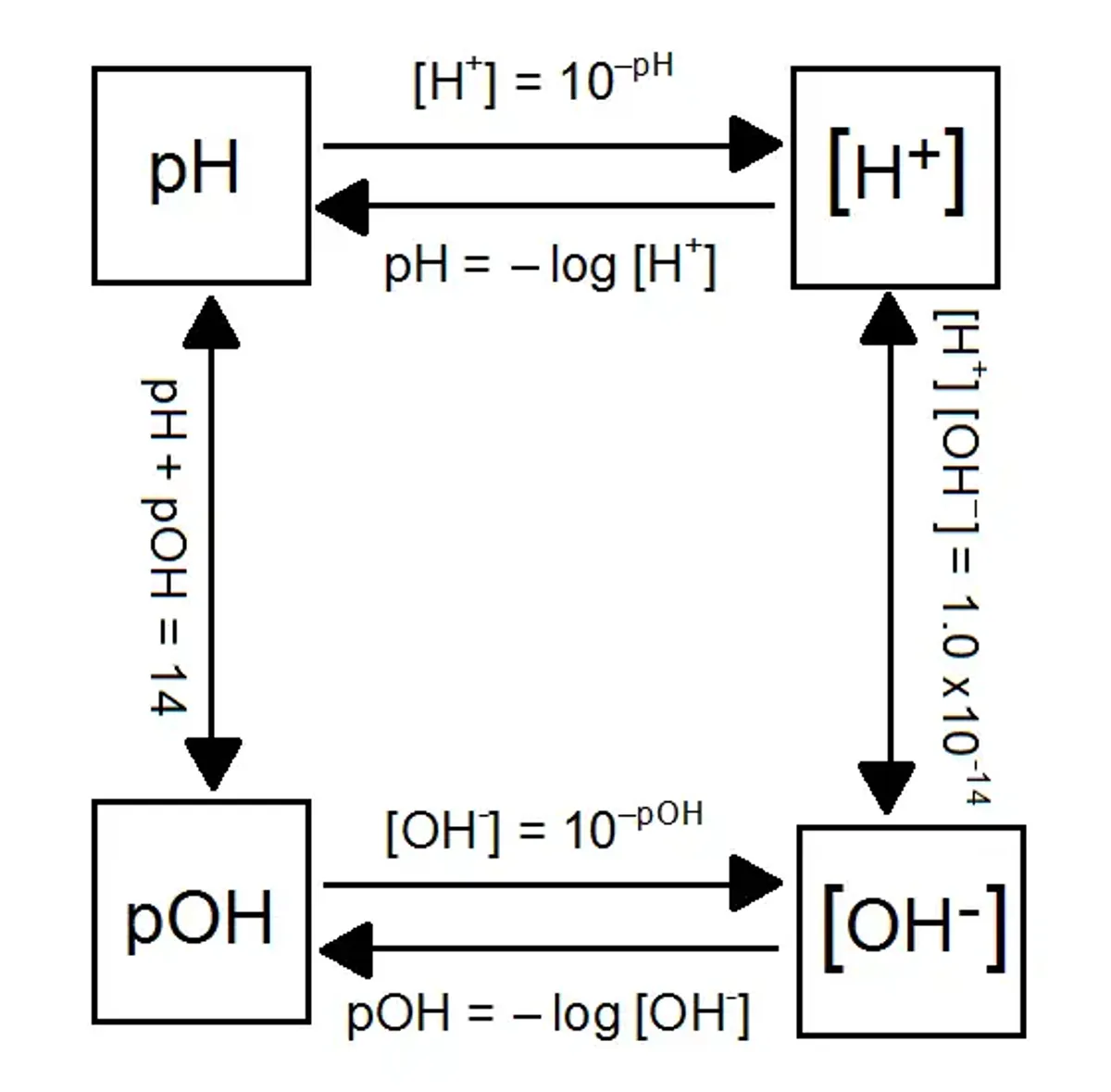
A Multi-Step Problem
Now, let's tie these concepts together with a more comprehensive problem that also reviews some of your stoichiometry skills from Module 5. The following video solves a problem where you must find the pH of a solution prepared by dissolving a specific mass of a strong base in water.
How to Calculate pH & pOH for Strong Acids & Bases - AP Chem Unit 8, Topic 2
This example integrates stoichiometry with pH calculations for a strong base, reflecting the kind of multi-step thinking required in engineering problems.
Watch the worked example starting at this timestamp. Follow the steps: Converting grams of Ca(OH)₂ to moles. Calculating the molarity of the Ca(OH)₂ solution. Determining the [OH^-] concentration (remembering the factor of 2!). Calculating [H^+] using K_w. Calculating the final pH. This video takes a slightly different path (calculating [H^+] before pH) than the previous one, but the final answer is the same, demonstrating the flexibility of the relationships you've learned.
Conclusion
In this lesson, we have added a quantitative layer to our understanding of acids and bases. We moved beyond simple definitions to perform calculations that describe the precise level of acidity or basicity in a solution. You are now equipped to handle problems involving strong acids and bases, which represent one of the fundamental pillars of aqueous chemistry.
Key Takeaways:
- pH and pOH are logarithmic scales defined as and .
- The autoionization of water establishes a constant relationship: .
- This leads to the crucial formula: (at 25°C).
- For strong acids, the H⁺ concentration equals the acid's initial concentration (e.g., ).
- For strong bases, calculate first (watching for dihydroxic species like Ca(OH)₂), then find pOH, and finally convert to pH.
We have focused on "strong" electrolytes, where dissociation is 100%. But what about the vast majority of acids and bases that only dissociate partially? In our next lesson, we will explore the world of weak acids and weak bases. This will require us to bring back the equilibrium concepts and ICE tables from Module 10 to solve for the pH.