Introduction
In our last session, we laid the theoretical groundwork for understanding weak acids and bases, focusing on their partial dissociation and how to write their corresponding equilibrium constant expressions, and . You learned that these constants quantify the extent of dissociation. Today, we put that theory into practice.
This lesson will guide you through the process of calculating the pH of weak acid and weak base solutions. We will use the ICE (Initial, Change, Equilibrium) table, a systematic tool you first encountered in our study of chemical equilibrium. By the end of this lesson, you will be able to take the initial concentration of a weak acid or base and its dissociation constant, and determine the pH of the solution—a core skill in chemical analysis and process design.
Calculating the pH of a Weak Acid
Calculating the pH of a strong acid is straightforward because we assume 100% dissociation. For a weak acid, the situation is more nuanced. Since only a fraction of the acid molecules donate a proton, we need to calculate the equilibrium concentration of ions. The ICE table method provides a structured way to do this.
Here is a visual summary of the five-step process we will follow:
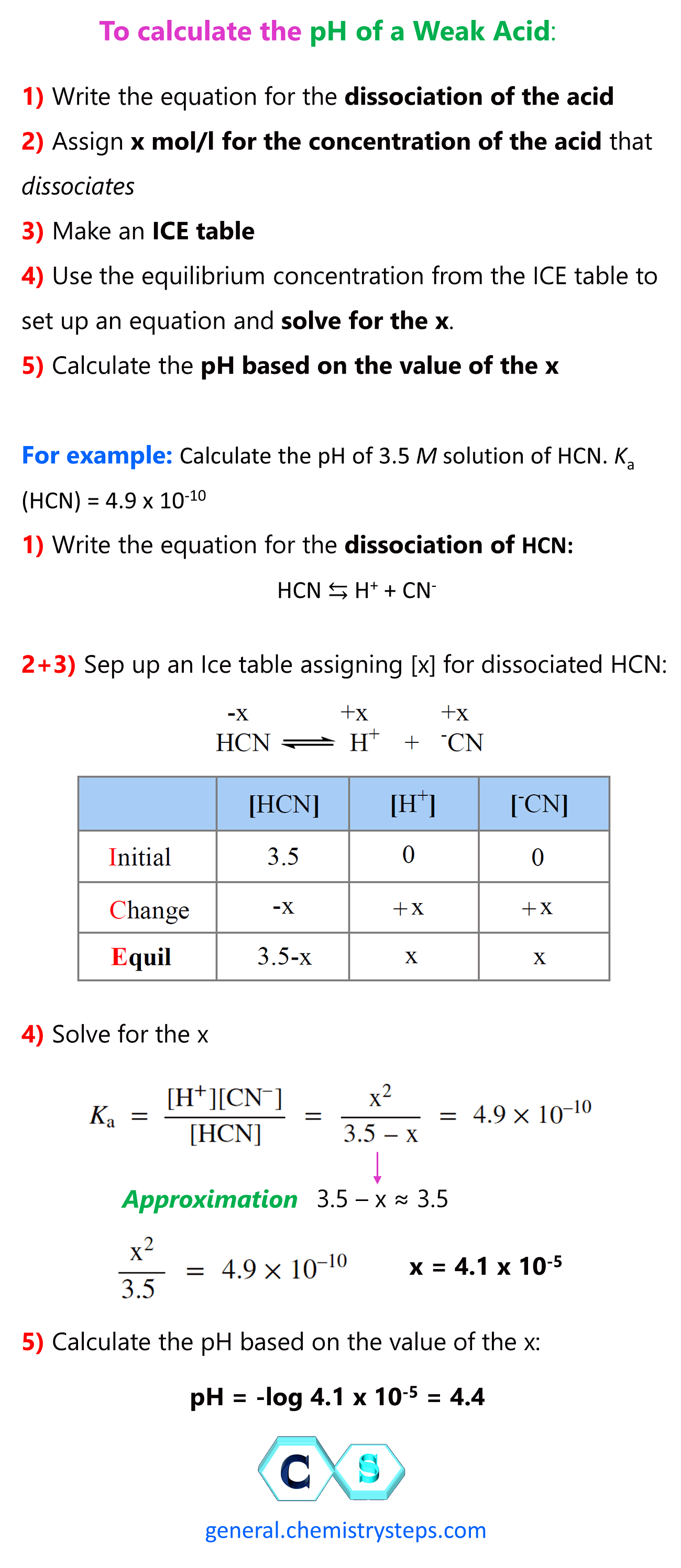
Let's walk through this process with a common example: a solution of acetic acid, , the main component of vinegar.
The ICE Table Method in Action
Suppose we want to find the pH of a 0.5 M solution of acetic acid ().
1. Write the dissociation reaction:
Acetic acid is a weak acid, so it establishes an equilibrium in water.
2. Set up the ICE table:
The table helps us track the concentrations of all species as the reaction moves from its initial state to equilibrium.
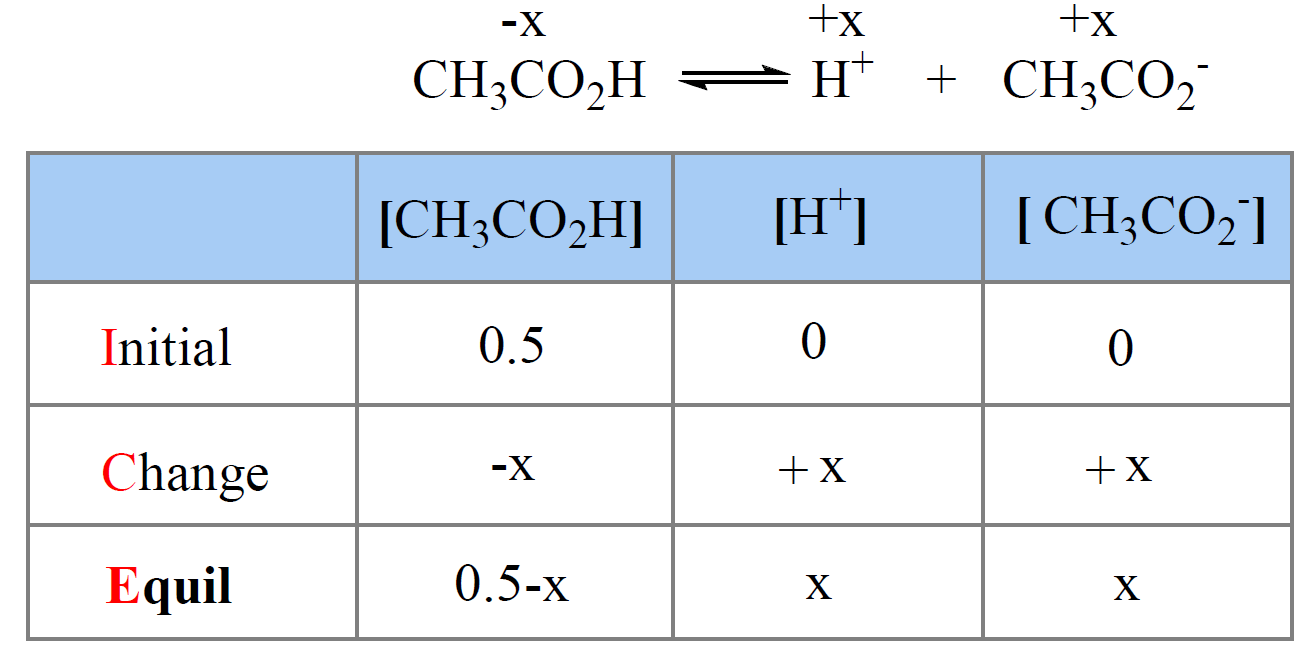
- Initial (I): We start with 0.5 M of and assume effectively zero concentration of the products, and .
- Change (C): As the reaction proceeds to equilibrium, some dissociates. We represent this amount by 'x'. For every mole of that dissociates, one mole of and one mole of are formed. So, the change is
-xfor the reactant and+xfor the products. - Equilibrium (E): The equilibrium concentrations are the sum of the initial and change rows.
3. Use the equilibrium expression to solve for x:
Now, we plug the equilibrium concentrations into the expression we learned about in the last lesson:
This gives us the equation:
Solving this equation exactly would require using the quadratic formula. However, we can often use a simplifying approximation.
The 5% Approximation
Because weak acids have very small values, the reaction equilibrium lies far to the left. This means that the amount of acid that dissociates, 'x', is very small compared to the initial concentration of the acid. We can assume that 0.5 - x ≈ 0.5.
This is known as the 5% approximation or 5% rule. It is generally valid if the acid dissociates by less than 5%. With this assumption, our equation becomes much simpler:
Now we can solve for x:
Since x represents the equilibrium concentration of , we have M.
Before we proceed, we should quickly check if our approximation was valid. Is x less than 5% of the initial concentration?
Since 0.6% is much less than 5%, our approximation was justified.
4. Calculate the pH:
Finally, we calculate the pH from the concentration:
To see this entire process explained with a similar example, please watch the following segment from a video by The Organic Chemistry Tutor.
pH of Weak Acids and Bases - Percent Ionization - Ka & Kb
This video provides a clear, step-by-step walkthrough of calculating the pH of a weak acid solution using an ICE table, including the setup, the approximation, and the final pH calculation.
Watch the example for a 0.75 M acetic acid solution. Notice how the logic is identical to the one we just worked through, reinforcing the general applicability of this method.
Calculating the pH of a Weak Base
The procedure for a weak base is very similar, but with two important distinctions:
- We use the base dissociation constant, .
- The 'x' in our ICE table will represent the concentration of hydroxide ions, , not . This means we will calculate the pOH first and then convert it to pH.
Let's calculate the pH of a 0.25 M ammonia () solution. The for ammonia is .
1. Write the reaction with water:
Remember, a weak base accepts a proton from water.
2. Set up the ICE table:
| Initial | 0.25 | 0 | 0 |
| Change | -x | +x | +x |
| Equil. | 0.25-x | x | x |
(Note: Water is a pure liquid, so its concentration is constant and we exclude it from the table and the expression).
3. Use the expression to solve for x:
Applying the 5% approximation ():
Here, M.
4. Calculate pOH, then pH:
First, we find the pOH from the hydroxide concentration.
Then, we use the relationship to find the pH.
As expected, the pH is basic (> 7).
The following video from Sarah Chem provides a fantastic, dedicated walkthrough of this exact process for a weak base.
Calculating the pH of a Weak Base Solution (ICE Chart)
This video clearly explains each step required to find the pH of a weak base solution, from setting up the reaction and ICE table to validating the small 'x' assumption with the 5% rule and converting pOH to pH.
Please watch the entire video from the example problem. The presenter does an excellent job of explaining the reasoning behind each step, especially the 5% rule check.
Practice and Summary
You now have a robust, systematic method for determining the pH of both weak acid and weak base solutions. The key is to correctly identify the type of substance, write the appropriate equilibrium reaction, and carefully work through the ICE table calculation.
To solidify your understanding, please study the following resource. It provides a concise summary and further worked examples.
16.5 pH Calculations for Weak Acids and Bases - Chad's Prep®
This guide from Chad's Prep offers a clear, step-by-step breakdown of the ICE table method for both weak acids and weak bases, including the crucial 5% approximation.
First, read the section How to Calculate pH of a Weak Acid to review the process for acids. Then, read the section on the Ammonia pH Calculation to reinforce the steps for weak bases. Pay close attention to how the logic remains the same, with the key difference being the final conversion from pOH to pH.
Conclusion
In this lesson, you have bridged the gap between the concept of weak acid/base equilibrium and its practical application in calculating pH. This is a significant step in your journey toward understanding chemical systems quantitatively.
Key Takeaways:
- The ICE table is a systematic tool for finding equilibrium concentrations in weak acid and base solutions.
- The 5% approximation simplifies calculations by assuming that the amount of dissociated acid/base ('x') is negligible compared to the initial concentration. This is valid when or is small.
- For weak acids, the value of 'x' from the ICE table directly gives you , which you use to calculate pH.
- For weak bases, 'x' gives you . You must first calculate pOH and then use the formula to find the pH.
In our next lesson, we will explore what happens when we have a solution containing both a weak acid and its conjugate base. This leads us to the important topic of buffer solutions, which are critical for maintaining stable pH in biological systems and industrial chemical processes.