Introduction
In our previous lesson, you mastered a crucial skill: calculating the pH of a solution containing either a weak acid or a weak base using ICE tables. We saw how their partial dissociation creates an equilibrium that determines the concentration of or . Now, let's explore a fascinating and powerful scenario: what happens when we intentionally create a solution that contains significant amounts of both a weak acid and its conjugate base at the same time?
This brings us to the topic of buffer solutions. In this lesson, we will focus on explaining the composition and function of these remarkable mixtures. You will learn what they are made of, how they manage to stabilize pH, and why this function is indispensable in fields ranging from industrial chemical production to the very biological processes that keep us alive. This concept is a cornerstone of chemical engineering, where controlling reaction conditions like pH is often paramount for safety, efficiency, and product quality.
What is a Buffer Solution?
At its core, a buffer is a solution that resists changes in pH when small quantities of an acid or a base are added to it. While pure water's pH plummets or soars with the addition of even a tiny amount of acid or base, a buffered solution maintains a relatively stable pH.
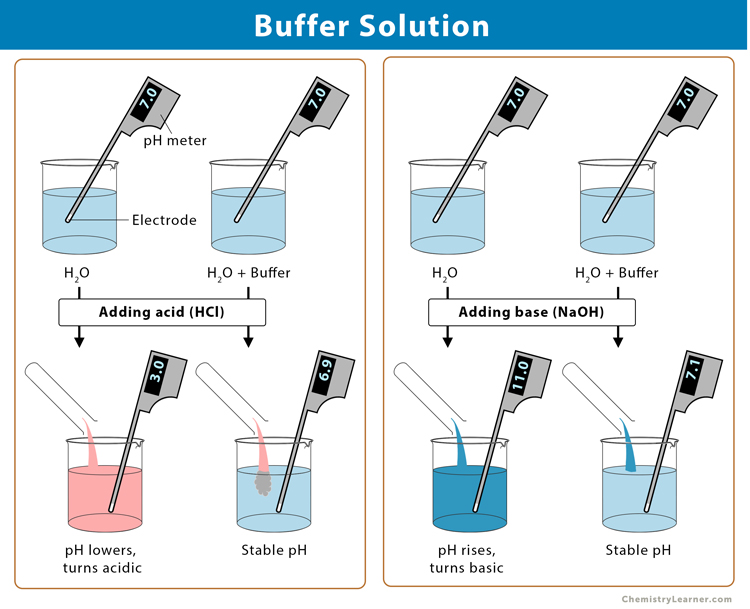
This property is not magic; it's a direct result of a buffer's specific composition. To see a great real-world example of buffering in action, watch the introduction to this Crash Course video.
Buffers, the Acid Rain Slayer: Crash Course Chemistry #31
This video introduces buffering through the compelling story of how a river in Montana naturally resisted the effects of acid rain, a large-scale chemical engineering problem.
Watch the first part of the video from the beginning. Pay attention to the definition given: a buffer solution is a mixture of a weak acid and its conjugate base, or a weak base and its conjugate acid.
As Hank Green explained, the key to a buffer is this "acid-base pair." Let's formalize that definition.
A buffer solution is composed of:
- A weak acid and its conjugate base (e.g., acetic acid, , mixed with its salt, sodium acetate, , which provides the acetate ion, ).
- A weak base and its conjugate acid (e.g., ammonia, , mixed with its salt, ammonium chloride, , which provides the ammonium ion, ).
The following video offers a very clear and concise summary of this composition.
This clip from The Organic Chemistry Tutor provides a straightforward definition of a buffer solution and gives several common examples.
Please watch the first minute of the video, from the introduction, to solidify your understanding of a buffer's components.
How Buffers Work: The Chemistry of Resistance
Now that we know what a buffer is, let's investigate how it works. The function of a buffer relies on having two components in the same solution: one that can neutralize any added base, and another that can neutralize any added acid.
Let's use the familiar acetic acid/acetate buffer system as our primary example. In this solution, we have a "reservoir" of weak acid molecules () and a "reservoir" of conjugate base ions ().
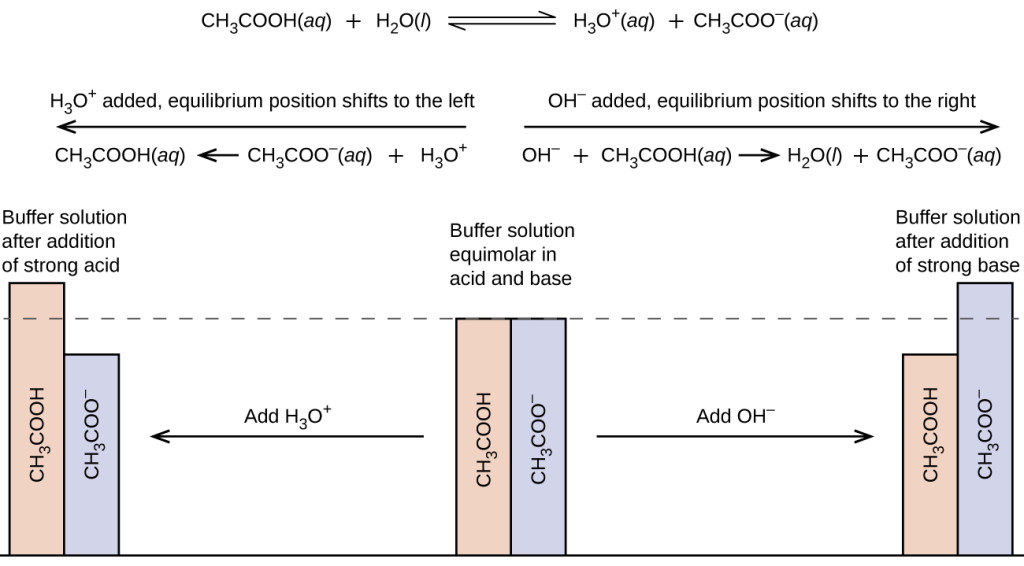
This image perfectly illustrates the buffer's mechanism. Let's break it down.
1. Adding a Strong Acid (like HCl)
When a strong acid is added, it introduces ions into the solution, which would normally cause the pH to drop sharply. In a buffer, however, the conjugate base component () springs into action.
The added strong acid is consumed by the conjugate base and converted into a weak acid (). Since the product is a weak acid, which dissociates very little, the overall increase in concentration is minimal, and the pH barely changes.
2. Adding a Strong Base (like NaOH)
When a strong base is added, it introduces ions. The weak acid component of the buffer () neutralizes them.
The added strong base is consumed by the weak acid and converted into a weak base (). This prevents the concentration from rising significantly, and thus the pH remains stable.
This entire process is a beautiful application of Le Châtelier's principle, which you'll recall from our module on equilibrium. The addition of an acid or base is a stress on the equilibrium system, and the system shifts to counteract that stress.
For a thorough explanation of this mechanism for both acidic and basic buffers, please read the following text.
6.2 – Buffer Solutions – General Chemistry for Gee-Gees
This section from "General Chemistry for Gee-Gees" provides a detailed breakdown of the neutralization reactions that occur within both acidic (weak acid/conjugate base) and basic (weak base/conjugate acid) buffer systems.
Please read the entire section titled How Buffers Work. Focus on the specific chemical reactions that show how the buffer components neutralize added H₃O⁺ and OH⁻.
A Vital Application: The Buffer System in Blood
Your interest in creating substances to improve human health makes this next example particularly relevant. One of the most critical buffer systems in nature operates constantly within our own bodies. Human blood must be maintained at a very stable pH of approximately 7.4. Deviations outside a narrow range (roughly 7.35-7.45) can be life-threatening.
This remarkable stability is achieved primarily by the carbonic acid-bicarbonate buffer system.
- Weak Acid: Carbonic Acid ()
- Conjugate Base: Bicarbonate Ion ()
When acidic substances from metabolism (like lactic acid from exercise) enter the bloodstream, the bicarbonate ion neutralizes them:
If the blood becomes too alkaline, the carbonic acid reacts:
This system is elegantly coupled with your respiratory system. The product of the first reaction, , is unstable and decomposes into water and carbon dioxide, which you then exhale. This link between chemical equilibrium and physiological function is a prime example of the interdisciplinary nature of chemical engineering.
6.2 – Buffer Solutions – General Chemistry for Gee-Gees
This passage explains how the carbonic acid-bicarbonate buffer system functions to regulate blood pH, a critical biological application of the principles we've just discussed.
Read the section Medicine: the Buffer System in Blood. Note how metabolic processes and even breathing are tied into maintaining this delicate chemical balance.
Buffer Capacity and Range
Finally, it's important to understand that buffers have limits. An engineer must always consider the operational limits of a system.
-
Buffer Capacity is the amount of acid or base a buffer can neutralize before the pH begins to change significantly. It depends on the concentrations of the weak acid and conjugate base. A more concentrated buffer has a higher capacity. If you add too much acid, you will eventually use up all the conjugate base, and the buffer will be "exhausted."
-
Buffer Range is the pH range over which the buffer is effective. It depends on the identity of the weak acid and its . A rule of thumb is that a buffer works best when the pH is within unit of the weak acid's .
These concepts define the working limits of a buffer, a crucial consideration when designing a chemical process that requires pH control.
Conclusion
In this lesson, we have moved from single weak acids or bases to the powerful combination of a conjugate acid-base pair. You have learned the fundamental principles behind buffer solutions, which are vital for controlling pH in countless applications.
Key Takeaways:
- Composition: A buffer consists of a mixture of a weak acid and its conjugate base, or a weak base and its conjugate acid.
- Function: Its purpose is to resist significant changes in pH upon the addition of small amounts of strong acid or strong base.
- Mechanism: The weak acid component neutralizes added base, while the conjugate base component neutralizes added acid, maintaining equilibrium.
- Application: Buffers are essential in biological systems like blood and in industrial processes where stable pH is critical.
- Limitations: The effectiveness of a buffer is defined by its capacity (how much acid/base it can handle) and its range (the pH values at which it works).
So far, we have explored the "what" and "how" of buffers conceptually. In our next lesson, we will address the quantitative aspect. You will learn to use the Henderson-Hasselbalch equation, a straightforward but powerful tool that allows you to calculate the precise pH of a buffer solution, connecting its composition directly to its function.