Hello! In our previous lesson, we mastered the use of VSEPR theory to predict the three-dimensional shapes of molecules. We saw that electron groups arrange themselves to be as far apart as possible, resulting in predictable geometries like tetrahedral (109.5°), trigonal planar (120°), and linear (180°).
This, however, introduces a fascinating puzzle. If you recall from our study of atomic structure, an atom's valence orbitals consist of a spherical s orbital and dumbbell-shaped p orbitals that are oriented at 90° to each other. How, then, can a carbon atom, with its s and p orbitals, form bonds at 109.5° in methane (CH₄)? The geometry of the atomic orbitals doesn't seem to match the geometry of the molecule.
Today's lesson resolves this paradox by introducing valence bond theory and the concept of hybridization. We will explore how atomic orbitals can mix to form new, "hybrid" orbitals that have the perfect shape and orientation to explain the molecular geometries we predicted with VSEPR. Your goal is to learn how to assign the correct hybridization—specifically sp, sp², and sp³—to the central atoms in molecules, providing a deeper explanation for why molecules adopt the shapes they do.
The Problem: Methane's Geometry
Valence bond theory states that a covalent bond forms when atomic orbitals from two different atoms overlap. However, as we noted, the standard atomic orbitals of carbon present a problem for explaining a molecule like methane (CH₄).
The following video from Chad's Prep does an excellent job of outlining this problem and introducing hybridization as the solution.
9.3 Hybridization | General Chemistry
This video clearly illustrates why the simple model of atomic orbital overlap fails to explain the observed geometry of methane and introduces the concept of hybrid orbitals.
Watch the segments from the beginning of the discussion on valence bond theory up to the introduction of hybridization. Pay close attention to the two main problems discussed: How can carbon form four bonds if its ground-state electron configuration only has two unpaired electrons? How can the resulting bonds have 109.5° angles if the p orbitals are all 90° apart? Then, continue watching from the explanation of hybridization to see how mixing the s and p orbitals creates four new, equivalent sp³ hybrid orbitals that perfectly match the tetrahedral geometry of methane.
As the video explains, hybridization is a mathematical model where the wave functions of the valence atomic orbitals are combined to produce a new set of equivalent orbitals, called hybrid orbitals. This process, known as a linear combination of atomic orbitals (LCAO), allows the atom to form stronger, more stable bonds with the correct geometry.
The Types of Hybridization
The type of hybridization an atom undergoes is directly linked to the number of electron domains around it—the very same count you used for VSEPR theory in the last lesson. Let's explore the three main types you'll encounter in organic and general chemistry.
We will use the text "Hybrid Atomic Orbitals" as our guide. It systematically explains how each type of hybridization corresponds to a specific electron-group geometry.
This reading delves into the specifics of sp, sp², and sp³ hybridization, showing how they are formed and what geometries they produce.
First, read the short introductory section, "The following ideas are important," which lists the key principles of hybridization. Next, we will look at each type of hybridization. As you read, focus on the direct relationship between the number of atomic orbitals mixed and the resulting number and geometry of the hybrid orbitals. Two Electron Domains (Linear): Read the section on sp Hybridization. Here, one s orbital and one p orbital mix to form two sp hybrid orbitals that are 180° apart. This perfectly explains the linear geometry. Three Electron Domains (Trigonal Planar): Read the section on sp² Hybridization. One s orbital and two p orbitals mix to create three sp² hybrid orbitals that are 120° apart, matching the trigonal planar arrangement. Notice that one p orbital is left unhybridized. Four Electron Domains (Tetrahedral): Read the section on sp³ Hybridization. One s orbital and three p orbitals mix to form four sp³ hybrid orbitals arranged in a tetrahedron with 109.5° angles. This applies not only to methane but also to atoms with lone pairs, like the nitrogen in ammonia and the oxygen in water.
This direct correspondence between electron domains, geometry, and hybridization is the core concept of this lesson. The following table provides a clear visual summary.

A Systematic Approach to Assigning Hybridization
Given your background in systematic processes, you can think of determining hybridization as a simple, three-step algorithm that builds directly on what you already know from VSEPR theory.
- Draw the Lewis Structure for the molecule.
- Count the number of electron domains around the atom of interest. An electron domain is either a lone pair or a connection to another atom (a single, double, or triple bond counts as just one domain). This count is sometimes called the steric number.
- Assign the hybridization based on the number of domains:
- 2 domains = sp hybridization
- 3 domains = sp² hybridization
- 4 domains = sp³ hybridization
This simple counting method is a powerful and quick way to determine hybridization without needing to think through the orbital mixing every time.
A Worked Example
Let's apply this algorithm to the atoms in the molecule shown below. The image labels this method as "Hybridization based on the Steric Number (SN)". Remember, Steric Number is just the sum of (Atoms Bonded) + (Lone Pairs).
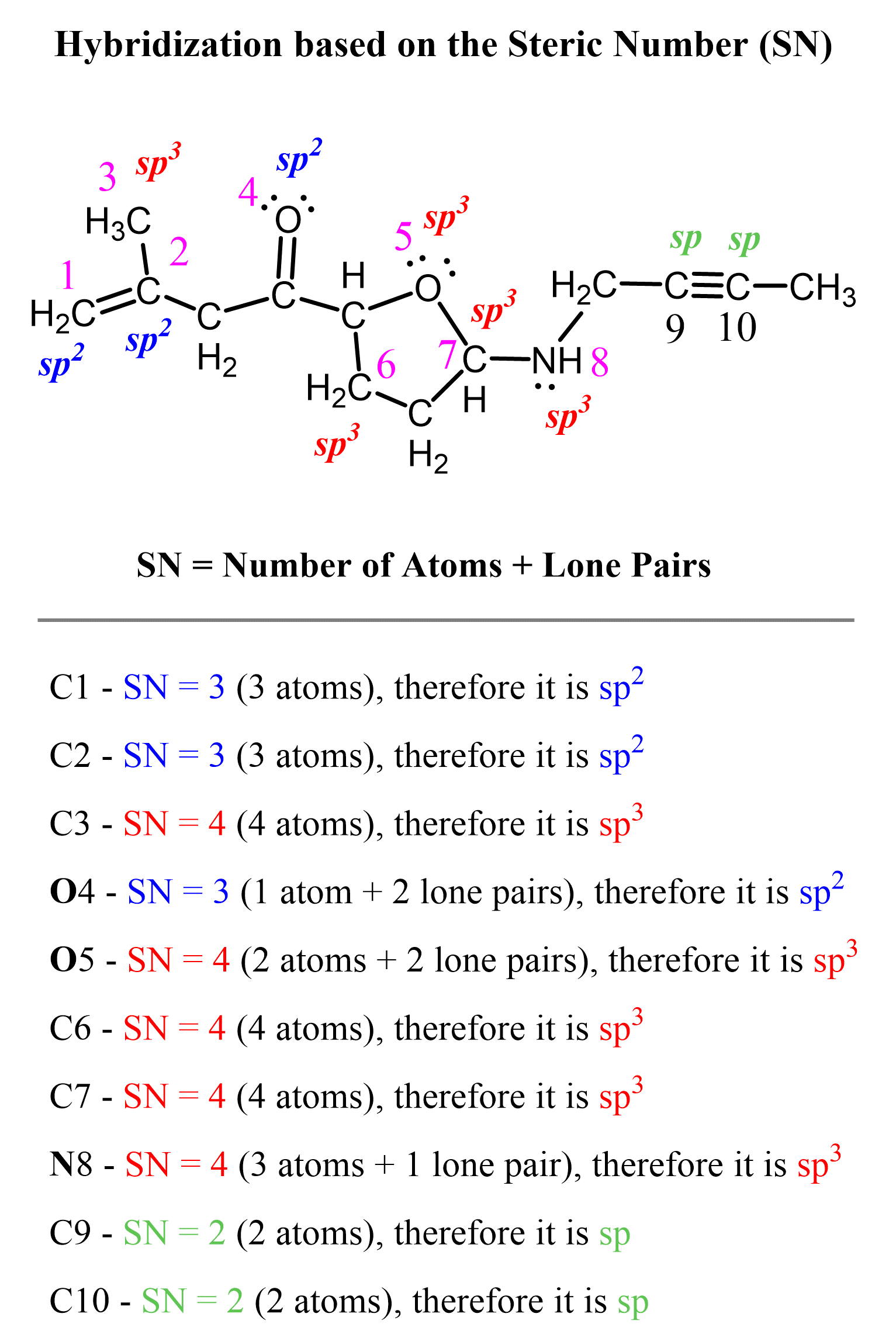
Let's look at a few atoms from the example:
-
C1 (Carbon 1): It is bonded to 3 other atoms (C2, H, H) and has 0 lone pairs.
- Steric Number = 3 atoms + 0 lone pairs = 3.
- 3 domains correspond to sp² hybridization.
-
O4 (Oxygen 4): It is bonded to 1 atom (C4) and has 2 lone pairs.
- Steric Number = 1 atom + 2 lone pairs = 3.
- 3 domains correspond to sp² hybridization.
-
N8 (Nitrogen 8): It is bonded to 3 atoms (C7, H, H) and has 1 lone pair.
- Steric Number = 3 atoms + 1 lone pair = 4.
- 4 domains correspond to sp³ hybridization.
-
C9 (Carbon 9): It is bonded to 2 other atoms (C8, C10) and has 0 lone pairs.
- Steric Number = 2 atoms + 0 lone pairs = 2.
- 2 domains correspond to sp hybridization.
This straightforward counting process is the key skill for this learning outcome.
Conclusion
In this lesson, you've moved beyond simply predicting a molecule's shape to understanding the underlying orbital mechanics that make that shape possible. Hybridization theory provides the crucial link between the quantum mechanical model of the atom and the observed three-dimensional structures of molecules.
Key Takeaways:
- Hybridization is the concept of mixing atomic orbitals (s, p, etc.) to form a new set of degenerate hybrid orbitals (sp, sp², sp³).
- Hybridization explains how atoms can form bonds with the geometries predicted by VSEPR theory (e.g., tetrahedral, trigonal planar).
- There is a direct correlation between the number of electron domains around an atom and its hybridization:
- 2 Domains → Linear geometry → sp hybridization
- 3 Domains → Trigonal Planar geometry → sp² hybridization
- 4 Domains → Tetrahedral geometry → sp³ hybridization
- You can quickly determine an atom's hybridization by drawing its Lewis structure and counting its electron domains (bonded atoms + lone pairs).
Now that you have a robust understanding of molecular geometry and the bonding orbitals that create it, you are well-equipped for our next lesson. We will combine this knowledge with the concept of electronegativity to determine a molecule's overall polarity, a property that governs how molecules interact with each other.