Welcome back! In our last lesson, we learned how to draw Lewis structures, creating 2D blueprints that show how atoms and electrons are arranged in a molecule. While incredibly useful, these flat diagrams don't tell the whole story. The real world is three-dimensional, and a molecule's 3D shape is critical to its function, determining everything from its boiling point to its biological activity.
Today, we will learn how to translate those 2D Lewis structures into 3D molecular models. We'll use the Valence Shell Electron Pair Repulsion (VSEPR) theory—a simple yet powerful model for predicting the geometry of molecules. The core idea is intuitive: electron groups, being negatively charged, repel each other and will arrange themselves around a central atom to be as far apart as possible. This lesson provides a systematic, almost algorithmic, method to determine a molecule's shape and bond angles, a process that should appeal to your experience with logical systems.
The Core Principles: Electron Groups and Geometry
Before we can predict shapes, we need to clarify two fundamental concepts: electron-group geometry and molecular geometry. VSEPR theory is built upon these ideas.
The following reading from Chemistry LibreTexts introduces the VSEPR model and clearly defines these crucial terms.
Geometry of Molecules - Chemistry LibreTexts
This reading introduces the foundational concepts needed to understand and apply VSEPR theory.
Read the sections from the beginning down to the heading "Electron-group geometry is determined by the number of electron groups." Focus on the definitions of an electron group, electron-group geometry, and molecular geometry. Understanding the distinction between the latter two is fundamental to correctly predicting shapes. An electron group is any region of electron density around the central atom: a single bond, a double bond, a triple bond, or a lone pair each count as one group.
To summarize the key distinction:
- Electron-Group Geometry describes the arrangement of all electron groups (both bonding pairs and lone pairs).
- Molecular Geometry describes the arrangement of only the atoms. Lone pairs are "invisible" in the final molecular shape, but their repulsive force is what determines the position of the atoms.
The VSEPR "Algorithm"
Applying VSEPR theory follows a clear, logical procedure. Given your background in systematic problem-solving, you can think of this as an algorithm:
- Draw the Lewis Structure: This is the essential starting point you learned in the last lesson.
- Count Electron Groups: Count the total number of electron groups (lone pairs and bonded atoms) around the central atom. Remember, double and triple bonds count as just one group.
- Determine Electron-Group Geometry: The total number of electron groups determines the overall arrangement (e.g., 4 groups = tetrahedral).
- Determine Molecular Geometry: Based on how many of those groups are bonding pairs vs. lone pairs, determine the final shape of the atoms.
- Estimate Bond Angles: Start with the ideal bond angles for the electron-group geometry and then adjust for distortions caused by lone pairs.
The following video provides an excellent visual and conceptual walkthrough of this process for several key molecules.
Molecular Geometry Made Easy: VSEPR Theory and How to Determine the Shape of a Molecule
This video, "Molecular Geometry Made Easy," provides a clear, step-by-step guide to applying VSEPR theory, focusing on the logic behind the shapes.
Watch the following segments to see the theory in action: SO₂ Example (Sulfur Dioxide): A great first example showing how to count "things" (electron domains), including a lone pair, to determine a bent shape. CO₂ Example (Carbon Dioxide): This contrasts with SO₂ to show why a molecule with the same number of atoms can have a different (linear) shape. CH₄ Example (Methane): This introduces the 3D tetrahedral shape, a cornerstone of molecular geometry. NH₃ Example (Ammonia): See how one lone pair changes a tetrahedral electron geometry into a trigonal pyramidal molecular geometry. H₂O Example (Water): Observe how two lone pairs create the bent shape of water, starting from the same tetrahedral electron arrangement.
A Systematic Tour of Molecular Geometries
Now that you have the conceptual framework, let's systematically explore the geometries that arise from having 2 to 6 electron groups. We will use a comprehensive text from Chemistry LibreTexts as our guide. It uses the AXmEn notation, where A is the central atom, X is a bonded atom, and E is a lone pair.
10.2: VSEPR Theory - The Five Basic Shapes
This resource provides a detailed, systematic walkthrough of all the major molecular geometries, organized by the number of electron groups. It's a comprehensive guide for applying the VSEPR rules.
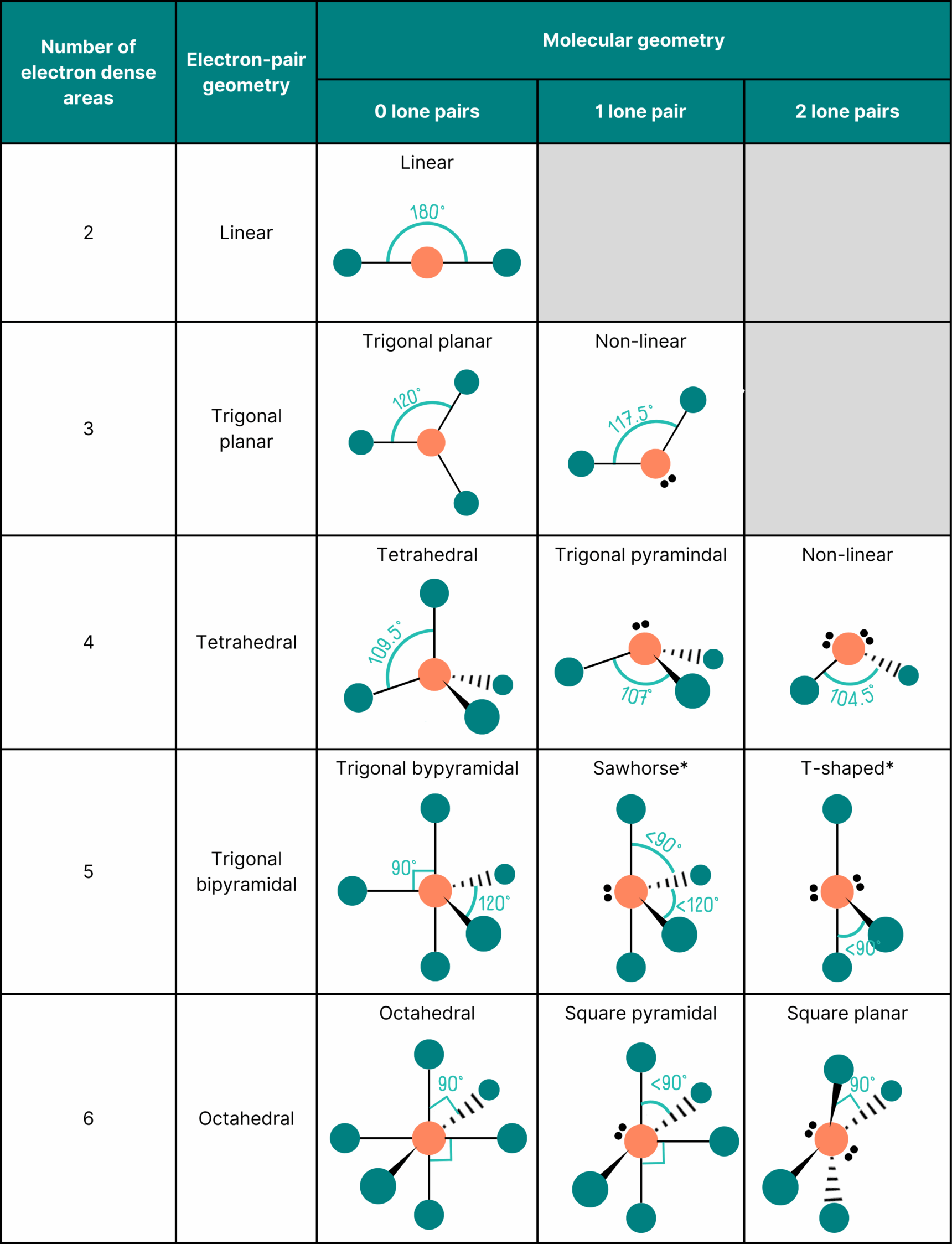
We will work through this text section by section. Focus on understanding the logic for each shape rather than memorizing every detail. First, read the introductory section, "The VSEPR Model," which formalizes the concepts we've discussed. Next, read the sections covering 2, 3, and 4 Electron Groups. Two Electron Groups (Linear). Examples: BeH₂, CO₂. Three Electron Groups (Trigonal Planar, Bent). Examples: BCl₃, SO₂. Note the key idea here: the lone pair in SO₂ repels the bonding pairs more strongly, "bending" the molecule and reducing the bond angle from the ideal 120°. Four Electron Groups (Tetrahedral, Trigonal Pyramidal, Bent). Examples: CH₄, NH₃, H₂O. This is the most common geometry for carbon. Pay close attention to how adding one lone pair (NH₃) and then two (H₂O) changes the molecular shape while the underlying electron-group geometry remains tetrahedral. Finally, review the sections on 5 and 6 Electron Groups, which involve "expanded octets." Five Electron Groups (Trigonal Bipyramidal, Seesaw, T-shaped, Linear). Examples: PCl₅, SF₄, BrF₃. The key strategic rule here is that lone pairs always occupy the "equatorial" (middle plane) positions to minimize repulsion. Six Electron Groups (Octahedral, Square Pyramidal, Square Planar). Examples: SF₆, BrF₅, ICl₄⁻.
The Hierarchy of Repulsion
As you saw in the reading, not all repulsions are equal. The general rule for repulsion strength is:
Lone Pair - Lone Pair (LP-LP) > Lone Pair - Bonding Pair (LP-BP) > Bonding Pair - Bonding Pair (BP-BP)
This is because lone pairs are held only by the central atom's nucleus, so their electron cloud is wider and more diffuse, taking up more space than a bonding pair, which is stretched between two atomic nuclei. This hierarchy explains why bond angles decrease from the ideal values when lone pairs are present.
Summary Chart
The relationships between electron groups, lone pairs, and molecular geometry can be summarized in a chart. The following image provides an excellent visual overview of the shapes you've just studied. Keep this handy as a reference while you practice.
Conclusion
In this lesson, we bridged the gap between two-dimensional drawings and three-dimensional reality. You learned to use VSEPR theory as a predictive tool to determine the shape of a molecule based on a simple, powerful principle: the mutual repulsion of electron groups.
Key Takeaways:
- VSEPR Theory: Predicts molecular shape by assuming electron groups (bonds and lone pairs) arrange themselves to minimize repulsion.
- Electron-Group vs. Molecular Geometry: The former describes the arrangement of all electron groups, while the latter describes the arrangement of only the atoms.
- Lone Pairs are Key: Lone pairs exert greater repulsive forces than bonding pairs, causing bond angles to decrease and defining the final molecular geometry.
- Systematic Prediction: You can reliably predict a molecule's shape by drawing its Lewis structure, counting its electron groups, and identifying the number of bonding vs. lone pairs.
You now have a model that explains how atoms are arranged in space. In our next lesson, we will explore hybridization. This theory will address the "why" behind these shapes, explaining how atomic orbitals (s, p, d) mix together to form the new orbitals necessary to create the geometries predicted by VSEPR theory.