Introduction
In our last lesson, you learned how to determine a molecule's polarity by analyzing its bond polarities and its three-dimensional geometry. You can now look at a molecule like water and know that its bent shape results in a net dipole moment, making it polar, whereas carbon dioxide's linear symmetry causes its bond dipoles to cancel, making it nonpolar.
Today, we will explore the consequences of this polarity. The forces of attraction between separate molecules, known as intermolecular forces (IMFs), are what hold liquids and solids together. These forces are a direct result of the charge distributions you've been studying. Our goal is to identify the three major types of intermolecular forces—London dispersion forces, dipole-dipole forces, and hydrogen bonds—and to develop a systematic method for ranking their relative strengths. Understanding these forces is a cornerstone of chemical engineering, as they dictate crucial physical properties like boiling point, viscosity, and solubility, which govern how substances are processed and separated.
Intramolecular vs. Intermolecular Forces
First, it's essential to distinguish between two types of forces. Intramolecular forces are the strong bonds that hold atoms together within a molecule, such as the covalent O-H bonds in a water molecule. Intermolecular forces are the much weaker attractions that exist between individual molecules.
Breaking a covalent bond requires a significant amount of energy (a chemical reaction), whereas overcoming intermolecular forces simply requires enough energy to change the state of matter, for instance, by boiling a liquid into a gas.
The video below from Professor Dave Explains provides an excellent conceptual overview of the different types of intermolecular forces and how they relate to the energy needed for phase changes.
Intermolecular Forces and Boiling Points
This video offers a concise introduction to the hierarchy of forces that exist between particles, from the strongest ion-ion interactions down to the weakest dispersion forces. It provides a great mental model for why different substances have vastly different boiling points.
Please watch the following segments: Introduction: Watch the brief intro to IMFs from the beginning until this point. It will define the forces and explain ion-dipole interactions, which builds on your knowledge of polarity. Forces Between Molecules: Watch the explanation of dipole-dipole interactions and hydrogen bonds in this section. Pay close attention to the specific requirements for hydrogen bonding. The Universal Force: Continue with the description of London dispersion forces here. Note how temporary, fluctuating dipoles can exist even in nonpolar atoms like helium. Ranking and Application: Finally, watch the summary of the force hierarchy and the "thought experiment" that powerfully connects force strength to boiling points in this segment.
The Three Key Intermolecular Forces
As you saw in the video, we will focus on three main intermolecular forces that are relevant for molecular substances. Let's examine each one in more detail using the well-structured text from Chad's Prep.
11.1 Intermolecular Forces - Chad's Prep®
This resource provides a clear, in-depth explanation of each type of intermolecular force, including crucial details and common misconceptions.
London Dispersion Forces (LDF): These are the most fundamental IMF, present in all molecules. For nonpolar molecules, they are the only force present. Read the section explaining their origin from temporary electron cloud fluctuations. Then, read about the two factors that govern their strength: molecular size (or weight) and surface area. Larger molecules are more "polarizable," leading to stronger LDFs. Dipole-Dipole Forces: These forces exist between polar molecules and are a direct result of the permanent dipoles you studied in the previous lesson. Read the section on these forces. A key point is that polar molecules have both dipole-dipole forces and London dispersion forces. Hydrogen Bonding: This is an especially strong type of dipole-dipole interaction. It is not a true bond, but it is the strongest IMF. Read the section on its requirements. The mnemonic "Hydrogen bonding is FON" is helpful: it only occurs when a hydrogen atom is covalently bonded to Fluorine, Oxygen, or Nitrogen. Then, read the important subsection on the formaldehyde misconception. This highlights the necessity of a direct H-F, H-O, or H-N bond.
A Systematic Approach to Identifying and Ranking IMFs
Your interest in systematic processes will be valuable here. Determining the strongest IMF in a molecule, and ranking different molecules, follows a clear algorithm.
First, you must identify all the IMFs a molecule can exhibit. The following flowchart provides a visual guide for this process.
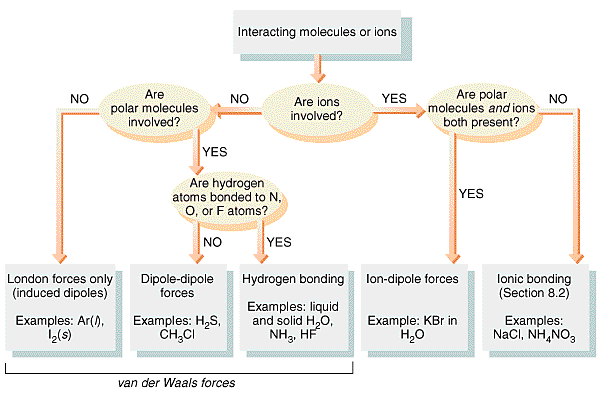
The process shown in the flowchart can be summarized as follows:
- Does the molecule contain only C and H, or is it nonpolar due to symmetry (like CO₂)? If yes, its only IMF is London Dispersion Forces.
- Is the molecule polar, but lacks an H-F, H-O, or H-N bond? If yes, it has Dipole-Dipole forces as its strongest IMF (it also has LDFs).
- Does the molecule have an H atom bonded directly to an F, O, or N atom? If yes, its strongest IMF is Hydrogen Bonding (it also has dipole-dipole and LDFs).
Ranking: When Size Competes with Polarity
The general hierarchy of strength is:
Hydrogen Bonding > Dipole-Dipole > London Dispersion
However, this ranking is only a reliable guide when comparing molecules of similar size. If there is a large difference in molecular weight, the cumulative effect of London dispersion forces in the larger molecule can overwhelm the dipole-dipole forces (or even, in extreme cases, the hydrogen bonding) of a smaller molecule.
This is where true chemical analysis comes in. You must weigh the type of force against the size of the molecule. The following reading provides a set of clear decision rules and worked examples for navigating this trade-off.
11.1 Intermolecular Forces - Chad's Prep®
This part of the text provides the practical strategy for ranking molecules, which is the core of this lesson's learning outcome.
First, carefully read through the four worked examples in the section Comparing Intermolecular Forces. These examples systematically address scenarios where: All molecules are nonpolar (Example 1). Molecules are similar in size but have different force types (Example 2). A polar molecule is compared to a significantly larger nonpolar molecule (Example 4). After reviewing the examples, study the three summary rules in the section 3 Decision Rules. These rules provide a robust strategy for tackling any comparison problem.
The table below provides a concise summary of all the forces, their nature, and their relative strengths. Notice the arrow on the right, which indicates that stronger forces lead to higher boiling points—a concept we will explore in depth in the next lesson.

Conclusion
In this lesson, we have moved from the structure of single molecules to the forces that govern how they interact with each other. You learned to identify the three primary intermolecular forces and, more importantly, to apply a systematic set of rules to rank their relative strengths by considering both the type of force and the size of the molecules.
Key Takeaways:
- Intermolecular forces (IMFs) are the attractions between molecules that determine the physical properties of liquids and solids. They are much weaker than the covalent bonds within molecules.
- London Dispersion Forces (LDFs) are present in all molecules and arise from temporary, induced dipoles. Their strength increases with molecular size and surface area.
- Dipole-Dipole Forces exist between polar molecules due to the attraction of their permanent positive and negative ends.
- Hydrogen Bonding is an exceptionally strong dipole-dipole force that occurs only when hydrogen is bonded directly to nitrogen, oxygen, or fluorine.
- To rank the total IMF strength, you must follow a clear process:
- First, identify the strongest type of force available to each molecule (H-bond > Dipole-Dipole > LDF).
- Then, compare the molecules. If they are of similar size, the hierarchy of force types dictates the ranking.
- If they differ significantly in size, the larger molecule's superior LDFs can make its total IMFs stronger, even if it has a "weaker" force type.
You are now equipped to analyze a set of substances and predict the relative strength of the forces holding them together. In our next lesson, we will put this skill to practical use by applying it to predict and compare macroscopic properties like boiling points and solubility, answering the fundamental question of why different substances behave so differently under the same conditions.