Introduction
In our previous lesson, you learned how to identify and rank the intermolecular forces (IMFs) that exist between molecules. We established a hierarchy—hydrogen bonding > dipole-dipole > London dispersion—and saw that molecular size and shape can also play a decisive role. Now, we will apply that knowledge to predict tangible, macroscopic properties. Your goal to become a chemical engineer involves transforming materials, and processes like distillation and extraction are fundamental tools for separating substances. The efficiency of these processes hinges on differences in boiling points and solubilities.
This lesson connects the molecular-level attractions you've studied to these critical physical properties. We will explore the direct relationship between the strength of intermolecular forces and a substance's boiling point. Then, we will investigate how these same forces govern solubility, guided by the principle of "like dissolves like." By the end of this lesson, you will be able to look at the structures of different compounds and predict their relative boiling points and how well they will dissolve in various solvents.
The Link Between Intermolecular Forces and Boiling Point
Boiling is the process where a substance transitions from the liquid phase to the gas phase. On a molecular level, this means giving the molecules enough kinetic energy (by adding heat) to overcome the attractive intermolecular forces that hold them together in the liquid state.
It follows logically that the stronger the intermolecular forces, the more energy is required to pull the molecules apart. More energy translates to a higher temperature. This gives us our first major principle:
Stronger total intermolecular forces result in a higher boiling point.
This direct correlation is one of the most powerful predictive tools in introductory chemistry.
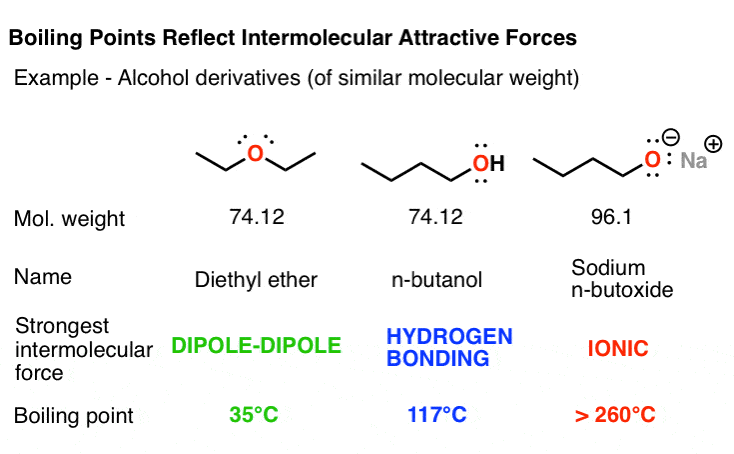
The image above powerfully illustrates this concept. N-butanol can form hydrogen bonds, giving it a much higher boiling point than diethyl ether, which relies on weaker dipole-dipole forces, even though they have identical molecular weights. Sodium butoxide, an ionic compound, has the strongest forces and thus the highest boiling point.
To formalize this concept, please read the following brief section.
Intermolecular Forces – Organic Chemistry: Fundamental Principles ...
This reading from "Fundamentals of Organic Chemistry" clearly explains the cause-and-effect relationship between IMFs and boiling points.
Please read the section titled "Effect of Intermolecular Forces on Boiling Points and Melting Points." Focus on the main paragraph that begins here and the analysis of the three compounds in Figure 2.2 (butane, propanal, and propanol).
Applying the Principle: Comparing Molecules
In the last lesson, we established a systematic process for ranking IMFs. Let's now use that process to predict boiling points. The video below provides excellent worked examples that combine the concepts of force type, molecular weight, and molecular shape.
Intermolecular Forces - Hydrogen Bonding, Dipole Dipole Interactions - Boiling Point & Solubility
This video from The Organic Chemistry Tutor demonstrates how to compare boiling points by analyzing the structures of different molecules.
Please watch the following segments: Hydrogen Bonding vs. Dipole-Dipole: Watch the comparison between ethanol and dimethyl ether from this section. This is a classic example showing the dramatic effect of hydrogen bonding. Surface Area and Branching: Watch the comparison of pentane and neopentane from this segment. This highlights how molecular shape influences London dispersion forces and, consequently, the boiling point, even when the chemical formula is identical.
The key factors influencing boiling point, which you should always consider, are:
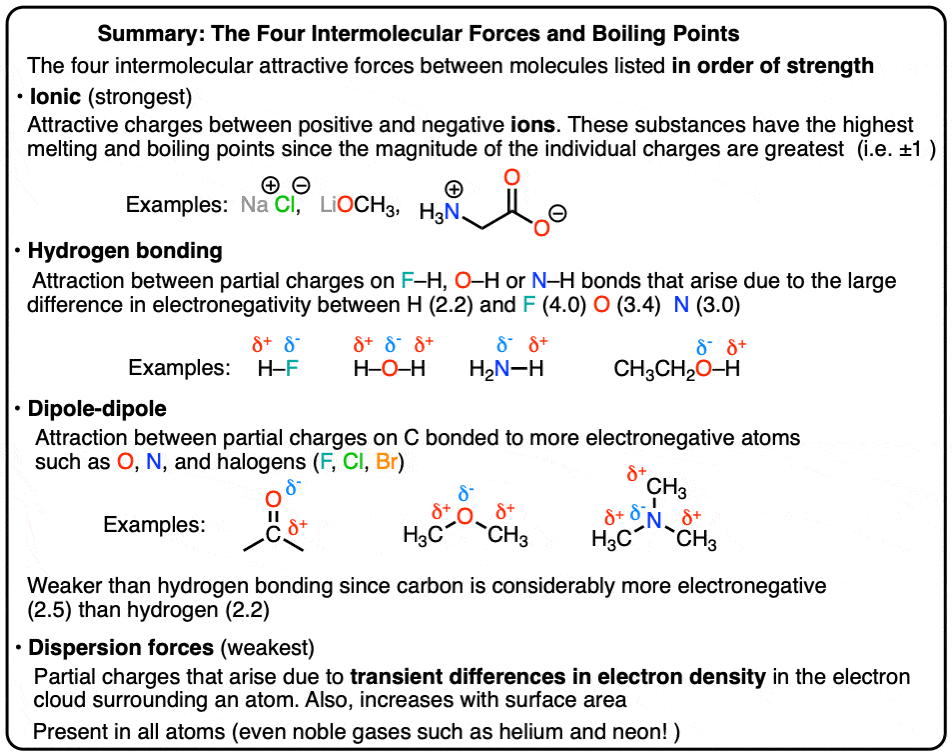
- Type of IMF: Hydrogen bonds lead to significantly higher boiling points than dipole-dipole forces, which in turn are stronger than London dispersion forces (for molecules of similar size).
- Molecular Weight/Size: For molecules with the same type of dominant IMF (e.g., comparing two nonpolar alkanes), the larger molecule with more electrons will have stronger London dispersion forces and a higher boiling point.
- Molecular Shape: For isomers (molecules with the same formula but different structures), elongated, "stringy" molecules have more surface area for interaction, leading to stronger LDFs and higher boiling points compared to compact, spherical molecules.
Intermolecular Forces and Solubility
The next property we can predict is solubility—the ability of a solute to dissolve in a solvent. The guiding principle here is simple and intuitive: "like dissolves like."
This means:
- Polar solutes tend to dissolve in polar solvents.
- Nonpolar solutes tend to dissolve in nonpolar solvents.
- Polar and nonpolar substances generally do not mix (they are "immiscible").
Why is this? Dissolving requires the solvent molecules to break apart the solute-solute interactions and the solvent-solvent interactions to form new solute-solvent interactions. This is only energetically favorable if the new interactions are of a similar type and strength to the ones that were broken.
For example, when you add table salt (NaCl, ionic) to water (polar, H-bonding), the strong ion-dipole interactions that form between the ions and water molecules are strong enough to overcome the attractions within the salt crystal and the hydrogen bonds between water molecules. However, if you add oil (nonpolar) to water, the weak LDFs between oil and water can't compete with the strong hydrogen bonds holding the water molecules together, so they don't mix.
Many organic molecules, which are central to chemical engineering, have both polar and nonpolar regions. We use specific terms to describe these parts:
- Hydrophilic (water-loving): Polar parts of a molecule that can interact with water (e.g., -OH, -NH2, -COOH groups).
- Hydrophobic (water-fearing): Nonpolar parts of a molecule, typically hydrocarbon chains (C-H bonds), that do not interact well with water.
The overall solubility of a molecule in a polar solvent like water depends on the balance between its hydrophilic and hydrophobic parts.
Intermolecular Forces – Organic Chemistry: Fundamental Principles ...
This text provides a clear explanation of the "like dissolves like" rule and introduces the important concepts of hydrophilic and hydrophobic groups.
Please read the entire section titled "Effect of Intermolecular Forces on Solubility." Pay close attention to the definitions of hydrophilic and hydrophobic and the example explaining why solubility in water decreases as the carbon chain gets longer.
The following video segment provides a dynamic explanation of this trade-off using a series of alcohols.
Intermolecular Forces - Hydrogen Bonding, Dipole Dipole Interactions - Boiling Point & Solubility
This segment explains how the size of the nonpolar region of a molecule affects its solubility in water.
Watch the comparison of ethanol, butanol, and octanol from this section. Notice how the boiling point increases with size, but the water solubility decreases as the hydrophobic hydrocarbon chain gets larger.
Practice Problem
Let's apply these principles. Consider the following three compounds:
- n-pentane (CH₃CH₂CH₂CH₂CH₃)
- 1-butanol (CH₃CH₂CH₂CH₂OH)
- Diethyl ether (CH₃CH₂OCH₂CH₃)
Question: Rank these compounds from lowest to highest boiling point and predict their relative solubility in water.
Your Thought Process:
- Analyze the IMFs for each:
- n-pentane: Contains only C-C and C-H bonds. It is nonpolar. The only IMFs are London dispersion forces.
- 1-butanol: Has an -OH group. It is polar and can participate in hydrogen bonding.
- Diethyl ether: Has a C-O-C bond. The molecule is bent and therefore polar. Its strongest IMF is dipole-dipole interaction. It does not have an H bonded to an O, so it cannot hydrogen bond.
- Compare Boiling Points:
- All three molecules have similar molar masses (72, 74, and 74 g/mol, respectively), so size is not the differentiating factor.
- The ranking of IMF strength is: Hydrogen bonding > Dipole-dipole > LDF.
- Therefore, the boiling point ranking is: n-pentane < diethyl ether < 1-butanol. (Actual values: 36°C < 35°C < 117°C. Note: ether and pentane are very close, but the principle generally holds that H-bonding is much stronger).
- Compare Solubility in Water:
- Water is a very polar solvent that uses hydrogen bonding. "Like dissolves like."
- 1-butanol: Can form hydrogen bonds with water. It has a hydrophilic (-OH) end and a moderately sized hydrophobic (4-carbon) chain. It will be somewhat soluble.
- Diethyl ether: Is polar and can accept hydrogen bonds from water, but cannot donate them. It will be slightly soluble.
- n-pentane: Is nonpolar. It cannot form favorable interactions with water. It will be insoluble.
- Therefore, the solubility ranking is: n-pentane < diethyl ether < 1-butanol.
For more practice, you can work through the exercises in the "Intermolecular Forces" reading.
5.1 Intermolecular Forces – Chemical Bonding and Organic Chemistry
This resource contains a set of exercises that will allow you to test your ability to apply IMF principles to predict boiling points.
Navigate to the Exercises section at the end of the chapter. Attempt problems 11, 12, 13, and 14. Check your reasoning against the provided solutions for the odd-numbered problems.
Conclusion
In this lesson, you have connected the microscopic world of intermolecular forces to the macroscopic properties of boiling point and solubility. This is a crucial step in developing a chemical intuition that is essential for a chemical engineer. You can now analyze molecular structures and make well-founded predictions about how substances will behave, which is the basis for designing separation and purification processes.
Key Takeaways:
- Boiling Point: A direct consequence of IMF strength. Stronger forces require more energy to overcome, leading to a higher boiling point. The ranking follows the hierarchy: Ionic > H-Bonding > Dipole-Dipole > London Dispersion (for similar-sized molecules).
- Solubility: Governed by the "like dissolves like" rule. Substances with similar types and strengths of IMFs tend to be soluble in one another.
- Hydrophilic vs. Hydrophobic: In large molecules, the balance between polar (hydrophilic) and nonpolar (hydrophobic) regions determines solubility in polar solvents like water.
You have now completed the module on molecular structure and bonding! You've built a foundation from the atom up to how collections of molecules interact. In our next lesson, we will begin a new module, "Chemical Accounting: Stoichiometry and Solutions." We will shift from the qualitative properties of matter to the quantitative, starting with the single most important unit in chemistry: the mole. This will allow us to count atoms and molecules and precisely calculate the amounts of substances involved in chemical reactions.