Introduction
In our last session, we mastered the core calculations of stoichiometry, learning how to use a balanced chemical equation as a precise recipe to convert a known amount of one substance into an equivalent amount of another. We operated under an ideal assumption: that we have exactly the right amount of every ingredient. However, in any real-world process, from cooking to industrial manufacturing, this is rarely the case. You almost always have more of some ingredients and not enough of others.
This lesson addresses that reality. We will explore how to determine which reactant gets used up first, a concept that governs the entire output of a reaction. This controlling ingredient is called the limiting reactant. By identifying it, you will learn to calculate the theoretical yield—the absolute maximum amount of product that can be formed. This is a crucial skill in chemical engineering, directly related to process efficiency, resource planning, and predicting the maximum output of a production facility.
The "Recipe" Analogy: What Runs Out First?
Imagine you're making sandwiches. A balanced equation is like a recipe. But what if you have a different number of each ingredient? To build a strong intuition for this, let's start with a video that uses cooking analogies to explain the concepts of limiting and excess reactants.
Introduction to Limiting Reactant and Excess Reactant
This video by Tyler DeWitt provides an excellent, step-by-step introduction to limiting reactants using simple, non-chemical analogies before moving on to a chemical example.
Please watch the first two sections. The first part introduces the concept using a cheeseburger recipe, clearly defining what limiting and excess reactants are. Then, pay close attention to the second part, which works through a bread roll recipe. This example is important because it shows that the limiting reactant isn't always the one you have the least of; it's the one that runs out first according to the recipe's ratio.
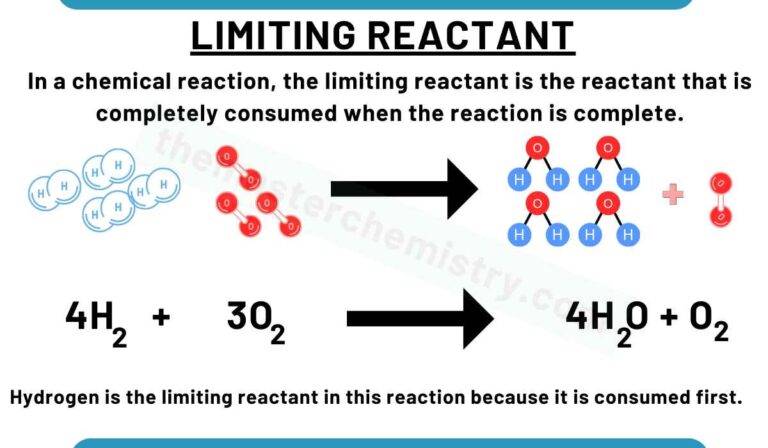
As the video makes clear, the limiting reactant (or limiting reagent) is the reactant that is completely consumed in a chemical reaction. Once it's gone, the reaction stops, no matter how much of the other reactants are left. The reactants that are left over are called excess reactants.
The image below visualizes this at a molecular level. We start with 4 molecules of H₂ and 3 molecules of O₂. The "recipe" (the balanced equation) is .
Calculating Theoretical Yield
The most reliable way to identify the limiting reactant and find the maximum amount of product you can make is a straightforward, two-part calculation that builds directly on our last lesson.
- Calculate the potential amount of product from each reactant. Assume the first reactant is limiting and calculate how much product it can make. Then, do the same for the second reactant. You will perform two separate stoichiometric calculations.
- Compare the results. The smaller of the two calculated amounts is the theoretical yield. The reactant that produced this smaller amount is the limiting reactant.
Why does this work? Because the reaction will stop as soon as the limiting reactant is depleted. Therefore, the true maximum yield is dictated by the reactant that produces the least amount of product.
To formalize these concepts, let's turn to a written resource.
7.2 Limiting Reagent and Reaction Yields – CHEM 1114
This text from BCCampus provides clear definitions and a systematic approach to identifying the limiting reactant and defining theoretical yield.
First, read the section Limiting Reactant. This reinforces the concept and provides two methods for identification. Then, carefully read the definition of Percent Yield, focusing on the term theoretical yield. Finally, walk through the logic in Example 1, which shows the "calculate and compare" method in action.
A Complete Worked Example
Seeing the full process for a more complex problem can solidify your understanding. The following video demonstrates how to solve a problem from start to finish, beginning with grams of two different reactants. The presenter uses the exact method we've just discussed: calculating the mass of product from each reactant and comparing the results to find both the limiting reactant and the theoretical yield.
Stoichiometry - Limiting & Excess Reactant, Theoretical & Percent Yield - Chemistry
This tutorial by The Organic Chemistry Tutor provides many excellent examples. We will focus on a specific gram-to-gram problem that perfectly illustrates the method.
Please watch the segment from the beginning of the problem until the theoretical yield is identified. The problem involves the combustion of benzene (C_6H_6) with oxygen. Pay close attention to how two separate mass-to-mass calculations are set up to find the potential yield of water from each reactant. The smaller result is the theoretical yield, and the reactant that gave that result (benzene) is identified as the limiting one.
The process you just watched is the standard, reliable method for solving these problems. It's a systematic approach that fits well with the logical rigor of both data analysis and engineering design.
- Balance the chemical equation.
- Convert the mass of reactant A to the mass of the product.
- Convert the mass of reactant B to the mass of the product.
- The smaller mass of product is the theoretical yield. The reactant that produced it is the limiting reactant.
Practice Problems
Now it's your turn to apply this process. Remember to be systematic. For each problem, perform two separate mass-to-mass calculations to find the theoretical yield.
Problem 1:
Ammonia (), a key component of fertilizers, is synthesized from nitrogen () and hydrogen () via the Haber-Bosch process. The balanced equation is:
If you react 56.0 g of with 15.0 g of , which is the limiting reactant, and what is the theoretical yield of ammonia in grams?
(Molar masses: g/mol, g/mol, g/mol)
Solution 1:
First, calculate the potential yield of from :
Next, calculate the potential yield of from :
- Comparison: 68.0 g is less than 85.0 g.
- Limiting Reactant: is the limiting reactant because it produces the smaller amount of product.
- Theoretical Yield: The theoretical yield of is 68.0 g.
Problem 2:
In a thermite reaction, powdered aluminum () reacts with iron(III) oxide () to produce molten iron () and aluminum oxide (). This reaction is used for welding thick steel rails.
If you mix 100. g of aluminum with 250. g of iron(III) oxide, what is the theoretical yield of molten iron in grams?
(Molar masses: g/mol, g/mol, g/mol)
Solution 2:
First, calculate the potential yield of from :
Next, calculate the potential yield of from :
- Comparison: 175 g is less than 207 g.
- Limiting Reactant: is the limiting reactant.
- Theoretical Yield: The theoretical yield of is 175 g.
Conclusion
You have now added two critical concepts to your chemical engineering toolkit. You can now analyze a reaction with arbitrary starting amounts, identify the resource that will run out first, and predict the maximum possible outcome.
Key Takeaways:
- Chemical reactions in the real world are limited by the reactant that gets consumed first—the limiting reactant.
- Any other reactants that are not fully consumed are called excess reactants.
- The theoretical yield is the maximum amount of product that can be formed, and it is determined entirely by the amount of the limiting reactant.
- The most robust method to find both is to calculate the potential product yield from each starting reactant and choose the smaller value.
In our next lesson, we will bridge the gap between theory and practice. We will introduce the concept of percent yield, which compares the actual yield you might get in a lab or factory to the theoretical yield you just learned to calculate. This will allow you to quantify the efficiency of a chemical process, a vital metric for any engineer.