Introduction
In our last lesson, we focused on calculating the theoretical yield—the maximum possible amount of product a reaction could create under perfect conditions, as dictated by the limiting reactant. This is the ideal scenario, a benchmark calculated on paper. However, the realities of a lab or an industrial plant are rarely perfect. Reactions can be incomplete, materials can be lost during handling, or side reactions can produce unintended byproducts.
This lesson bridges the gap between that ideal calculation and real-world results. We will introduce the concept of actual yield, which is the amount of product you actually obtain from an experiment. By comparing this to the theoretical yield, we can calculate the percent yield, a crucial metric that measures the efficiency of a chemical reaction. For a chemical engineer, maximizing percent yield is often a primary goal, as it directly impacts profitability, resource management, and waste reduction.
From Theory to Reality: Defining Yield
To start, let's build an intuition for the different types of yield. Just like a recipe might theoretically make three sandwiches, you might only end up making two. The difference between what's possible and what's made is at the heart of today's lesson.
Percent Yield Made Easy: Stoichiometry Tutorial Part 4
This short video from ketzbook introduces the concepts of theoretical, actual, and percent yield using a simple and effective analogy of making peanut butter and jelly sandwiches.
Please watch the introduction from the beginning until the end of the analogy. Pay close attention to how it distinguishes between the maximum you could make, what you actually make, and how to express the relationship between them as a percentage.
As the video explained, we have three key terms:
- Theoretical Yield: The maximum amount of product that can be produced, calculated from the balanced chemical equation and the limiting reactant. You mastered this calculation in the previous lesson.
- Actual Yield: The measured amount of product that is actually obtained from a reaction performed in a lab or factory. This is an experimental value and is usually given in a problem.
- Percent Yield: The ratio of the actual yield to the theoretical yield, expressed as a percentage.
The formula for percent yield is straightforward and serves as a key performance indicator for a chemical process.

To formalize these definitions, let's turn to a brief reading.
Yields – Introductory Chemistry – 1st Canadian Edition
This text from OpenTextBC clearly defines the key terms for this lesson.
Please read the introductory section, starting from the beginning down to the percent yield formula. This will solidify the definitions we've just discussed.
Why Aren't Reactions 100% Efficient?
A percent yield of 100% is the ideal, but in practice, it's rarely achieved. Understanding the reasons for this is fundamental to troubleshooting and optimizing chemical processes.
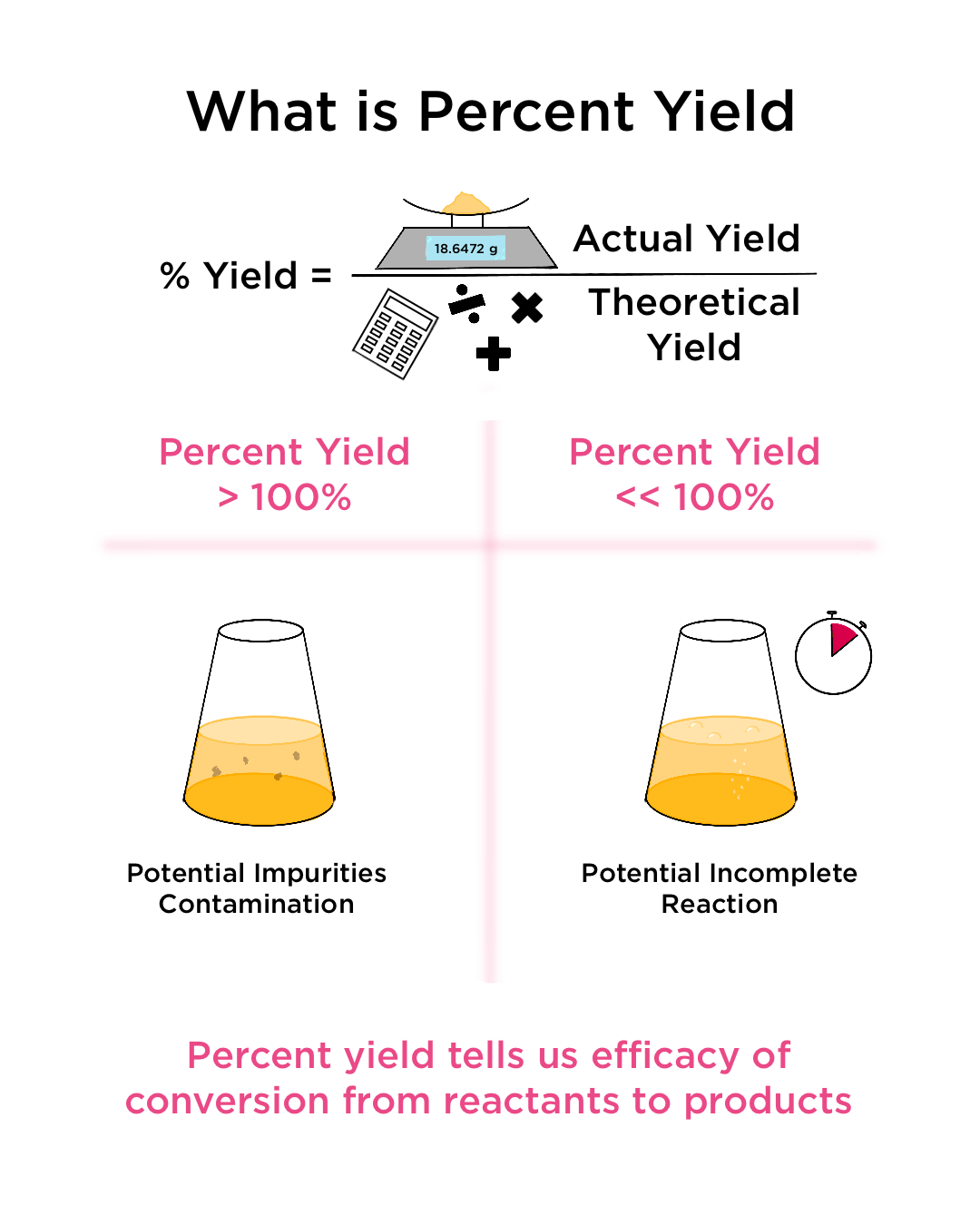
Common reasons for a percent yield being less than 100% include:
- Incomplete reactions: Many reactions are reversible, meaning they reach a state of equilibrium where both reactants and products are present. We will explore this in detail in Module 10.
- Side reactions: The reactants may participate in other, unintended reactions that form different products.
- Loss of product: Some product may be lost during handling, for example, when transferring it between containers or during purification steps.
It is also possible, though indicative of an error, to have a percent yield greater than 100%. This usually means the product you collected is not pure. For example, if the product is supposed to be a dry solid but still contains water when you weigh it, the water's mass will be included in the actual yield, making it artificially high.
Calculating Percent Yield: A Step-by-Step Process
The calculation itself is a two-step process that combines the skills from our last lesson with the new formula:
- Calculate the theoretical yield of the desired product based on the limiting reactant (if applicable). This is the mass-to-mass stoichiometric calculation you are familiar with.
- Calculate the percent yield by dividing the given actual yield by the theoretical yield you just calculated, and multiplying by 100.
Let's watch a video that works through a complete example, from balancing the equation to the final percent yield calculation.
How To Calculate Theoretical Yield and Percent Yield
This video by The Organic Chemistry Tutor provides a clear, methodical walkthrough of a complete percent yield problem.
Watch from the introduction of the formula to the end of the calculation. The presenter first defines the terms, then calculates the theoretical yield of CO₂ from the combustion of propane, and finally uses that to find the percent yield.
Application: Percent Yield in Drug Manufacturing
Your goal to create substances that improve human health directly connects to the field of pharmaceutical synthesis. This is an area where percent yield is of enormous economic and practical importance. Most drugs are created through multi-step syntheses, and the overall yield is the product of the yields of each individual step.
Yields – Introductory Chemistry – 1st Canadian Edition
This section from the OpenTextBC resource provides a real-world example of how percent yields impact the production of the asthma drug albuterol.
Please read the section titled Actual Yields in Drug Synthesis. Note how the yields of individual steps are multiplied to find the overall yield. A 90% yield might seem high, but over a 10-step process, the overall yield drops to just 35%. This illustrates why process optimization is so critical in chemical engineering.
Practice Problems
Now it's your turn to apply these concepts. For each problem, you will first need to calculate the theoretical yield, then use the given actual yield to find the percent yield.
Problem 1:
The Haber-Bosch process for synthesizing ammonia () is given by the balanced equation:
A chemist starts with 16.5 g of nitrogen gas () and an excess of hydrogen gas. The reaction produces 2.05 g of ammonia. Calculate the theoretical yield and the percent yield of .
(Molar masses: g/mol, g/mol)
Solution 1:
-
Step 1: Calculate the theoretical yield.
Since is in excess, is the limiting reactant.The theoretical yield is 20.0 g of .
-
Step 2: Calculate the percent yield.
The actual yield is given as 2.05 g.The percent yield is 10.3% (rounded to three significant figures).
Problem 2:
Aspirin () is synthesized by reacting salicylic acid () with acetic anhydride. The balanced equation is:
If a student reacts 14.0 g of salicylic acid with excess acetic anhydride and obtains 15.6 g of aspirin, what is the percent yield of the reaction?
(Molar masses: g/mol, g/mol)
Solution 2:
-
Step 1: Calculate the theoretical yield.
Salicylic acid is the limiting reactant.The theoretical yield is 18.3 g of aspirin.
-
Step 2: Calculate the percent yield.
The actual yield is given as 15.6 g.The percent yield is 85.2%.
Conclusion
Today, we connected the ideal world of stoichiometric calculations with the practical world of the laboratory. You learned how to assess the efficiency of a chemical reaction, a skill that is paramount in any field involving chemical production, from industrial manufacturing to pharmaceutical development.
Key Takeaways:
- Theoretical yield is the maximum product amount calculated from stoichiometry.
- Actual yield is the experimentally measured amount of product obtained.
- Percent yield quantifies reaction efficiency using the formula: .
- Yields are typically less than 100% due to factors like incomplete reactions, side reactions, and product loss.
- In multi-step syntheses, like those for many pharmaceuticals, the overall percent yield is the product of the individual step yields, making high efficiency at each stage critical.
In our lessons so far, we have focused on reactions involving pure substances, often solids or gases. However, many chemical processes occur in solutions. In our next lesson, we will learn how to describe and calculate the concentration of solutions using molarity, a fundamental concept for working with reactions in a liquid phase.