Introduction
In our previous lessons, we've established the ground rules for describing chemical change. We learned how to balance chemical equations to respect the law of conservation of mass, and how to classify reactions into types like synthesis or combustion. Think of this as learning the grammar and genres of the language of chemistry. Now, we will use this language to answer one of the most fundamental questions in any engineering discipline: "How much?"
This lesson focuses on stoichiometry, the area of chemistry that involves calculating the amounts of reactants and products in chemical reactions. You will learn to use the ratios from a balanced equation to find the mass or moles of any substance in the reaction, given the amount of another. Your experience with data analysis and systematic problem-solving will be an asset here, as stoichiometry is a highly logical, process-driven skill. It is the bridge between a chemical recipe and a real-world manufacturing plan.
The Core Concept: The Mole Ratio
At its heart, stoichiometry is about ratios, much like a cooking recipe. If a recipe says you need 2 cups of flour to make 1 cake, you instinctively know you need 6 cups of flour for 3 cakes. A balanced chemical equation is simply a recipe written in terms of atoms and molecules.
To build this intuition, let's start with a short video that uses a simple analogy to introduce the core idea of using a recipe—or a balanced equation—to determine quantities.
Stoichiometry Made Easy: Stoichiometry Tutorial Part 1
This video from ketzbook provides a clear, intuitive introduction to stoichiometry using a grilled cheese sandwich recipe, then applies the same logic to a chemical reaction.
Watch the first part of the video, which covers the recipe analogy and then connects it to a real chemical reaction, the Haber process for making ammonia. Focus on how the coefficients in the balanced equation give you a fixed ratio, just like the ingredients in a recipe.
As the video explains, the coefficients in a balanced equation like give us the mole ratio. This tells us that 1 mole of nitrogen reacts with 3 moles of hydrogen to produce 2 moles of ammonia. This ratio is the central conversion factor that allows us to connect the quantity of any substance in the reaction to any other.
The Stoichiometric "Road Map"
While mole-to-mole conversions are the core of stoichiometry, in a lab or factory, we measure quantities by mass (grams), not by directly counting moles. This means we need a reliable process to convert between the mass we can measure and the moles the equation understands.
The following "Stoichiometry Road Map" provides a perfect visual blueprint for this process. It shows how different quantities like mass, volume, and number of particles are all connected through the central concept of the mole.

Look closely at the map. To get from any property of substance X to any property of substance Y, you must travel through the "Moles of X" and "Moles of Y" hubs. The critical step is crossing the bridge between them using the mole ratio from the balanced equation.
Therefore, the most common and important calculation, a mass-to-mass conversion, follows a three-step path:
- Grams of A → Moles of A (using the molar mass of A)
- Moles of A → Moles of B (using the mole ratio from the balanced equation)
- Moles of B → Grams of B (using the molar mass of B)
Executing the Plan: Mass-to-Mass Calculations
This three-step process is the workhorse of stoichiometry. The following image breaks down a real example, showing how each conversion factor is built and used in a continuous calculation. This method, often called the factor-label method or dimensional analysis, is powerful because it uses unit cancellation to ensure your calculation is set up correctly.
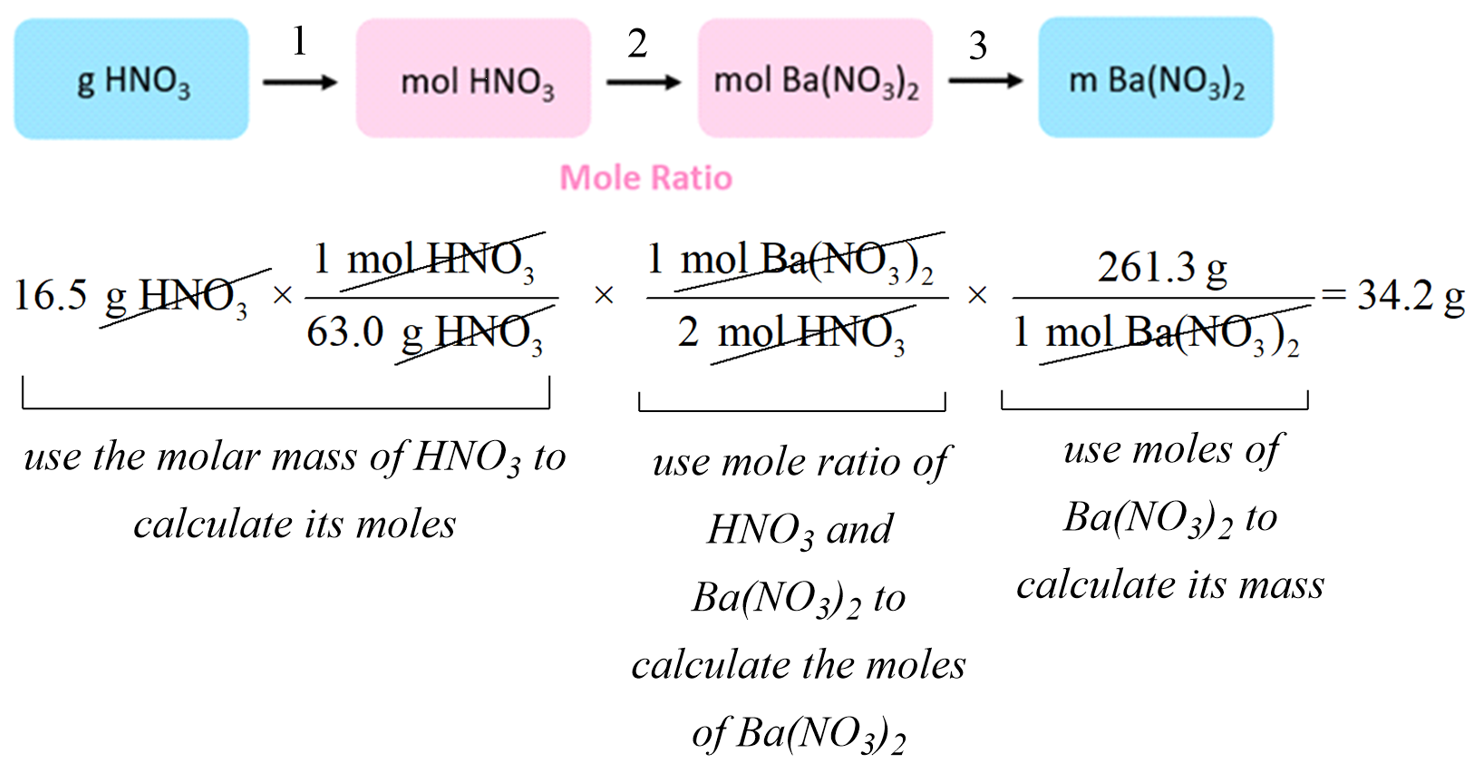
To make this process even more systematic, we can adopt a structured approach. The PUNC method (Plan, Units, Numbers, Calculator) is a great way to ensure accuracy and mirrors the kind of procedural logic used in project management and programming.
Mass-to-Mass Stoichiometry | Chemistry Tutorial at The Physics Classroom
This tutorial from The Physics Classroom provides a fantastic, systematic guide to solving mass-to-mass stoichiometry problems. It introduces the "Mole Island" diagram (similar to our road map) and the PUNC problem-solving strategy.
First, read the section Developing a Plan, which explains the three-step pathway. Then, focus on the PUNC method, which provides a clear framework for your calculations. Finally, carefully study Example 1, which applies this entire process to the ammonia synthesis reaction. Pay close attention to how the units cancel at each step.
To see this entire process in action with a narrated explanation, the following video provides a comprehensive walkthrough of all the common calculation types, including the three-step gram-to-gram problem.
Stoichiometry Basic Introduction, Mole to Mole, Grams to Grams, Mole Ratio Practice Problems
This comprehensive tutorial by The Organic Chemistry Tutor systematically explains and demonstrates all the key types of stoichiometric calculations.
First, watch the introduction where the presenter outlines the 1-step, 2-step, and 3-step problems. Then, you can watch the walkthrough of a full gram-to-gram conversion. This will reinforce the three-step process you just read about. If you feel you need more review, the sections on mole-to-mole and gram-to-mole/mole-to-gram conversions are also excellent.
Practice Problems
Now, let's apply what you've learned. Use the systematic approach to solve the following problems. For each problem, remember to:
- Write and/or balance the chemical equation.
- Map out your plan (e.g., grams A → moles A → moles B → grams B).
- Set up the calculation using the factor-label method, ensuring units cancel.
- Calculate the final answer with the correct units.
Problem 1:
The combustion of propane (), a common fuel, produces carbon dioxide and water. The balanced equation is:
If you burn 88.2 g of propane, what mass of carbon dioxide () is produced?
(Molar masses: g/mol, g/mol)
Solution 1:
-
Plan: g → mol → mol → g
-
Setup and Calculation:
- Step 1 (g to mol): mol
- Step 2 (mol to mol): mol
- Step 3 (mol to g): g
Answer: Burning 88.2 g of propane produces 264 g of carbon dioxide.
Problem 2:
Iron(III) oxide (), or rust, can be reduced to pure iron () by reacting it with carbon monoxide () at high temperatures, a key process in steel manufacturing. The balanced equation is:
To produce 1.00 kg (1000 g) of pure iron, how many grams of carbon monoxide are required?
(Molar masses: g/mol, g/mol)
Solution 2:
-
Plan: g → mol → mol → g
-
Setup and Calculation:
- Step 1 (g to mol): mol
- Step 2 (mol to mol): mol
- Step 3 (mol to g): g
Answer: Approximately 752 g of carbon monoxide are required to produce 1.00 kg of iron.
Conclusion
Today, you have mastered the foundational quantitative skill in chemistry: stoichiometry. You've learned how to translate the theoretical ratios in a balanced chemical equation into practical, measurable quantities like mass. This is the essence of chemical accounting.
Key Takeaways:
- Stoichiometry is the calculation of reactant and product quantities in a chemical reaction.
- The mole ratio, derived from the coefficients of a balanced equation, is the essential link between any two substances in the reaction.
- The "Stoichiometry Road Map" provides a universal blueprint for all stoichiometric calculations, emphasizing that all conversions must pass through moles.
- Mass-to-mass calculations follow a consistent three-step process: grams to moles, moles to moles, and moles back to grams.
- A systematic approach, like dimensional analysis or the PUNC method, is crucial for setting up calculations correctly and avoiding errors.
In our next lesson, we will address a common real-world scenario: what happens when you run out of one ingredient before another? This will lead us to the concepts of the limiting reactant and theoretical yield, which are critical for predicting the maximum possible output of any chemical process.