Welcome back to our study of atomic structure. In the previous lesson, we saw how the electron configurations of the elements give the periodic table its distinctive shape. You learned to use the table as a map to quickly determine how electrons are arranged in any atom. Today, we will leverage that knowledge to see how the table is not just descriptive, but powerfully predictive.
The properties of elements are not random; they follow clear, predictable patterns, or "trends," across the periods and down the groups. This lesson focuses on using your understanding of electron structure to predict these trends for three fundamental atomic properties: atomic radius, ionization energy, and electronegativity. By the end of our session, you'll be able to look at two elements on the periodic table and predict which is larger, which gives up an electron more easily, and which attracts electrons more strongly. The key to this predictive power lies in a single, unifying concept: effective nuclear charge.
The Driving Force: Effective Nuclear Charge (Zeff)
The behavior of an atom's valence electrons—the electrons involved in chemical reactions—is governed by a tug-of-war. They are attracted to the positive charge of the protons in the nucleus, but they are also repelled by the negative charge of the other electrons in the atom.
The inner, or core electrons, are particularly effective at repelling the valence electrons, "shielding" them from the full attractive pull of the nucleus. The net positive charge that a valence electron actually experiences is called the effective nuclear charge, or Zeff.
We can approximate Zeff with a simple formula:
where:
- is the atomic number (the actual number of protons in the nucleus).
- is the number of shielding electrons (which we can approximate as the number of core electrons).
The following video introduces these concepts and explains how to think about the interplay between nuclear attraction and electron repulsion.
Effective Nuclear Charge, Shielding effect, & Periodic Properties Tutorial; Crash Chemistry Academy
This video from Crash Chemistry Academy provides a clear, visual introduction to the concepts of electron shielding and effective nuclear charge (Zeff).
Please watch the first two segments of the video: Introduction: This part explains the basic forces at play within an atom. Calculating Zeff: Pay close attention to how Zeff is calculated for lithium and fluorine and how it changes as you move across a period.
As the video explains, the trends in Zeff are the key to understanding the trends in all other atomic properties. Let's summarize:
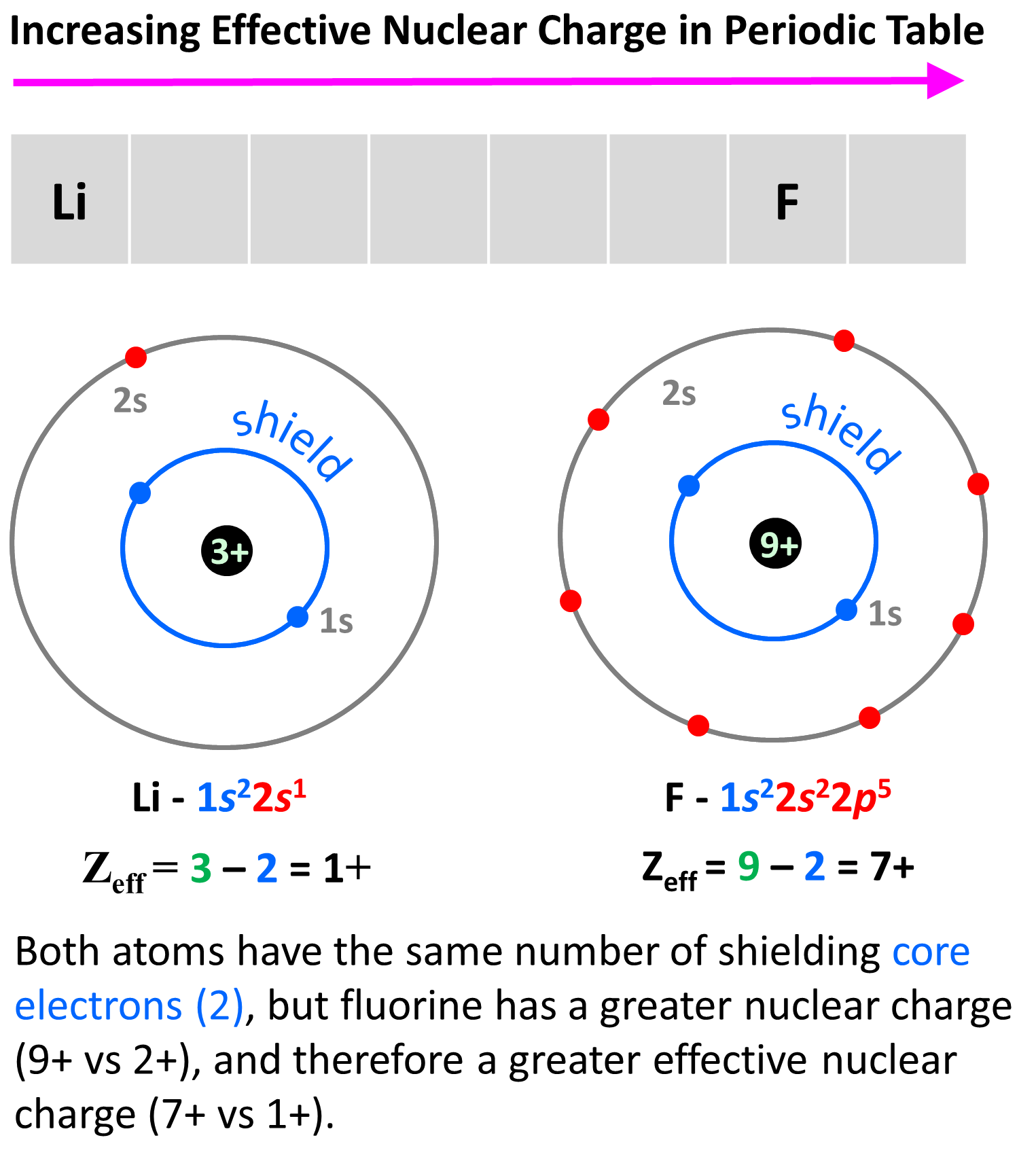
- Across a period (left to right): The number of protons (Z) increases, but the number of core electrons (S) stays the same because electrons are being added to the same outer shell. This causes Zeff to increase significantly.
- Down a group (top to bottom): The number of protons (Z) increases, but so does the number of core electrons (S) as a whole new electron shell is added. These two increases largely offset each other, so Zeff increases only slightly.
The image below compares Lithium (Li) and Fluorine (F), both in Period 2. Notice how the increase in protons from +3 to +9, with the number of shielding core electrons remaining at 2, results in a much larger effective nuclear charge for Fluorine.
Now, let's see how Zeff governs the periodic trends.
1. Atomic Radius
The atomic radius is a measure of the size of an atom. For elements that bond together, it's typically defined as half the distance between the nuclei of two identical atoms. The size of an atom is determined by how far its valence electron shell extends from the nucleus.
The following text explains how Zeff and the addition of new electron shells determine the trend in atomic size.
2.5 Periodic Variations in Element Properties
This section from the textbook Chemical Bonding and Organic Chemistry clearly explains the trends in atomic radius and provides excellent diagrams to illustrate them.
Please read the section titled Variation in Covalent Radius. Focus on these two key explanations: Why atomic radius increases down a group. The explanation of why atomic radius decreases across a period, which reinforces the concept we just covered.
To summarize the trends for atomic radius:
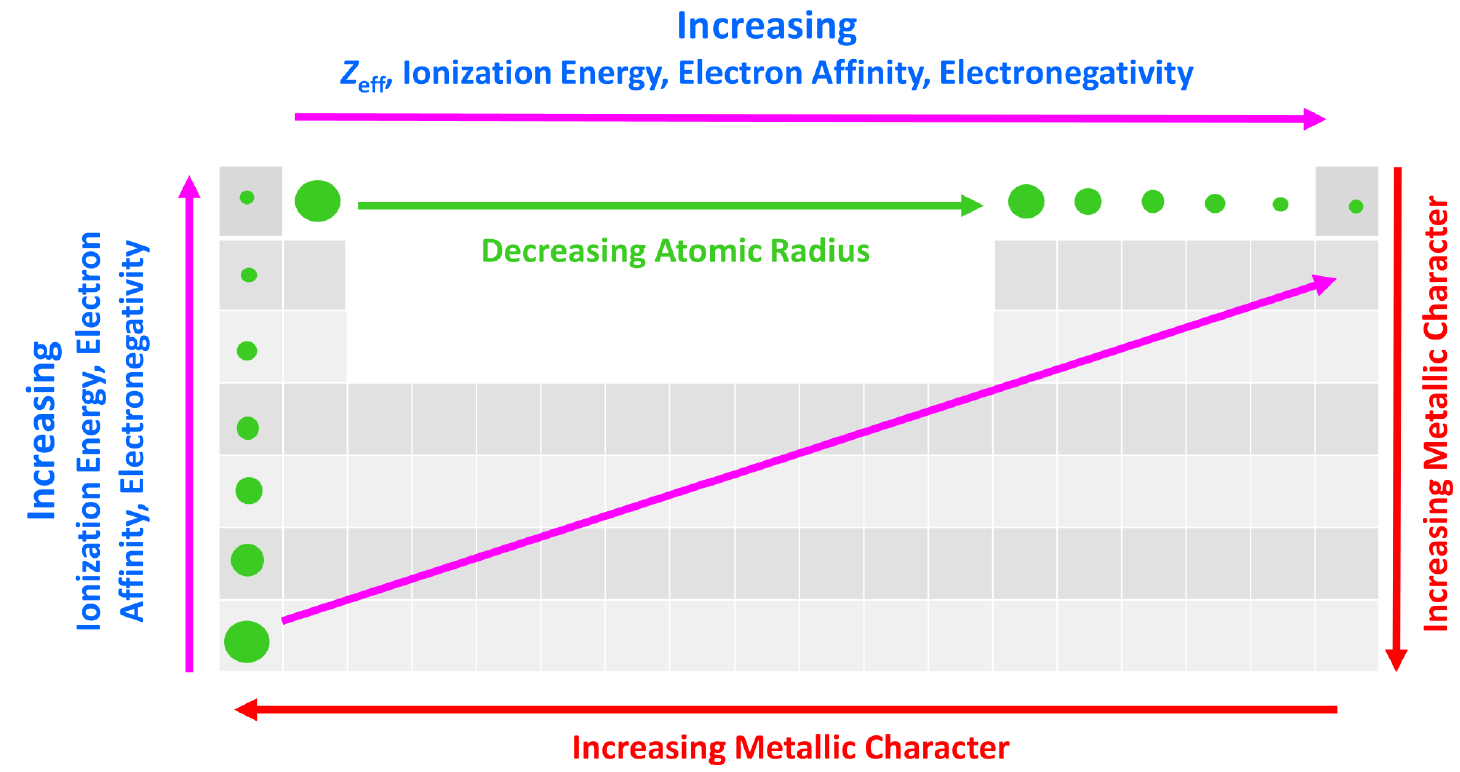
- Decreases across a period (left to right): As Zeff increases, the nucleus pulls the electron shells more strongly, shrinking the atom.
- Increases down a group (top to bottom): A new principal energy level (shell) is added. This new shell is at a much greater distance from the nucleus, and the increased shielding from the new core electrons pushes the valence shell even further out. This effect far outweighs the slight increase in Zeff, so the atom gets significantly larger.
2. Ionization Energy
Ionization energy (IE) is the energy required to remove an electron from a gaseous atom. It's a measure of how tightly an atom holds onto its electrons. A low IE means an element gives up an electron easily, while a high IE means it's difficult to remove an electron.
Think about the factors we've discussed:
- A higher Zeff means a stronger pull on the electrons, making them harder to remove (higher IE).
- A larger atomic radius means the valence electron is farther from the nucleus, making it easier to remove (lower IE).
These relationships directly lead to the trends in ionization energy. The following reading explains these trends and also discusses some important exceptions that reveal more about electron structure.
Periodic Trends - Chemistry LibreTexts
This section from Chemistry LibreTexts details the trends in ionization energy and explains the underlying reasons, including the concept of electron shielding.
Read the section on Ionization Energy Trends. Pay attention to: The general trends across a period and down a group. The equation relating IE to Zeff and the principal quantum number (n), which formalizes the concepts we're discussing: I = \frac{R_H Z^2_{\text{eff}}}{n^2}.
Some minor exceptions to the IE trend occur, for example, when moving from Group 2 to Group 13 (like Be to B) or from Group 15 to Group 16 (like N to O). These are caused by the relative stability of filled or half-filled subshells, a concept from our lessons on electron configurations. Removing an electron that disrupts this stability is slightly easier than the general trend would predict.
3. Electronegativity
Finally, let's consider electronegativity. This property is defined as the ability of an atom to attract electrons when it is part of a chemical bond. It's a crucial concept for understanding how and why atoms join together to form molecules, which we will explore in the next module.
The trend for electronegativity follows directly from Zeff. A higher effective nuclear charge means an atom's nucleus is more attractive to electrons—both its own and those of other atoms in a bond.
The following video explains this trend clearly.
Ionization Energy, Electron Affinity, Atomic Radius, Ionic Radii, Electronegativity, Metal Character
This segment from The Organic Chemistry Tutor provides a focused explanation of electronegativity and its trends.
Please watch the section on electronegativity. The video also discusses some specific values, noting that Fluorine (F) is the most electronegative element.
To summarize all the trends we've discussed:
Conclusion
Today, we've seen how the underlying principles of electron configuration and effective nuclear charge give rise to predictable patterns in atomic properties. You can now use an element's position on the periodic table to make educated predictions about its size and chemical behavior.
Key Takeaways:
- Effective Nuclear Charge (Zeff) is the net pull a valence electron feels from the nucleus. It generally increases across a period and changes very little down a group.
- Atomic Radius decreases across a period (due to increasing Zeff) and increases down a group (due to adding new electron shells).
- Ionization Energy increases across a period (stronger pull from Zeff) and decreases down a group (electron is farther away).
- Electronegativity increases across a period (nucleus is more attractive) and decreases down a group (bonding electrons are farther away).
In our next lesson, we will begin a new module on chemical bonding. We will immediately apply the concept of electronegativity to understand the fundamental difference between ionic and covalent bonds—the two main ways atoms connect to create the vast array of substances in our world.