Hello! Let's continue our exploration of the atom's structure.
In our last lesson, you learned the fundamental principles that govern how electrons arrange themselves in an atom: the Aufbau principle, Hund's rule, and the Pauli exclusion principle. You now have the tools to construct the electron configuration for any element, essentially creating a unique address for every electron. Today, we will connect that abstract set of rules directly to a tangible and powerful tool: the periodic table.
This lesson will show you that the periodic table's seemingly peculiar shape is no accident. It is a direct map of atomic orbital filling. By the end of our session, you will be able to relate an element's position on the periodic table to its electron configuration, allowing you to "read" the table to quickly determine the electronic structure of any atom. This skill transforms the periodic table from a simple chart into a predictive framework, a concept that should resonate with your background in building and using systematic models.
1. The Architecture of the Periodic Table
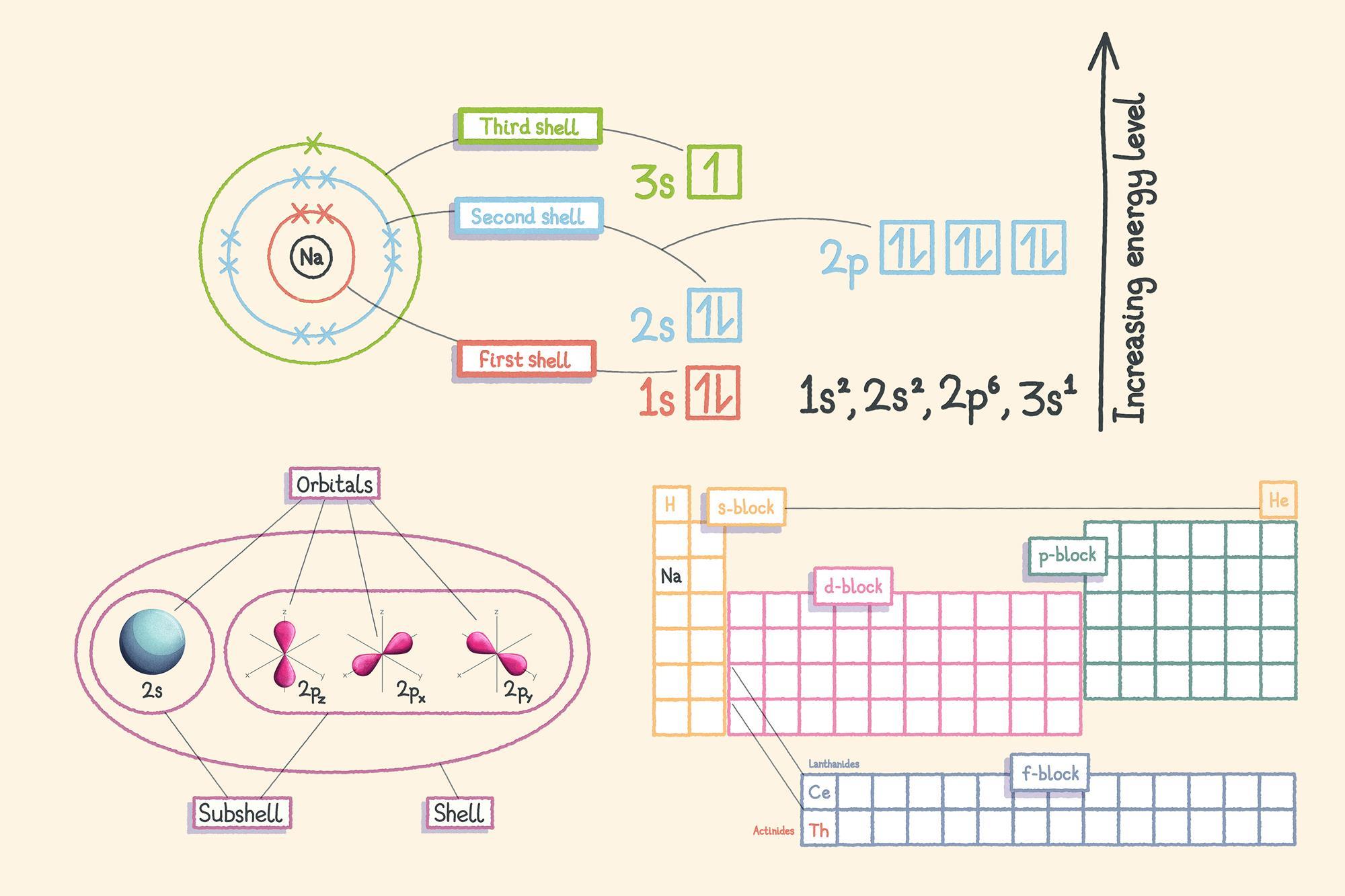
The organization of the periodic table is a direct consequence of the quantum mechanical model of the atom. The rows (periods) and columns (groups) are arranged precisely according to the order in which electron orbitals are filled.
The table is divided into sections, or blocks, which correspond to the type of subshell being filled with the outermost electrons.

The widths of these blocks are determined by the maximum number of electrons that can occupy each type of subshell:
- s-block (Groups 1-2): Two columns wide, because an
ssubshell has one orbital that can hold a maximum of 2 electrons. - p-block (Groups 13-18): Six columns wide, because a
psubshell has three orbitals that can hold a maximum of 6 electrons. - d-block (Groups 3-12): Ten columns wide, because a
dsubshell has five orbitals that can hold a maximum of 10 electrons. - f-block (Lanthanides and Actinides): Fourteen columns wide, because an
fsubshell has seven orbitals that can hold a maximum of 14 electrons.
The following reading explains how this structure emerges as we "build up" the elements one by one.
14.3: Electron Configurations and the Periodic Table (The Block Method) - Chemistry LibreTexts
This article from Chemistry LibreTexts clearly illustrates how the periodic table's layout mirrors the filling of electron subshells.
Read the initial part of the article, starting from the introduction, to see how the first few rows of the table are constructed. Then, continue to the next part which defines the blocks, starting from the s-block definition.
2. Valence Electrons and Chemical Families
In the last lesson, we defined valence electrons as the electrons in the outermost shell (the highest principal energy level, ). These are the electrons involved in forming chemical bonds, and they largely determine an element's chemical properties.
The block structure of the periodic table beautifully organizes elements with similar chemical behavior. Elements in the same group (column) have the same number of valence electrons and a similar valence electron configuration. This is why they are often called chemical families. For example, all the elements in Group 1 (the alkali metals) have a single valence electron in an s orbital (ns¹).
The following reading further clarifies this crucial connection between an element's group and its valence configuration.
14.3: Electron Configurations and the Periodic Table (The Block Method) - Chemistry LibreTexts
This section of the same article explains the concept of valence electrons in the context of the periodic table.
Please read the section starting from the definition of valence electrons. Pay close attention to the table showing the configurations for Group 1 elements; it's a perfect illustration of this principle.
3. Reading Configurations from the Table
Now, let's put this all together to use the periodic table as a practical tool. You can determine an element's electron configuration by simply "reading" across the periods, just like reading a book.
The process is best understood visually. The following video provides a clear, step-by-step guide.
How to Write the Electron Configuration for an Element in Each Block
This video by Melissa Maribel provides an excellent, structured walkthrough of how to write electron configurations for elements in each block by navigating the periodic table.
Please watch the following segments: Introduction to Blocks: A quick recap of the subshell blocks. s-block and p-block Examples: See how to write the configuration for Beryllium (s-block) and Sulfur (p-block), and how to use the condensed (noble gas) notation. d-block Example: This part is crucial. Pay close attention to the special rule for the d-block.
As you saw in the video, there are a couple of key rules to remember when navigating the d-block and f-block:
- The
n-1Rule for the d-block: When you enter the d-block in periodn, the principal quantum number for the d-orbitals is actuallyn-1. For example, in Period 4, you fill the4sorbital, followed by the3dorbitals. - The
n-2Rule for the f-block: Similarly, when you enter the f-block in periodn, the principal quantum number for the f-orbitals isn-2. For example, in Period 6, after filling the6sorbital, you fill the4forbitals before returning to the5dorbitals.
Let's practice with an element that requires us to use the n-1 rule. Consider Germanium (Ge), atomic number 32.
- Locate it: Germanium is in Period 4, Group 14 (in the p-block).
- Find the previous noble gas: The noble gas at the end of Period 3 is Argon (Ar). So, our abbreviated configuration will start with
[Ar]. - Read across Period 4:
- We start in the s-block:
4s²(for K and Ca). - Next, we enter the d-block. It's Period 4, so we use the
n-1rule:3d. We cross all 10 elements, so it's3d¹⁰. - Finally, we enter the p-block. We are still in Period 4. Germanium is the second element in, so it's
4p².
- We start in the s-block:
Combining these parts gives the final abbreviated electron configuration for Germanium: [Ar] 4s² 3d¹⁰ 4p².
This method of using the periodic table as a map is far more efficient than memorizing the Aufbau filling order, especially for larger elements. It directly translates the element's position into its most fundamental chemical property: its electronic structure.
Conclusion
Today, we've demystified the structure of the periodic table, revealing it as a physical manifestation of the rules of quantum mechanics. You've learned to use this structure to your advantage, transforming it from a reference chart into a powerful predictive tool.
Key Takeaways:
- The periodic table is organized into s, p, d, and f blocks, which correspond to the subshell of the outermost electrons.
- An element's period number indicates the principal energy level () of its valence electrons.
- Elements in the same group have similar valence electron configurations, which explains why they share chemical properties.
- You can write an electron configuration by "reading" the periodic table, but you must remember the
n-1rule for the d-block and then-2rule for the f-block.
This ability to quickly determine an element's electron configuration is not just a procedural skill. It is the foundation for understanding why elements behave the way they do. In our next lesson, we will apply this knowledge to explore and predict periodic trends, such as atomic size, ionization energy, and electronegativity.