Hello! Welcome back to our journey into the building blocks of matter.
In our last lesson, we established the fundamental "rules of the game" for electrons in an atom. We learned that an electron's state is described by four quantum numbers, which define its energy level, the shape of its orbital, its spatial orientation, and its spin. We also saw that the Pauli exclusion principle limits any orbital to a maximum of two electrons. We have the game board (the orbitals) and the pieces (the electrons). Today, we'll learn the strategy for placing those pieces on the board.
This lesson focuses on writing electron configurations for atoms. You will learn three key principles—the Aufbau principle, Hund's rule, and the Pauli exclusion principle—that govern how electrons systematically fill the available orbitals. Mastering this skill is like learning the grammar of chemistry; it allows us to read the periodic table and predict an element's behavior. The structured, rule-based nature of this process should feel familiar, given your experience with systematic approaches in data analysis and project management.
1. The Principles of Electron Arrangement
To determine the electron configuration of an atom, we follow a set of three fundamental rules. These rules ensure that we arrive at the ground-state configuration, which is the most stable, lowest-energy arrangement of electrons.
The Aufbau Principle: Building Up from the Bottom
The Aufbau principle (from the German Aufbau, "to build up") states that electrons occupy the lowest-energy orbitals available before entering higher-energy orbitals. The energy of an orbital is primarily determined by its principal quantum number () and secondarily by its azimuthal quantum number ().
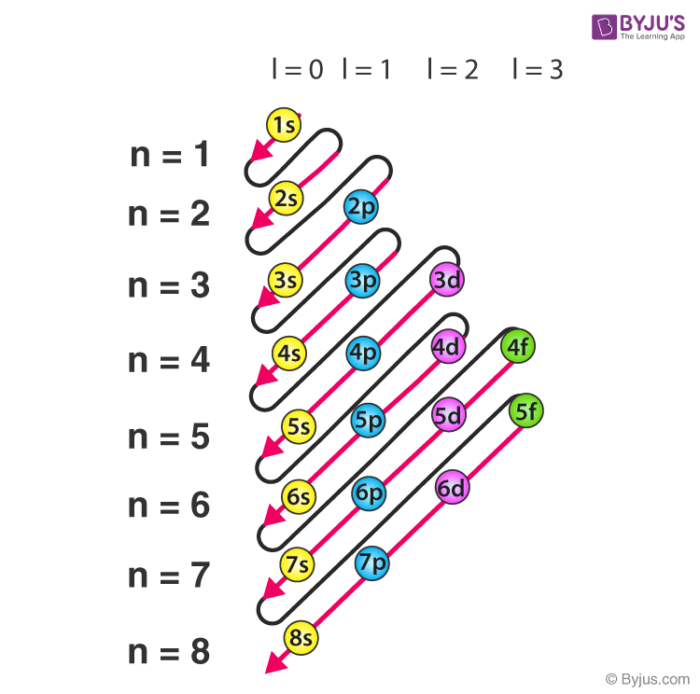
Generally, energy increases as increases. Within the same shell (same ), energy increases with in the order . However, as we move to higher energy levels, these shells begin to overlap. For instance, the 4s orbital is actually slightly lower in energy than the 3d orbitals.
The following diagram is a classic mnemonic for remembering the filling order. You follow the arrows from head to tail.
We describe the arrangement of electrons using electron configuration notation.
8.3: Electron Configurations- How Electrons Occupy Orbitals
The Chemistry LibreTexts article explains the standard notation for writing electron configurations.
Please read the short section that begins just below the first image and the heading "The Aufbau Principle". Start at the definition of electron configuration notation. This will show you how to write something like 1s^2 2s^1.
The Pauli Exclusion Principle: Two's a Crowd
As we reviewed in the last lesson, the Pauli exclusion principle states that no two electrons in an atom can have the same set of four quantum numbers. The practical consequence is that a single orbital can hold a maximum of two electrons, and those two electrons must have opposite spins (one spin "up," , and one spin "down," ). We represent this in orbital diagrams with two arrows pointing in opposite directions within the same box.
Hund's Rule: Spread Out First
When filling a set of degenerate orbitals (orbitals of the same energy, like the three p-orbitals or the five d-orbitals), Hund's rule comes into play. It states that the lowest-energy configuration is achieved by placing one electron in each degenerate orbital with the same spin before pairing any electrons.
Think of it this way: electrons are negatively charged and repel each other. It's more energetically favorable for them to occupy separate orbitals (like people taking separate seats on a bus) before being forced to pair up in the same orbital.
The following resource gives a clear and concise summary of these three essential rules.
Aufbau's Principle, Hund's Rule, and Pauli's Exclusion ...
This article from Chemistry Steps provides clear, separate explanations for each of the three rules.
Read the sections titled Aufbau's Principle and Pauli's Exclusion Principle, then continue to read the section on Hund's Rule. Finally, review the concise summary at the end. Focus on the core idea of each rule.
2. Constructing Electron Configurations and Orbital Diagrams
Now, let's combine these three principles to build the electron configuration for an atom. We'll use both the standard notation (e.g., ) and orbital diagrams, which use boxes for orbitals and arrows for electrons.
The following video provides a great dynamic illustration of how these rules work together.
Aufbau's Principle, Hund's Rule & Pauli's Exclusion Principle - Electron Configuration - Chemistry
This video from The Organic Chemistry Tutor demonstrates how to apply all three principles to fill an orbital energy diagram.
Watch from the beginning to the end (the full video). Pay attention to how the narrator first applies the Aufbau principle to fill lower levels, then Hund's rule when he reaches the 2p orbitals, and finally the Pauli principle when pairing electrons.
Let's walk through an example step-by-step for a carbon atom (atomic number Z=6, so it has 6 electrons):
- Aufbau Principle: The lowest energy orbital is 1s.
- Pauli Principle: We place two electrons in the 1s orbital with opposite spins. Configuration is now . (2 of 6 electrons placed).
- Aufbau Principle: The next lowest orbital is 2s.
- Pauli Principle: We place two electrons in the 2s orbital with opposite spins. Configuration is now . (4 of 6 electrons placed).
- Aufbau Principle: The next lowest orbitals are the three degenerate 2p orbitals.
- Hund's Rule: We have two electrons left. We place one electron in the first 2p orbital and the second electron in a different 2p orbital, with the same spin.
- Final Configuration: The full electron configuration for carbon is .
The orbital diagram would look like this:
The following resource provides excellent diagrams showing the "build-up" process for the first ten elements.
8.3: Electron Configurations- How Electrons Occupy Orbitals
This section of the LibreTexts article walks through the electron configurations and orbital diagrams for elements from Hydrogen to Neon.
Read the text and examine the diagrams in the section "The Aufbau Principle" (from the second paragraph onwards). Follow along as they build each atom, paying close attention to how Hund's rule is applied for carbon and nitrogen.
For a slightly more complex atom like Silicon (Si, Z=14), the process is the same, just extended.

3. A Practical Shortcut: Abbreviated Configurations and the Periodic Table
Writing out the full configuration for larger atoms can be tedious. To simplify this, we use an abbreviated notation involving noble gases.
The electrons in the outermost shell (highest ) are called valence electrons—these are the electrons involved in chemical bonding. The inner electrons are called core electrons. The configuration of the core electrons of any element is always identical to the electron configuration of a noble gas.
For example, Sodium (Na, Z=11) has the configuration . The configuration is the same as that of Neon (Ne). So, we can abbreviate Sodium's configuration as [Ne] .
This not only saves space but also immediately highlights the valence electrons, which are crucial for understanding chemical properties.
Using the Periodic Table as a Cheat Sheet
The structure of the periodic table is a direct reflection of electron configurations. By knowing an element's position, you can determine its configuration without memorizing the Aufbau diagram. The table is organized into blocks:
- s-block: Groups 1 and 2
- p-block: Groups 13 through 18
- d-block: The transition metals (Groups 3-12)
- f-block: The lanthanides and actinides
The following video brilliantly explains how to use this structure to your advantage.
Quantum Numbers, Atomic Orbitals, and Electron Configurations
Professor Dave Explains how electron configurations relate directly to the periodic table.
Watch from this section. He first explains the Aufbau principle, then demonstrates a full configuration for chlorine. The most important part is where he introduces the s, p, d, and f blocks of the periodic table as a tool for quickly writing configurations, including the noble gas abbreviation.
4. Exceptions to the Rule
The Aufbau principle is a powerful predictive model, but like many models in science, it has exceptions. These usually occur with transition metals in the d-block and f-block, where orbital energies are very close together.
The most common exceptions to know are Chromium (Cr, Z=24) and Copper (Cu, Z=29).
- Chromium (Cr): Predicted as [Ar] . Actual is [Ar] .
- Copper (Cu): Predicted as [Ar] . Actual is [Ar] .
In both cases, an electron moves from the 4s orbital to the 3d orbital. This happens because there is a special stability associated with having a half-filled () or a fully-filled () subshell. The small energy cost of promoting an electron from 4s to 3d is more than compensated for by the stability gained.
8.3: Electron Configurations- How Electrons Occupy Orbitals
This final section from the LibreTexts article discusses the important exceptions for Chromium and Copper.
Read the paragraph that begins "The periodic table can be a powerful tool...". This explains the reason for the exceptions, grounding it in the concept of stability.
Conclusion
In this lesson, you've learned the systematic process for mapping out the electronic structure of any atom. This is a cornerstone of chemistry, as an atom's electron configuration dictates almost all of its chemical behavior.
Key Takeaways:
- Electron configurations are determined by three rules:
- Aufbau Principle: Fill orbitals from lowest to highest energy.
- Pauli Exclusion Principle: A maximum of two electrons per orbital, with opposite spins.
- Hund's Rule: Place one electron in each degenerate orbital before pairing them up.
- Configurations can be written in full notation (e.g., ) or abbreviated using a noble gas core (e.g., [He] ).
- Orbital diagrams visually represent the distribution and spin of electrons in orbitals.
- The structure of the periodic table (s, p, d, f blocks) provides a powerful shortcut for determining electron configurations.
- Exceptions to the filling order (like Cr and Cu) occur to achieve the extra stability of half-filled or fully-filled d-subshells.
You are now equipped with a powerful tool for deciphering the language of the elements. In our next lesson, we will use this skill to explore the periodic table in depth, understanding how an element's position is directly tied to its electron configuration and how that, in turn, dictates periodic trends like atomic size and reactivity.