Introduction
In our last lesson, we established the language of thermochemistry, learning to distinguish between a system and its surroundings and to classify processes as exothermic or endothermic based on the direction of heat flow. We learned to describe that heat is transferred, but as a future engineer, you know that description is only the first step. The next, crucial step is quantification.
This lesson bridges that gap. We will move from classifying heat flow to calculating it. You will learn to use the principles of calorimetry—the science of measuring heat—and master the fundamental equation that governs it: . We'll dissect this formula, understand the physical meaning of each variable, and apply it to solve practical problems. By the end of this lesson, you will be able to calculate the amount of heat transferred in a physical process or a chemical reaction, a foundational skill for analyzing energy balances in any engineering system.
The Key to Quantifying Heat: Specific Heat Capacity
Imagine you leave a metal spoon and a wooden spoon in the sun. Which one gets hotter to the touch? The metal spoon, of course. Even though both absorb a similar amount of energy from the sun, their temperatures increase by different amounts. This difference is due to an intrinsic property of materials called specific heat capacity.
Specific heat capacity, denoted by the symbol , is the amount of heat energy required to raise the temperature of 1 gram of a substance by 1 degree Celsius (or 1 Kelvin). It's a measure of a substance's "thermal inertia" or resistance to temperature change.
- A low specific heat capacity means a substance heats up and cools down quickly (like the metal spoon).
- A high specific heat capacity means a substance requires a lot of energy to change its temperature (like water).
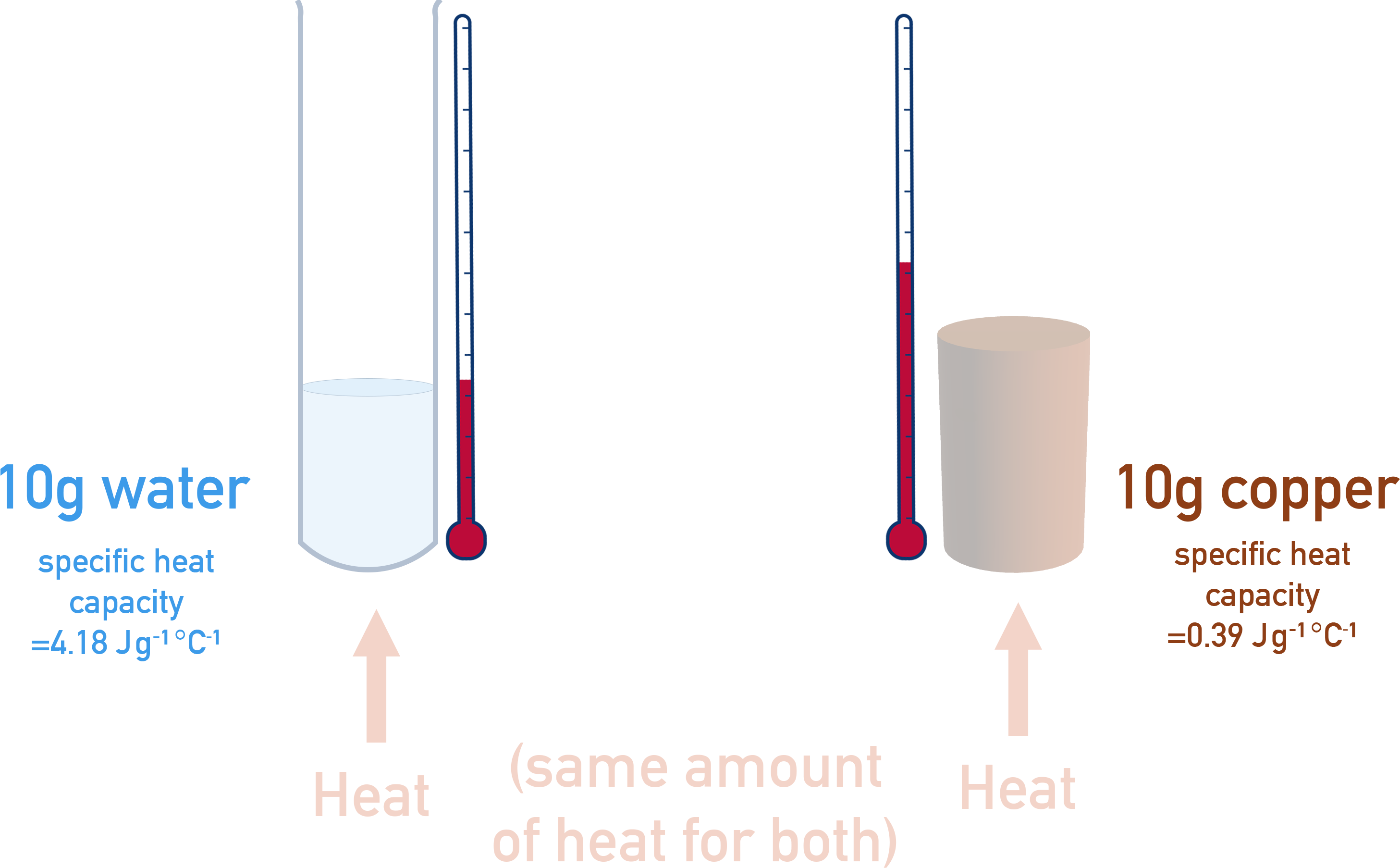
This image illustrates the concept of specific heat capacity. When the same amount of heat is applied to equal masses of water and copper, the copper's temperature rises significantly more than the water's. This is because copper has a much lower specific heat capacity (0.39 J/g°C) than liquid water (4.18 J/g°C).
To understand the physical reason for this difference, let's watch a brief segment from a CrashCourse Chemistry video.
Calorimetry: Crash Course Chemistry #19
Hank Green provides an excellent intuition for why different substances, particularly water, absorb heat differently at the molecular level.
Watch the segment from the beginning of the explanation. Pay attention to how absorbed heat can do more than just increase the speed of molecules; it can also be involved in breaking and forming intermolecular bonds, like the hydrogen bonds in water.
This concept is captured in a simple but powerful equation that relates heat transferred (), mass (), specific heat capacity (), and the change in temperature ().
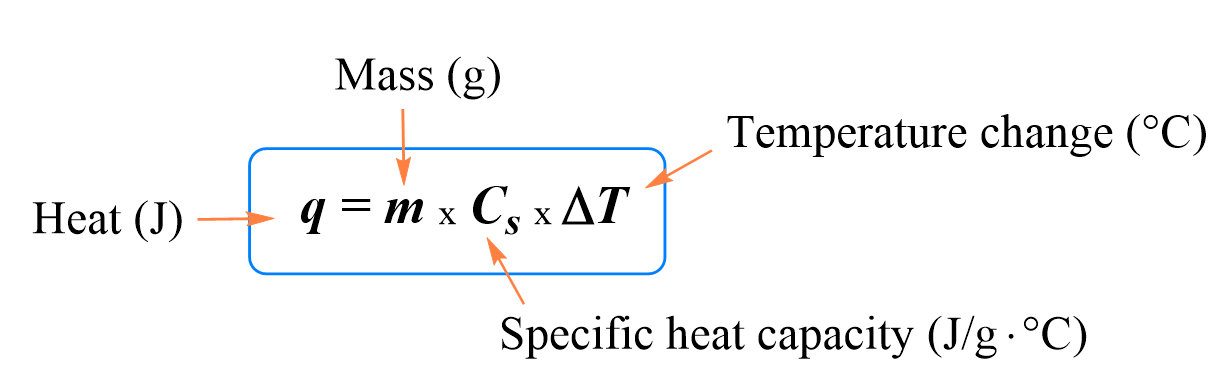
The fundamental equation for calculating heat transfer. Here, is used for specific heat capacity, but we will use the lowercase letter .
The formula is written as:
where:
- is the heat absorbed or released (in Joules, J).
- is the mass of the substance (in grams, g).
- is the specific heat capacity of the substance (in J/g°C).
- is the change in temperature, calculated as (in °C).
Now, let's turn to a textual resource for a more formal definition and to see a table of specific heat values for various substances.
12.3: Heat Capacity, Enthalpy, and Calorimetry - Chemistry LibreTexts
This article from Chemistry LibreTexts provides a clear, mathematical definition of heat capacity and specific heat.
Please read the first two sections of the article. Start with the section titled Heat Capacity. Focus on the distinction between heat capacity (an extensive property, depending on the amount) and specific heat capacity (an intensive property, independent of amount). Continue to the next section, up to the table of values. Read from the text relating heat transferred to heat capacity. This section formally presents the q = mc\Delta T equation and includes a valuable table of specific heats for common substances.
Measuring Heat Transfer: The Principle of Calorimetry
Now that we have the tool (), we need a method to use it. This method is calorimetry. The device used, a calorimeter, is essentially an insulated container designed to prevent heat from escaping to or entering from the outside world. Common examples range from a simple "coffee-cup calorimeter" made of Styrofoam to sophisticated, high-precision "bomb calorimeters" used in research.
The core principle of calorimetry is the conservation of energy. In an ideally insulated system, energy is not created or destroyed; it is only transferred. This means that the heat lost by one part of the system must be equal to the heat gained by another part.
If we place a hot object (like a piece of metal) into a container of cool water, the metal will cool down (losing heat) and the water will warm up (gaining heat) until they both reach the same final temperature (thermal equilibrium). In an ideal calorimeter, we can state this mathematically:
Or, more usefully:
For our metal-in-water example, this becomes:
The negative sign is crucial. It reflects the fact that from the system's perspective (as we learned in the last lesson), losing heat is a negative and gaining heat is a positive .
Calorimetry | General Chemistry
This resource from Lumen Learning introduces the basic setup of a calorimetry experiment and formally states the principle of heat exchange.
Read the introductory section of the article, from the beginning down to the end of the paragraph that introduces the equation q_{\text{Substance M}} = -q_{\text{Substance W}}. This will solidify your understanding of the foundational principle of calorimetry.
Applying the Concepts: Calorimetry Calculations
We can now combine the principle of calorimetry with our heat transfer equation. Since and , we can write:
Expanding the term gives us the full working equation:
This equation is the workhorse of simple calorimetry. By measuring masses and initial and final temperatures, you can solve for an unknown, such as a substance's specific heat or its initial temperature.
Let's watch a clear, step-by-step example of how to solve a typical calorimetry problem.
Calorimetry Concept, Examples and Thermochemistry | How to Pass Chemistry
In this video, Melissa Maribel walks through a complete calorimetry calculation, showing how to set up the equation and solve for the final temperature.
First, watch the brief introduction to the formula from this point. Then, follow the detailed worked example where she calculates the final temperature of a mixture of copper and water. Notice how she carefully organizes the given information before plugging it into the expanded equation.
The same principles apply when the heat is generated by a chemical reaction instead of a hot object. The heat released by an exothermic reaction () is absorbed by the surrounding solution ().
And we can calculate using .
To see this principle applied in different scenarios, let's return to the Lumen Learning article and work through its examples.
Calorimetry | General Chemistry
These worked examples demonstrate how to apply the calorimetry equations to different types of problems, including a chemical reaction.
Please study the following two examples in the "Calorimetry" article you looked at earlier. Example 1: Heat Transfer between Substances at Different Temperatures. Review this first example, which is similar to the video but solves for an unknown initial temperature. Example 3: Heat Produced by an Exothermic Reaction. Carefully study this second example. It shows how to calculate the heat produced by a neutralization reaction. Pay close attention to the assumptions made, such as treating the solution's density and specific heat as if they were pure water—a common and practical approximation in these calculations.
Conclusion
In this lesson, we moved from qualitative description to quantitative analysis of heat transfer. We established that specific heat capacity () is a fundamental property that dictates how a substance's temperature responds to heat. By combining this concept with the principle of energy conservation in an insulated calorimeter, we derived and applied the essential equation .
Key Takeaways:
- Specific Heat Capacity (): An intensive property representing a substance's resistance to temperature change. Water has a very high specific heat, while metals have low specific heats.
- Calorimetry: The technique for measuring heat transfer based on the principle of energy conservation in an isolated system, where .
- The Heat Transfer Equation: is the central tool for calculating the amount of heat absorbed or released based on changes in mass, specific heat, and temperature.
- Application: This framework allows us to calculate the heat exchanged between objects or the heat generated by a chemical reaction by measuring the temperature change of the surroundings (typically water or a solution).
So far, we have been using to represent heat transfer. In our next lesson, we will introduce a more formal thermodynamic quantity called enthalpy (). You will learn that under the common condition of constant pressure, the change in enthalpy () is exactly equal to the heat () we have been calculating today. This will provide a more robust framework for studying the energy of chemical reactions.