Introduction
Welcome to our first lesson in the module on Thermochemistry. In our previous discussions on phase diagrams, we mapped out the conditions under which substances change state—from solid to liquid, or liquid to gas. We saw that these transitions happen, but we didn't explore the energy that drives them. Today, we begin to answer that question.
This lesson introduces the foundational concepts for studying energy in chemical and physical processes. We will start by defining the precise language used to describe energy transfer, distinguishing between the system we are studying and its surroundings. You'll then learn to classify processes as exothermic or endothermic based on the direction of heat flow. This framework is essential for an engineer, as it's the first step in accounting for and controlling the energy involved in any process, from a simple phase change to a complex industrial reaction.
Defining the Arena: System and Surroundings
Before we can track energy, we need to clearly define our boundaries. In engineering and data analysis, defining the scope of a problem is the critical first step. Thermochemistry is no different. We divide the universe into two parts: the part we are interested in and everything else.
- The system is the specific portion of the universe we are studying. This could be the reactants and products in a chemical reaction, a cube of ice melting in a glass, or the gas inside a piston.
- The surroundings are everything outside the system. This includes the beaker holding the reaction, the air in the room, and even the person observing the experiment.
The universe, in this context, is simply the system and the surroundings combined. Energy can move between the system and surroundings, but the total energy of the universe remains constant. This is a core idea of the First Law of Thermodynamics, which we will explore more later.
The following reading provides a more formal introduction to these terms and the related concepts of thermal energy, temperature, and heat.
This resource from the UW-Madison Chemistry Resource Book will help you differentiate between key thermal concepts and formally define the system and its surroundings.
First, read the section Thermal Energy, Temperature, and Heat. Focus on understanding the distinct definitions of thermal energy (total kinetic energy), temperature (average kinetic energy), and heat (the transfer of thermal energy). Next, read the section System vs. Surroundings. This part introduces the core definitions and the crucial relationship: q_system = -q_surroundings. This equation mathematically states that any heat lost by the system must be gained by the surroundings, and vice-versa.
As the reading highlights, heat, denoted by the variable , is the energy that flows between the system and surroundings due to a temperature difference. The direction of this flow is what defines a process as either exothermic or endothermic.

The Direction of Heat Flow: Exothermic and Endothermic
We classify processes based on whether the system absorbs heat from the surroundings or releases heat to them.
-
An endothermic process is one where the system absorbs heat from the surroundings.
- Since heat flows into the system, the heat value is positive ().
- Because the surroundings lose heat, their temperature decreases. A chemical cold pack is a practical example; the dissolving salt (the system) absorbs heat from its surroundings (your skin), making it feel cold.
-
An exothermic process is one where the system releases heat to the surroundings.
- Since heat flows out of the system, the heat value is negative ().
- Because the surroundings gain heat, their temperature increases. A burning fire is a classic example; the combustion reaction (the system) releases heat and light into the surroundings, making them warmer.
It's crucial to remember that the sign of is always from the perspective of the system.
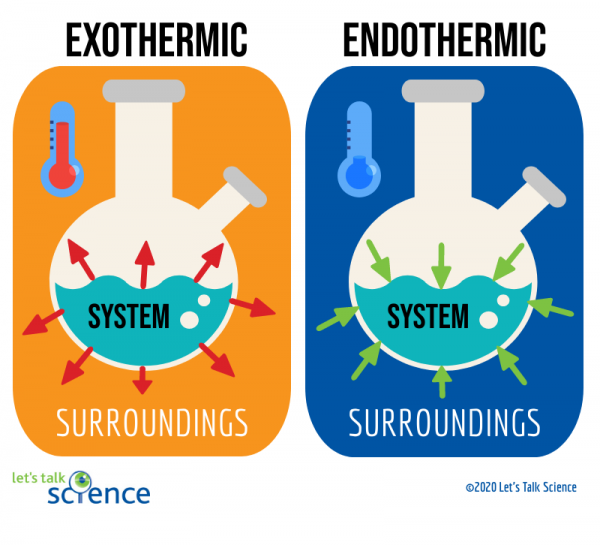
The following video offers a dynamic explanation of these concepts and connects them to phase changes and chemical bonds.
Endothermic and Exothermic Reactions
This video from The Organic Chemistry Tutor provides clear definitions, energy diagrams, and practical examples of both types of processes.
Watch the following segments to solidify your understanding: Start with the initial definitions and potential energy diagrams. Notice how the relative energy of reactants and products determines whether a reaction is endothermic or exothermic. Next, jump to the section on phase changes. This directly links to our previous lesson, classifying melting, freezing, and other transitions as either endothermic or exothermic. Pay close attention to the excellent explanation of condensation on a cold glass. Finally, watch the segment on breaking and forming bonds. This explains the origin of energy changes at a molecular level.
Applying the Concepts
Let's summarize the key applications from the video, linking back to our lesson on phase diagrams.
1. Phase Transitions:
To move to a state with more particle motion (higher thermal energy), the system must absorb energy. To move to a more ordered state, the system must release energy.
-
Endothermic (Energy Absorbed, ):
- Melting (Fusion): Solid → Liquid
- Vaporization (Boiling): Liquid → Gas
- Sublimation: Solid → Gas
-
Exothermic (Energy Released, ):
- Freezing: Liquid → Solid
- Condensation: Gas → Liquid
- Deposition: Gas → Solid
The example in the video of water condensing on a cold glass is a perfect illustration of identifying the system and surroundings.
- System: The cold water in the glass. It is absorbing heat from the surroundings, so from its perspective, the process is endothermic.
- Surroundings: The air and the water vapor in it. The water vapor (gas) releases heat to the cold glass, causing it to condense into liquid water on the outside of the glass. For the water vapor, the process is exothermic.
2. Chemical Reactions:
Energy changes in chemical reactions are about breaking old chemical bonds and forming new ones.
- Bond Breaking ALWAYS requires an input of energy (Endothermic).
- Bond Formation ALWAYS releases energy (Exothermic).
A reaction's overall classification depends on the balance between the energy required to break bonds in the reactants and the energy released when forming bonds in the products. If more energy is released than absorbed, the reaction is exothermic, and vice versa.
Conclusion
In this lesson, we established the fundamental vocabulary of thermochemistry. By clearly defining a system and its surroundings, we can precisely track the flow of energy. We learned that this flow determines whether a process is endothermic (the system absorbs heat, ) or exothermic (the system releases heat, ).
Key Takeaways:
- The system is the object of study, while the surroundings are everything else.
- Heat () is the transfer of thermal energy between the system and surroundings.
- An endothermic process absorbs heat from the surroundings, causing them to cool down. Examples include melting ice, boiling water, and chemical cold packs.
- An exothermic process releases heat into the surroundings, causing them to warm up. Examples include freezing water, combustion, and chemical hand warmers.
- Phase changes toward more disordered states (like melting and boiling) are endothermic, while changes toward more ordered states (like freezing and condensation) are exothermic.
We have now learned to classify heat flow. The logical next step is to quantify it. In our next lesson, we will learn how to calculate the amount of heat transferred in a process using the principles of calorimetry and the equation .