Introduction
In our last lesson, we developed a practical method for measuring heat transfer, , using calorimetry. We saw that for processes open to the atmosphere, like a reaction in a coffee-cup calorimeter, we could quantify the energy released or absorbed by measuring temperature changes. Today, we'll formalize this concept by introducing a new, powerful thermodynamic quantity called enthalpy.
This lesson will define enthalpy () and explore its fundamental relationship to internal energy, pressure, and volume. Most importantly, we will derive the direct connection between the change in enthalpy () and the heat transferred at constant pressure (). This will reveal that the quantity you were measuring in the last lesson's calorimetry experiments has a formal thermodynamic name. Understanding enthalpy is crucial for an engineer, as it provides the primary means of accounting for energy in most real-world chemical processes.
From Internal Energy to Enthalpy
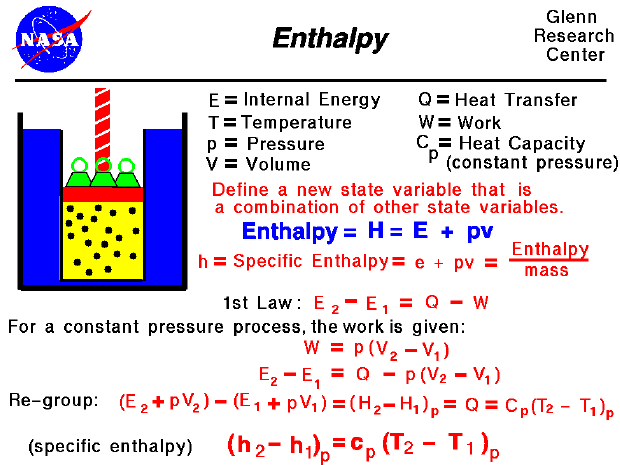
Let's begin by recalling the First Law of Thermodynamics, which states that the change in a system's internal energy () is the sum of the heat transferred () and the work done ():
Internal energy accounts for all energy changes in a system. However, many chemical and biological processes occur in vessels open to the atmosphere, where the pressure is effectively constant.
Consider a reaction that produces a gas in an open beaker. The gas has to push the atmosphere out of the way as it expands. This is a form of work, known as pressure-volume work, and is given by . In this case, the system does work on the surroundings, so it loses energy. While captures this total energy balance, we are often most interested in the heat generated or consumed by the reaction itself—this is what determines if a reactor needs heating or cooling.
To isolate the heat transfer under these common constant-pressure conditions, we define a new quantity. This is the core motivation for introducing enthalpy. The following video provides a clear introduction to this idea by contrasting a constant-volume process with a constant-pressure one.
ENTHALPY and INTERNAL ENERGY in 12 Minutes!
This video from "Less Boring Lectures" does an excellent job of showing why enthalpy is a useful concept for constant-pressure systems, which are common in engineering.
Please watch the following segments: Start with the introduction, which sets up the comparison. Watch the explanation for a constant-volume system, like a pressure cooker, where heat equals the change in internal energy (q = \Delta U). Next, see how for a constant-pressure system, like a piston-cylinder, the work term becomes important, leading to the definition of enthalpy. Finally, note the clear summary distinguishing the two concepts from this point.
As the video explains, for a constant pressure process, the heat transferred () is equal to the change in internal energy plus the work done by the system's expansion. This specific combination of terms is so frequently encountered that we give it its own name: enthalpy.
Defining Enthalpy
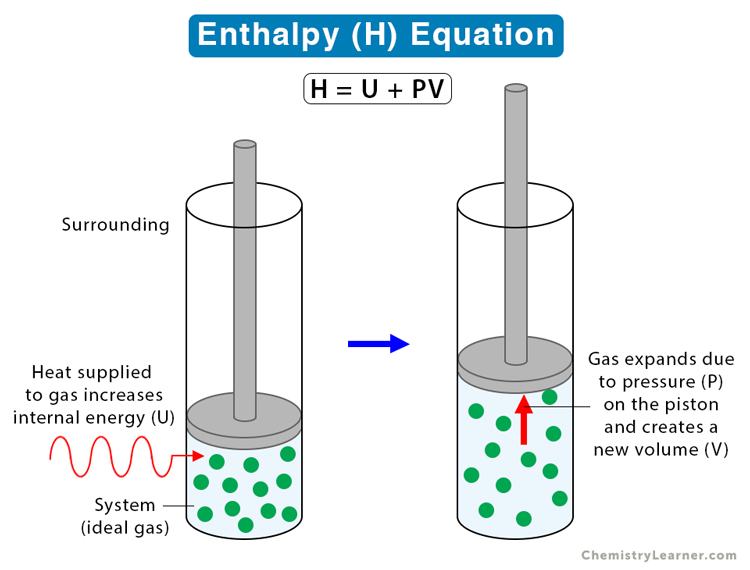
Enthalpy () is formally defined as the sum of a system's internal energy () and the product of its pressure () and volume ().
Enthalpy is a state function, which means its value depends only on the current state of the system (its temperature, pressure, etc.), not on how it got there. This is a crucial property, as it allows us to calculate the change in enthalpy () simply by knowing the initial and final states: .
The term represents the internal energy of the system's components (kinetic and potential energies of the molecules). The term can be thought of as the energy required to "make room" for the system by pushing back the surroundings to establish the system's volume at pressure .
For a deeper conceptual understanding, let's turn to a short reading.
The "Physical interpretation" section of the Wikipedia article on Enthalpy provides a very clear explanation of what the U and pV terms represent.
Please read the section titled Physical interpretation. Focus on how it describes the pV term as the work required to "make room" for the system and why this makes enthalpy the appropriate measure for heat in reactions at constant atmospheric pressure.
The Key Relationship: ΔH = q_p
We've now established a conceptual basis for enthalpy. The real power of this quantity comes from its direct relationship to heat under constant pressure. Let's derive this relationship formally. The derivation is a cornerstone of thermochemistry.
We will start with the definition of enthalpy and use what we know about the First Law of Thermodynamics and pressure-volume work. This video provides an excellent, step-by-step walkthrough.
In this video from Ben's Chem Videos, the presenter clearly defines enthalpy and then derives its relationship to heat at constant pressure.
First, watch the formal definition of enthalpy and the explanation of it being a state function. Then, pay close attention to the step-by-step derivation that combines the definition of enthalpy, the first law of thermodynamics, and the equation for pressure-volume work to arrive at the final result.
To solidify your understanding, let's review those same steps in a textual format.
6.6: Enthalpy- The Heat Evolved in a Chemical Reaction at Constant Pressure - Chemistry LibreTexts
This resource from Chemistry LibreTexts presents the same derivation with formal mathematical notation.
Find the heading "The internal energy U of a system..." and read the derivation that follows. It begins with the definition of enthalpy and proceeds through the substitution of the First Law (\Delta U = q + w) to arrive at the final, crucial result: the derivation showing that \Delta H = q_p.
The result, , is simple but profound. It tells us that for any process occurring at constant pressure, the change in enthalpy is exactly equal to the heat gained or lost by the system. This is why the heat you calculated in your calorimetry experiments last lesson is correctly referred to as the "enthalpy change" of the process.
This also means the sign conventions are the same:
- Exothermic process: The system releases heat, so is negative. Therefore, .
- Endothermic process: The system absorbs heat, so is positive. Therefore, .
Conclusion
In this lesson, we bridged the gap between the practical measurement of heat and its formal thermodynamic description. We introduced enthalpy as a state function specifically designed to account for energy changes in systems at constant pressure, the conditions under which most chemical reactions are run.
Key Takeaways:
- Enthalpy () is defined as the sum of a system's internal energy () and its pressure-volume product (): .
- Conceptually, enthalpy includes both the internal energy of a system and the energy required for it to occupy its volume against an external pressure.
- The most important relationship is that for a process at constant pressure, the change in enthalpy () is exactly equal to the heat transferred ().
- Because of this relationship, the heat measured in a constant-pressure calorimeter (like a coffee-cup calorimeter) is the enthalpy change, .
- An exothermic process has , and an endothermic process has .
Now that you have a solid understanding of what enthalpy represents, our next step will be to learn how to calculate it without always needing to run an experiment. In the next lesson, we will explore how to determine the enthalpy change for any reaction using tabulated values called standard enthalpies of formation.