Introduction
In our last lesson, we established that for any chemical process occurring at constant pressure, the heat transferred () is equal to the change in the system's enthalpy (). This gave us a direct way to measure in the lab using calorimetry. While powerful, this experimental approach isn't always practical. Imagine needing to predict the heat output of a new rocket fuel or an industrial process—you'd want a way to calculate it without building a full-scale prototype first.
This lesson introduces a powerful predictive method that does just that. We will focus on how to calculate the standard enthalpy change of a reaction () using tabulated values called standard enthalpies of formation (). You will learn what these formation values represent, the formula that connects them to the overall reaction enthalpy, and why this method works. Mastering this technique is a cornerstone of chemical engineering, allowing you to quantify the energy involved in nearly any chemical reaction using readily available data.
Standard Enthalpy of Formation: The Building Blocks
To calculate a reaction's enthalpy change, we first need a common reference point. In thermochemistry, this reference is the formation of compounds from their constituent elements in their most stable form under standard conditions.
First, let's define these terms. The standard state of a substance is its pure form at a pressure of 1 atmosphere and a specified temperature, usually 25°C (298.15 K). The standard enthalpy of formation () is the enthalpy change when one mole of a compound is formed from its elements in their standard states.
The following video introduces these concepts clearly.
Enthalpy: Crash Course Chemistry #18
This segment from Crash Course Chemistry explains the idea of a standard state and defines the standard enthalpy of formation.
Watch the portion of the video that discusses Germain Hess's contributions, leading into the definitions of standard state and standard enthalpy of formation. Pay close attention to the crucial convention: the standard enthalpy of formation for any element in its most stable form is defined as zero.
This "zero" baseline for pure elements is the key. It's like defining sea level as zero elevation; all other altitudes are measured relative to it. Similarly, all compound formation enthalpies are measured relative to their constituent elements.
A "formation reaction" must follow two strict rules:
- Exactly one mole of a single product is formed.
- All reactants must be elements in their standard states.
Let's see how to write these specific types of reactions.
Enthalpy of Formation Reaction & Heat of Combustion, Enthalpy Change Problems Chemistry
This video from The Organic Chemistry Tutor provides clear, step-by-step examples of how to construct formation reactions.
Watch the first part of the video, which demonstrates how to write formation reactions for several compounds, including water, methane, and others. Notice how fractional coefficients are sometimes necessary on the reactant side to ensure only one mole of product is formed. Then, listen to the key takeaway about elements in their natural state from this segment.
To reinforce this, the following text provides a formal definition and a useful table of standard states for common elements.
5.3 Hess's Law and Enthalpies of Formation - Chad's Prep®
This resource from Chad's Prep clearly lays out the rules for formation reactions.
Please read the section titled What Is a Formation Reaction?. Then, review the table of standard states and the special note about carbon. Finally, examine the example for writing the formation reaction for sodium bicarbonate (NaHCO_3), found here.
Calculating Reaction Enthalpy: Products Minus Reactants
Now that we understand what values are, we can use them to calculate the enthalpy change for any reaction. Since enthalpy is a state function, the overall enthalpy change depends only on the final state (products) and the initial state (reactants). This leads to a straightforward formula:
Where:
- (sigma) means "the sum of".
- and are the stoichiometric coefficients of each product and reactant in the balanced chemical equation.
Let's see this formula applied to a real-world example: the reaction inside a disposable hand warmer.
Enthalpy: Crash Course Chemistry #18
The same Crash Course video now demonstrates how to use the "products minus reactants" formula to calculate the heat released by the reaction that warms your hands.
Watch from this point, where the mathematical formula is presented and then applied to the reaction of iron and oxygen.
This "products minus reactants" structure is a direct consequence of enthalpy being a state function. We can imagine the reaction happening in two hypothetical steps:
- The reactants decompose into their constituent elements in their standard states.
- These elements then recombine to form the products.
The image below illustrates this concept. The overall enthalpy change from reactants to products is the same whether we go directly or take the indirect path through the elemental building blocks.
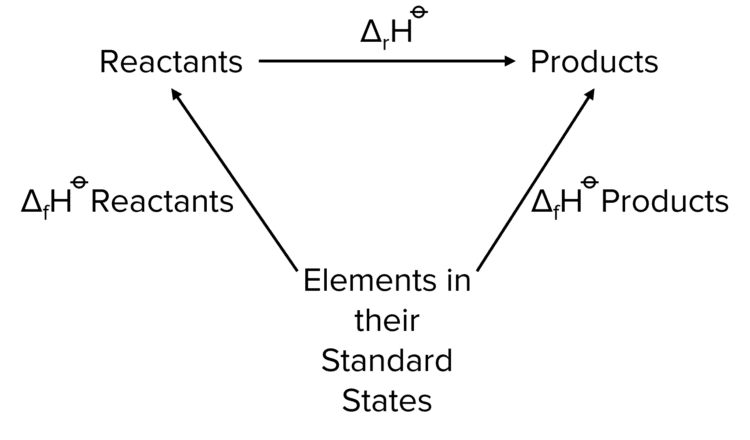
The "demolition" of reactants back to their elements is the reverse of their formation, so its enthalpy change is . The "rebuilding" to form products is simply . Summing these gives the formula.
This next reading provides an excellent analogy for this process.
5.3 Hess's Law and Enthalpies of Formation - Chad's Prep®
This section explains the theoretical justification for the products-minus-reactants formula.
Read the section titled Why the Method Works. The analogy of demolishing and rebuilding a room is a powerful way to understand why this calculation is valid.
A Worked Example
Let's solidify this with another step-by-step calculation.
Consider the combustion of methane (), the primary component of natural gas:
We are given the following standard enthalpies of formation:
- (element in standard state)
Step 1: Sum the enthalpies of the products, multiplied by their coefficients.
Step 2: Sum the enthalpies of the reactants, multiplied by their coefficients.
Step 3: Subtract the reactant sum from the product sum.
The negative sign indicates that the reaction is exothermic, releasing 890.3 kJ of energy for every mole of methane burned according to the balanced equation.
For more practice, the following resource contains a wealth of examples, including problems where you solve for an unknown value.
Hess' Law - using standard enthalpies of formation - chemteam.info
This page from ChemTeam provides numerous worked examples that will help you master this calculation.
Start by reviewing Example #1 (combustion of ethanol) and Example #2 (combustion of glucose). Then, look at Example #3 and Example #4, which show how to rearrange the formula to find the enthalpy of formation for a single substance when the overall reaction enthalpy is known.
Conclusion
In this lesson, you have learned a vital thermochemical calculation method. Instead of relying on experiments, you can now predict the enthalpy change for a vast number of chemical reactions by simply looking up standard enthalpy of formation values and applying a straightforward formula. This is a fundamental skill for any engineer dealing with chemical processes, energy balances, and reactor design.
Key Takeaways:
- The standard enthalpy of formation () is the enthalpy change when one mole of a compound is formed from its constituent elements, all in their standard states (25°C and 1 atm).
- By convention, the of any pure element in its most stable form is zero.
- The standard enthalpy change for a reaction () can be calculated using the formula: .
- This method is a direct consequence of enthalpy being a state function, meaning the path from reactants to products doesn't alter the total energy change.
We've seen that the "products minus reactants" formula is actually a shortcut derived from a more general principle. In our next lesson, we will explore this underlying principle, Hess's Law, which allows us to calculate enthalpy changes by combining the values of other known reactions.