Introduction
In our last lesson, we developed a powerful method for calculating a reaction's standard enthalpy change () using a table of standard enthalpies of formation (). We saw that this "products minus reactants" formula works because enthalpy is a state function—the overall change depends only on the start and end points, not the path taken. I also mentioned that this formula is actually a shortcut derived from a more fundamental principle.
Today, we delve into that principle: Hess's Law. This lesson will equip you with a universal method for determining the enthalpy change of any reaction, even those difficult or impossible to measure directly. We will treat chemical equations as algebraic expressions that can be manipulated and combined. You will learn the rules for this manipulation and apply a systematic, almost algorithmic, procedure to solve for an unknown . This approach, which relies on logical decomposition and reassembly, may resonate with the structured thinking used in project management and coding.
The Logic of Hess's Law: Path Independence
At its core, Hess's Law is a direct consequence of enthalpy being a state function. It states that if a chemical process can be represented as the sum of several individual steps, the total enthalpy change for the process is the sum of the enthalpy changes of those steps.
Imagine traveling from a city at sea level (the reactants) to a city on a plateau at 1000 meters elevation (the products). Your total change in altitude is +1000 meters. It doesn't matter if you took a direct flight or a winding road with many ups and downs; the net change between your starting and ending points is the same.
Chemical reactions work the same way. The overall enthalpy change from reactants to products is constant, regardless of the intermediate reactions or "pathway" taken.
Let's visualize this with a simple, classic example: the formation of carbon dioxide from solid carbon.
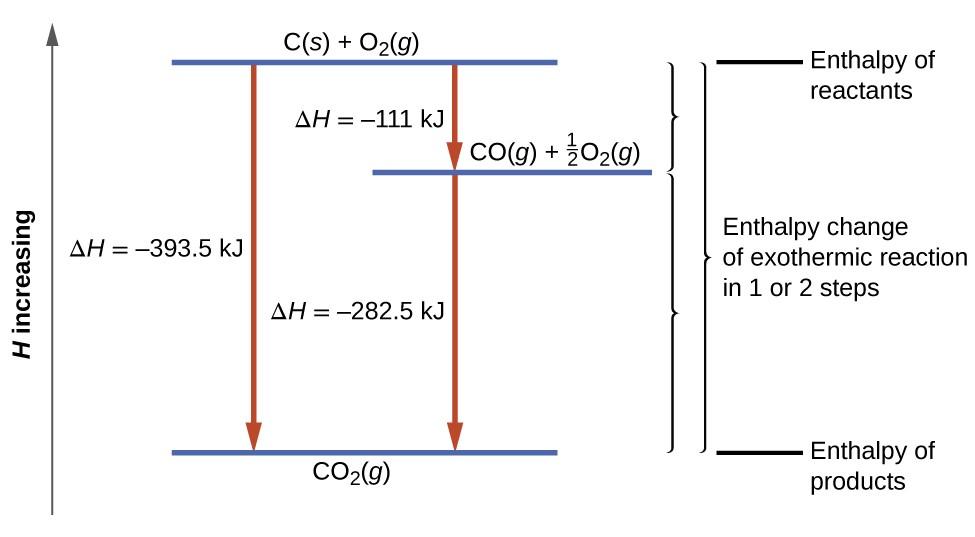
As the diagram shows, we can go from carbon and oxygen to carbon dioxide in one direct step:
Or, we can use a two-step pathway through carbon monoxide (CO):
According to Hess's Law, the sum of the enthalpy changes for the two-step path should equal the enthalpy change for the direct path:
The values match perfectly. This powerful idea allows us to calculate the for a reaction we don't know by combining reactions we do know.
The Rules of the Game
To use Hess's Law, we treat thermochemical equations like algebraic equations. There are two main rules for manipulating them:
-
Reversing a reaction: If you flip a reaction (swapping reactants and products), you must change the sign of its .
- Example: becomes .
-
Multiplying a reaction by a factor: If you multiply the stoichiometric coefficients of a reaction by a number (integer or fraction), you must multiply the value by that same number.
- Example: becomes .
By applying these two rules, you can transform a set of known "data" reactions into a "target" reaction.
A Systematic Approach to Solving Hess's Law Problems
Hess's Law problems can feel like puzzles. To solve them efficiently, you need a methodical process. The following resource lays out a robust 5-step method.
5.3 Hess's Law and Enthalpies of Formation - Chad's Prep®
This section from Chad's Prep outlines a clear, step-by-step algorithm for tackling any Hess's Law problem. This systematic approach eliminates guesswork and ensures you handle all components of the reaction correctly.
Read the section titled The 5-Step Core Method. Internalize these five steps, particularly the crucial first step of skipping any species that appears in more than one of the provided data reactions.
Let's apply this method to an example.
Target Reaction: Calculate for .
Given Data:
Applying the 5-Step Method:
-
Step 1: The first species in our target is C(s). It appears only in data reaction (2). We need 2 moles of C(s) on the reactant side. Reaction (2) has 1 mole on the reactant side.
- Action: Multiply reaction (2) by 2.
- Result:
-
Step 2: The next species is H₂(g). It appears only in data reaction (3). We need 1 mole on the reactant side, which is exactly what reaction (3) has.
- Action: Leave reaction (3) as is.
- Result:
-
Step 3: The final target species is C₂H₂(g). It appears only in data reaction (1). We need 1 mole on the product side. Reaction (1) has 1 mole, but on the reactant side.
- Action: Reverse reaction (1).
- Result:
-
Step 4 (Verification): Now, let's add our manipulated reactions and cancel out the intermediates (species that appear on both the reactant and product sides).
Sum:
The on both sides cancels out. We are left with our target reaction: .
-
Step 5 (Final Calculation): Sum the enthalpy changes of the manipulated reactions.
The following videos provide more worked examples that will help solidify this process.
Hess's Law - Chemistry Tutorial
This tutorial from TheChemistrySolution walks through two examples of applying Hess's Law, starting with a 2-equation problem and moving to a more complex 3-equation problem.
First, watch the demonstration of manipulating two equations to find the enthalpy of a target reaction from this segment. Next, follow the more involved example with three equations from this part, paying close attention to how intermediates are identified and cancelled.
Practicing the Method
Now it's time to practice. The best way to master Hess's Law is by working through problems. The following resource contains a large collection of them.
Hess' Law - using three equations and their enthalpies
This page from ChemTeam provides numerous examples of Hess's Law problems. Working through them will help you become fluent in the manipulation and summation process.
Carefully study the solutions for Example #2 and Example #5. Then, review Example #7 and Example #8, which show how to apply this method to find enthalpies of combustion and formation, respectively. Try to apply the 5-step method we discussed to follow their logic.
Tying It All Together: Why the Formation Method Works
Finally, let's connect back to our previous lesson. How does the "products minus reactants" formula using relate to Hess's Law?
The formation method is simply a clever and efficient application of Hess's Law. It constructs a specific hypothetical pathway from reactants to products:
- Step 1: Decomposition. All reactants are broken down into their constituent elements in their standard states. The enthalpy change for this is the negative of their enthalpies of formation ().
- Step 2: Formation. These elements are then recombined to form the products. The enthalpy change for this is simply the sum of the products' enthalpies of formation ().

Summing the enthalpy changes for these two hypothetical steps gives us the total reaction enthalpy:
This is exactly the formula from our last lesson. Hess's Law is the fundamental principle that guarantees this shortcut works.
Conclusion
In this lesson, you've mastered the foundational principle of Hess's Law, which is central to thermochemistry. You now have a powerful and flexible tool to calculate the enthalpy change of virtually any reaction by strategically combining known thermochemical data. This skill is indispensable in chemical engineering for predicting the energy requirements or outputs of chemical processes without having to run every reaction in a lab.
Key Takeaways:
- Hess's Law states that the total enthalpy change for a reaction is constant, regardless of the pathway taken.
- This law allows us to calculate for a target reaction by summing the values of a series of "data" reactions that add up to the target.
- The two key manipulations are:
- Reversing a reaction changes the sign of its .
- Multiplying a reaction's coefficients by a factor means multiplying its by the same factor.
- A systematic, step-by-step approach is the most reliable way to solve Hess's Law problems.
- The "products minus reactants" formula using enthalpies of formation, which we learned previously, is a specific and highly useful application of Hess's Law.
In our next lesson, we will explore yet another way to estimate reaction enthalpies: using average bond energies. This will involve conceptually breaking a reaction down not into other reactions, but into the individual chemical bonds being broken and formed.