Hello! Welcome to the first lesson in our new module, "Scaling the Narrative."
In the previous modules, you've built a fantastic toolkit for creating and refining individual scenes, culminating in our last lesson on troubleshooting audio/video sync issues. You've mastered the building blocks. Now, it's time to become the architect. Your goal is to create compelling 1, 3, and 5-minute videos, and that requires moving beyond single clips to crafting a complete narrative with a beginning, middle, and end.
This lesson directly addresses that challenge. We'll be focusing on how to expand the 3-act structure for a 3-5 minute narrative by adding a midpoint or subplots. You'll learn two powerful techniques used by professional storytellers to add complexity, depth, and engagement to stories that are longer than a simple sketch.
Recapping the Foundation: The 3-Act Structure
Back in Module 1, we introduced the classic 3-act structure:
- Act 1: The Setup. We meet the characters and learn their goal. The inciting incident kicks off the story.
- Act 2: The Confrontation. The protagonist faces obstacles in pursuit of their goal.
- Act 3: The Resolution. The story reaches a climax, and the central conflict is resolved.
For a 30-second or 1-minute video, this is often enough. But as you scale up to 3 or 5 minutes, Act 2—the "middle"—can start to feel stretched out or lose momentum. This is a common problem known as the "saggy middle." Our two tools for today, the midpoint and subplots, are the solution.
Part 1: The Midpoint - Re-energizing Your Story
The midpoint is a major event that occurs right in the middle of your story (and of Act 2). It's a point of no return or a major revelation that spins the narrative in a new direction, raises the stakes, and forces your protagonist to change their approach.
Think of it as a pivot point that divides your story into two halves: the character's initial approach to the problem (before the midpoint) and their new, often more active or desperate, approach (after the midpoint).

To get a deep dive into how this works, let's watch an excellent video that breaks down the concept.
The Midpoint in Film — 5 Ways to Write a Compelling Act Two
The video 'The Midpoint in Film' by StudioBinder defines the midpoint and explains its crucial functions in a narrative. It's a foundational concept for strengthening your second act.
Please watch from 00:51 to 07:09. Focus on: The definition of the midpoint as a major turning point. The five key functions it serves: linking story halves, setting up the final act, introducing a time clock, raising the stakes, and forcing the protagonist to change.
As the video explains, a strong midpoint isn't just a random event; it serves clear purposes:
- It raises the stakes: The consequences of failure become much more severe.
- It forces the protagonist to change: They must shift from a reactive to a proactive mindset.
- It can introduce a time clock: A deadline adds urgency (e.g., the iceberg hits the Titanic).
- It reveals new information: The true nature of the problem or the villain might be revealed.
Types of Midpoints
A midpoint can take many forms. The StudioBinder video you just watched goes on to explain several common types. This next segment will give you a menu of options to choose from when designing your own story.
The Midpoint in Film — 5 Ways to Write a Compelling Act Two
Let's continue with the same video to explore the different flavors a midpoint can have. This will give you a practical toolbox for your own stories.
Please watch from 07:09 to 13:09. Pay attention to the five types of midpoints and their examples: Setback / False Defeat: The hero seems to fail completely. False Victory: The hero seems to succeed, but it's an illusion or creates a new problem. Reversal: The hero's goal fundamentally changes. Twist: A shocking revelation changes everything we (and the hero) thought we knew.
Here is a quick summary of those midpoint types. For a more detailed breakdown, you can also refer to the companion article from StudioBinder, "Examples of Midpoint In Movies."
| Midpoint Type | Description | Example |
|---|---|---|
| Setback | The protagonist faces a massive failure, pushing them further from their goal. | In Jaws, the shark attacks on the 4th of July, making the threat personal for Chief Brody. |
| False Victory | The protagonist appears to achieve their goal, but this "win" leads to greater complications. | In 500 Days of Summer, Tom and Summer have a moment of deep connection, which sets him up for greater heartbreak later. |
| False Defeat | It seems like all is lost, but this apparent defeat reveals a new path to victory. | In The Matrix, the Oracle tells Neo he is not "The One," which is what he needs to hear to start believing in himself. |
| Reversal | The protagonist's core goal changes entirely. | In Eternal Sunshine, Joel starts by wanting to erase Clementine but halfway through, his goal reverses to trying to save his memories of her. |
| Twist | A huge, unforeseen revelation turns the entire plot on its head. | In Parasite, the Kim family discovers the secret basement and the person living in it. |
Test your understanding!
Imagine a 3-minute story: "A shy inventor creates a robot to help him ask his crush on a date. Act 1 ends with him sending the robot."
What could be a Setback Midpoint for this story? What about a Twist Midpoint?
Show answer
- Setback Midpoint: The robot goes to the crush but malfunctions, horribly embarrassing the inventor and making the situation much worse. The inventor now has to fix the mess himself.
- Twist Midpoint: The robot finds the crush, who reveals that she is also a shy inventor... and she had just sent her own robot to ask him out. The story is no longer about one person's quest but about two robots trying to coordinate a date for their creators.
Part 2: Subplots - Adding Depth and Dimension
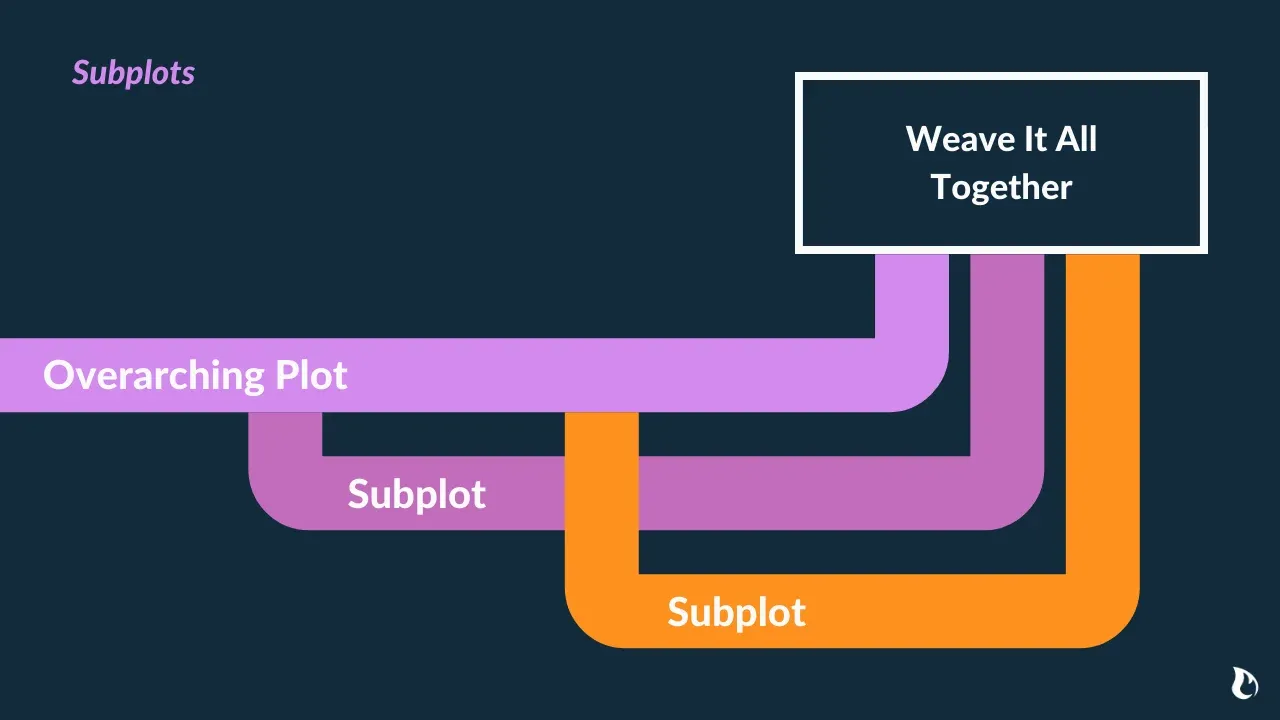
While the midpoint adds a powerful jolt to your main plot (the "A-story"), subplots add richness and texture. A subplot is a secondary storyline that runs alongside the main narrative.
A simple, powerful way to think about subplots is: Subplot = Relationship.
A subplot typically explores the relationship between the protagonist and another character, or between two secondary characters. It has its own beginning, middle, and end, but it serves to illuminate the main plot.
Why Use Subplots?
Subplots are not just filler. They are essential for longer stories because they:
- Develop Characters: They show us different sides of our protagonist and give depth to secondary characters.
- Explore the Theme: A subplot can echo the main theme in a different context. If the main plot is about courage, a subplot might explore a different character's struggle with cowardice.
- Control Pacing: You can cut from a high-tension scene in the main plot to a quieter, more emotional subplot scene to give the audience a breath.
- Increase Stakes: The subplot can become entangled with the main plot, making the final climax even more impactful.
Let's watch another great video to see the different types of subplots and how they function.
How to Write a Subplot in a Screenplay — Adding Layers to Your Film
This video, 'How to Write a Subplot in a Screenplay' also by StudioBinder, provides a clear taxonomy of subplot types and their narrative purpose.
Please watch from 00:50 to 09:53. Focus on: The definition of a subplot. The four common types: romantic, expository (backstory), parallel, and contrasting. The various purposes of subplots, such as characterization and heightening the stakes.
A Practical Framework for Subplots
Thinking in terms of "relationships" makes subplots intuitive to create. The excellent article "The Importance of Subplots" by Scott Myers on Go Into The Story provides a simple, three-step process for integrating them into your story.
This article offers a powerful, character-centric way to think about subplots. We'll focus on its actionable advice for building them.
Please read these two key sections: Start with the section that begins 'Subplot = Relationship.' This is the core concept. Then, read the three-step process under the heading 'So how to use subplots?' which includes imagining, tracking, and placing subplot beats.
To summarize that practical advice:
- Imagine: Think about your characters. What is the relationship between your protagonist and their mentor? Their rival? A friend? Each of these is a potential subplot.
- Track: Give each relationship its own mini-arc. What is its Beginning (how does it start?), its Middle (how does it develop or face conflict?), and its End (how is it resolved or changed?).
- Place: Weave the "beats" of your subplot into your main story. A scene can often serve both the main plot and a subplot simultaneously.
Test your understanding!
Let's return to our inventor story. The main plot ("A-story") is the inventor trying to get a date. Let's say he has an old, grumpy mentor who thinks the robot is a terrible idea.
How could you frame the inventor's relationship with his mentor as a subplot with a beginning, middle, and end?
Show answer
- Beginning: The mentor scoffs at the robot idea, telling the inventor to just be a man and ask her out himself. The inventor ignores him.
- Middle: After the robot plan fails (the Midpoint!), the inventor goes to his mentor for help. The mentor, instead of saying "I told you so," offers a piece of surprising, heartfelt advice based on his own past romantic failure.
- End: After the inventor succeeds (or fails) in the main plot, he has a final conversation with his mentor. Their relationship has changed from one of simple disagreement to one of mutual respect and understanding. The mentor's story has helped the inventor grow, regardless of the A-story's outcome.
Conclusion
You've now added two of the most powerful structural tools in storytelling to your arsenal. By moving beyond a simple beginning-middle-end, you can create narratives with the tension, depth, and complexity needed to sustain a 3- to 5-minute video.
Key Takeaways:
- The Midpoint is a major turning point in Act 2 that reinvents your story, raises the stakes, and keeps the "saggy middle" from sagging.
- Subplots are secondary stories, best thought of as relationships, that add emotional depth, explore your theme, and develop your characters.
- For longer stories, you don't just stretch the plot; you strategically add these structural elements to build a richer and more engaging world.
Preview of the Next Lesson:
Knowing what a midpoint and subplot are is the first step. The next is putting them on paper. In our next lesson, we will focus on how to outline a multi-scene story, ensuring each scene contributes to the overall plot progression. We'll take these high-level structural ideas and break them down into a concrete, actionable blueprint for your next video project.