Ciao! Welcome to your next lesson.
Introduction
In our last lesson, we focused on asking "How are you?" and saw how the question changes depending on who you're speaking to: Come stai? for a friend (tu) versus Come sta? for a stranger (Lei). This distinction between formal and informal "you" is a cornerstone of Italian conversation.
Today, we'll officially learn the set of words that drives these changes: the subject pronouns. Our goal is to identify and use all the Italian subject pronouns—words like io (I), tu (you), lui (he), and lei (she). Mastering these is the first step in building your own sentences, as they are the "who" that performs any action. This lesson lays the foundation for the next several topics, where we'll start pairing these pronouns with essential verbs.
Part 1: Who is the Subject?
In any language, when we talk about an action, we need to know who is performing it. Is it me, you, or someone else? These roles are called the "subject" of the verb and are categorized as first person (I/we), second person (you), and third person (he/she/they).
This short video from the Italy Made Easy channel provides a great conceptual introduction, linking the English pronouns you already know to this grammatical structure.
Italian Subject Pronouns - Beginner Italian Course: Lesson 8
Let's start by understanding the concept of first, second, and third person subjects. This video explains it clearly.
Watch from the beginning until 01:51. The instructor, Manu, will walk you through the basic idea of subjects, which is the same in both English and Italian.
Now that you have the concept, let's see the full list of Italian subject pronouns, or pronomi personali soggetto.
Part 2: The Italian Subject Pronouns
Here are the core subject pronouns you'll need for everyday conversation. Pay close attention to their spelling and pronunciation.
| Person | Singular | English | Plural | English |
|---|---|---|---|---|
| 1st Person | io | I | noi | we |
| 2nd Person | tu | you (informal) | voi | you (all) |
| 3rd Person | lui lei Lei |
he she you (formal) |
loro | they |
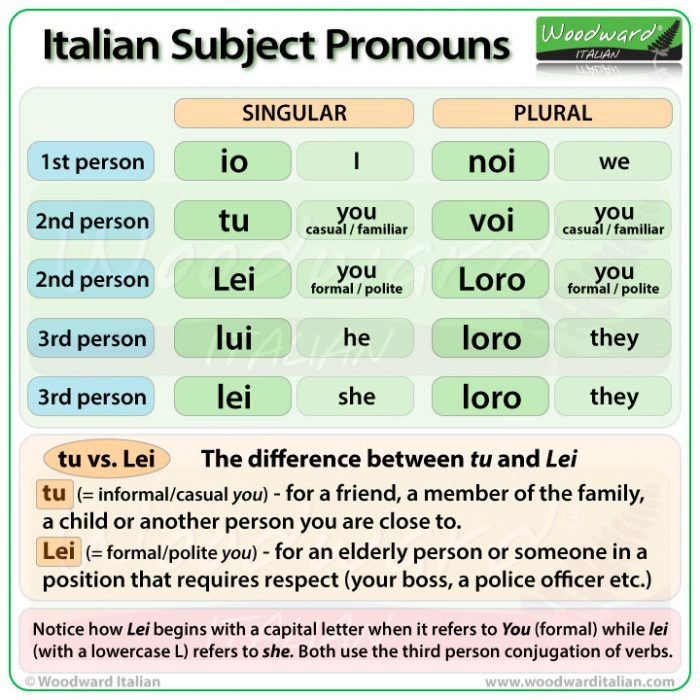
Notice that there are three words for "you": tu, Lei, and voi. We will dive into this crucial difference in the next section.
The following resource provides a clear list and some very important initial explanations.
Let's review this list in a structured article from Woodward Italian. It also introduces some key rules we'll be exploring.
Please read the initial section titled 'I pronomi personali soggetto in italiano'. It presents the full list of pronouns we'll be working with.
One key takeaway from that list is that io (I) is only capitalized at the beginning of a sentence, unlike in English.
Part 3: The Crucial Distinction: Formal vs. Informal 'You'
As you've already seen with phrases like scusi/scusa and Come sta?/Come stai?, choosing the correct form of "you" is essential for politeness.
- tu (you, singular informal): Use this with friends, family, children, and people your own age.
- Lei (you, singular formal): Use this with strangers, older people, and in professional or formal settings (e.g., with a police officer, a shopkeeper, a new boss). Note the capital "L" to distinguish it from
lei(she). - voi (you, plural): Use this when addressing a group of people, typically in an informal or neutral context (e.g., "What are you all doing?").
- Loro (you, plural formal): This is the formal equivalent of
voi, but it's rarely used in modern spoken Italian. People often default tovoieven in formal group settings. For your goals, it's good to recognizeLorobut focus on masteringtuandLei.
This article section explains the social context for these choices perfectly.
Let's read more about the rules of engagement for using the different forms of 'you'.
In the same article, find and read the sections titled 'Lei and Loro' and 'Tu vs. Lei'. This explains the capitalization rule and gives context for when to use each pronoun.
This chart provides a helpful visual summary of the pronouns, including the formal/informal distinction.
Part 4: A Key Feature of Italian: Dropping the Pronoun
Here's an interesting feature of Italian that connects to your background in programming and logic. In English, you must say "I speak Italian." The pronoun "I" is mandatory. In Italian, you can say Io parlo italiano, but it's much more common to simply say Parlo italiano.
Why? Italian is a "pro-drop" language. Because the verb ending changes for each subject (like you saw with sta vs. stai), the pronoun is often redundant. The verb itself tells you who is doing the action.
parl**o**can only mean "I speak"parl**i**can only mean "you speak" (tuform)
You don't need to learn these verb endings yet; the important concept is that the pronoun is optional and usually omitted unless you want to add emphasis or avoid confusion.
The Woodward Italian article explains this concept brilliantly.
Let's explore why you won't always hear these pronouns in conversation. This is a fundamental aspect of Italian grammar.
Read the section titled 'Italian pronouns with verbs'. It provides an excellent explanation of why Italian can 'drop' its subject pronouns.
So, when do you use the pronoun?
- For emphasis:
Io parlo italiano, ma lui parla francese.(I speak Italian, but he speaks French.) - For clarity: If the context is ambiguous, the pronoun makes it clear who you mean.
For your immediate travel goals, you'll hear and use sentences both with and without the pronoun. The key is to not be confused when it's missing!
Test your understanding!
Choose the correct Italian subject pronoun for each situation.
-
You are introducing yourself. Which pronoun refers to "I"?
a) noi
b) tu
c) io -
You are talking to a single friend. Which pronoun means "you"?
a) Lei
b) tu
c) voi -
You are speaking to an older shopkeeper you've just met. Which pronoun should you use for "you"?
a) tu
b) Lei
c) lei -
You and your travel partner are asking for a table for two. Which pronoun means "we"?
a) loro
b) voi
c) noi -
Why is the sentence
Mangio una pizza("I eat a pizza") grammatically complete in Italian without the wordio?
a) Because pizza is a singular noun.
b) Because the verb ending-oonmangioalready implies the subject isio(I).
c) Because it's an informal sentence.
Show answer
- c) io -
Iomeans "I". - b) tu -
tuis the informal singular "you", used for friends. - b) Lei -
Leiis the formal singular "you", used for strangers and in formal situations.leiwith a lowercase 'l' means "she". - c) noi -
noimeans "we". - b) Because the verb ending
-oonmangioalready implies the subject isio(I). This is the "pro-drop" principle in action.
Conclusion
Ottimo lavoro! (Great work!) You have now learned the essential toolkit of Italian subject pronouns. These are the building blocks you'll use in every conversation.
Key Takeaways:
- The main subject pronouns are
io, tu, lui/lei, noi, voi, loro. - The distinction between
tu(informal "you") andLei(formal "you") is crucial for politeness. - Italian often drops the subject pronoun because the verb ending already identifies who is performing the action (e.g.,
parlomeans "I speak"). - Pronouns are included for emphasis or clarity.
In our next lesson, we will put these pronouns to immediate use. You'll learn how to conjugate the two most important verbs in the entire language: essere (to be) and avere (to have). By combining the pronouns you learned today with these verbs, you'll be able to form your first real, descriptive sentences, like "I am a programmer" or "You have a question."
A presto