Introduction
Ciao! In our last lesson, we mastered the essential courtesy phrases: per favore, grazie, prego, and the formal/informal pair scusi/scusa. You learned how the choice between scusa and scusi depends on your relationship with the person you're speaking to, a crucial concept in Italian politeness.
Today, we'll complete our first module by building directly on that formal/informal distinction. Our goal is to learn how to ask someone "How are you?" and how to give a variety of natural responses. This is one of the most common exchanges you'll have, and getting it right will make your first conversations feel much more authentic. By the end of this lesson, you'll be able to confidently use Come stai? and Come sta? and know exactly how to reply.
Part 1: The Verb Behind the Question
To understand the difference between the formal and informal ways of asking "How are you?", we first need to look at the verb that powers this phrase: stare. In English, you use the verb "to be" ("How are you?"), but in Italian, you use stare, which literally means "to stay" or "to be" in the sense of a temporary state or condition.
The article from Joy of Languages provides a perfect grammatical breakdown, which will give you the clear structure you prefer.
How to answer COME STAI in Italian (and 3 common mistakes to avoid)
To understand how to ask 'How are you?', let's first examine the verb 'stare'. This article, 'How to answer COME STAI in Italian', clearly explains the verb and its conjugation.
Please read the section titled 'Use STARE to ask and understand how everyone is'. Focus on the conjugation table for 'stare'. This will be the foundation for everything else in this lesson.
As you saw, the verb stare changes its ending depending on who you are talking about. The two forms we need for today are:
stai- fortu(you, informal)sta- forLei(you, formal) AND forlui/lei(he/she)
Part 2: Asking "How are you?" — Formal and Informal
Now that you know the verb forms, asking the question is simple. You just add the word Come (How) in front.
Come stai?(informal) - Use this with friends, family, and people your age. It's the equivalent of usingtu.Come sta?(formal) - Use this with strangers, older people, or in professional settings. It's the equivalent of usingLei.
This formal/informal split is the same logic we applied to scusa/scusi in the previous lesson.
Let's look at the Joy of Languages article one more time for a direct comparison, and then see a helpful visual summary.
How to answer COME STAI in Italian (and 3 common mistakes to avoid)
The same article provides an excellent, concise explanation of the difference between the two forms.
Read the short section titled 'Come stai vs. come sta'. It provides clear examples of when to use each.
This image provides a great visual reminder of the formal and informal distinction for several key phrases, including the one we're learning today.
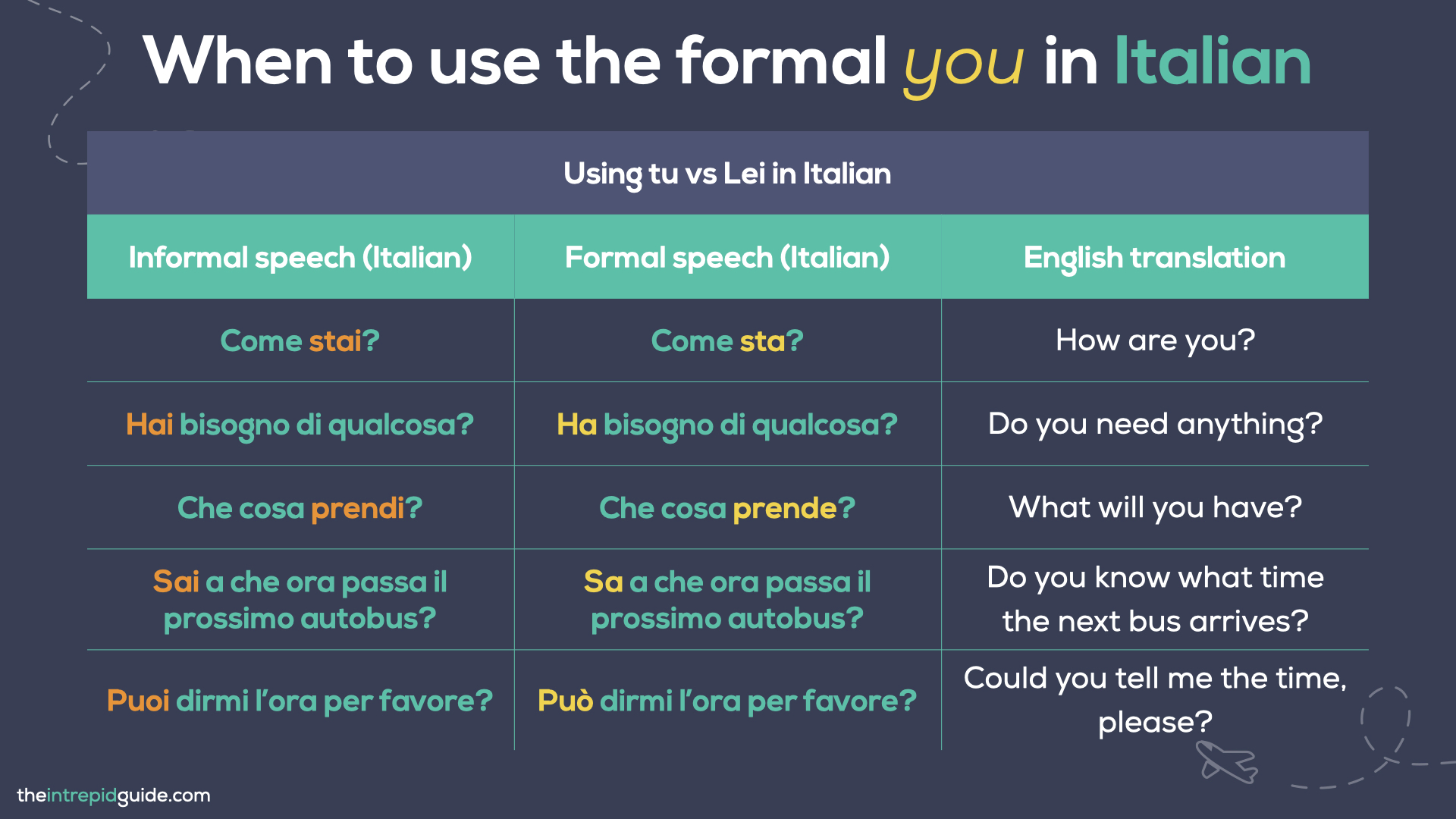
A very common, slightly more casual alternative you will hear is Come va?, which means "How's it going?". It is generally used in informal contexts.
Part 3: How to Respond
Now for the fun part: answering the question. Italians have a wide range of responses, from enthusiastic to non-committal. A simple Bene, grazie (Well, thank you) is always correct, but using a wider vocabulary will make you sound much more natural.
This video from Learn Italian with Lucrezia gives a fantastic overview of common, authentic responses.
How Italians commonly answer to "Come stai/va?" in informal conversation (sub)
Let's watch a video that showcases how Italians typically respond to 'Come stai?'. Lucrezia provides many natural-sounding options.
Watch from 01:17 to 03:20. In the first part (until 02:49), she covers positive responses. In the second part (from 02:49), she discusses more neutral or vague answers. Notice how the answer can change depending on whether the question was 'Come stai?' or 'Come va?'.
Here's a summary of some of the most useful responses, from positive to so-so:
| Italian Phrase | English Meaning | Nuance |
|---|---|---|
Benissimo! |
Really great! | Very enthusiastic. |
Tutto bene! |
Everything's fine! | A common, positive response. |
Tutto a posto. |
Everything's in order. | Informal, similar to "all good." |
Bene, grazie. |
Fine, thank you. | The standard, polite response. |
Non c'è male. |
Not bad. | A common, slightly understated positive. |
Così così. |
So-so. | Neutral. |
As Lucrezia mentions, how you answer often depends on who you're talking to. With a close friend, you might be more honest, but in a casual encounter, a simple Bene, grazie. E tu? (Fine, thanks. And you?) is perfect.
Part 4: Sounding More Natural — Tips and Common Mistakes
To go from a learner to a more natural-sounding speaker, it's often about the small things you don't say. This is where your interest in underlying rules and structures will be very helpful.
The Joy of Languages article has some excellent advice on common mistakes that learners make. Understanding why they are mistakes will help you avoid them.
How to answer COME STAI in Italian (and 3 common mistakes to avoid)
Let's return to our main article one last time to learn some pro tips and pitfalls to avoid.
Please read the sections 'Bonus tips to sound like a native' and 'Three mistakes to avoid when answering COME STAI'. Pay special attention to the distinction between the adverb 'bene' (well) and the adjective 'buono' (good). This is a key grammatical point.
Key Points to Remember:
- Drop
Io sto: WhileSto bene("I am well") is grammatically correct, native speakers usually just sayBene. It's like replying "Fine" instead of "I am fine" in English. Benevs.Buono: This is a classic stumbling block.Beneis an adverb that describes a verb (likestare).Buonois an adjective that describes a noun (likeun buon caffè). Since you are describing how you are, you must usebene.- Avoid
Va bene:Va beneis the correct response toCome va?(How's it going?), but as a reply toCome stai?, it sounds unnatural. More commonly,Va beneis used to mean "OK" or "Alright," to agree to something.
Test your understanding!
Imagine you are in Italy. Choose the best phrase for each situation.
-
You run into your friend, Luca, at the piazza. How do you ask him how he is?
a)Come sta?
b)Come stai?
c)Come va bene? -
Luca replies, "
Benissimo, grazie! E tu?" You're feeling pretty good. What's a natural, positive response?
a)Tutto a posto!
b)Buono, grazie.
c)Io sto bene. -
Later, you have a meeting with your new boss, Signora Ricci. How do you politely ask her how she is?
a)Come stai?
b)Prego?
c)Come sta? -
Someone asks you
Come stai?and you replyVa bene. Why might this sound strange?
a) It's too formal.
b) It's grammatically incorrect.
c) It sounds like you're saying "OK" or "Sure" rather than answering the question about your well-being.
Show answer
- b)
Come stai?- Luca is a friend, so the informaltuform is appropriate. - a)
Tutto a posto!- This is a natural, informal, and positive response.Buonois incorrect (adjective vs. adverb), andIo sto beneis less natural than simply sayingBeneor a similar phrase. - c)
Come sta?- Signora Ricci is your boss, so the formalLeiform is required. - c) It sounds like you're saying "OK" or "Sure" rather than answering the question about your well-being. While
va benecan be a response toCome va?, its most common use is to agree to something, which makes it an odd reply toCome stai?.
Conclusion
Complimenti! You've now completed the first module of our course. You can handle the first steps of any Italian conversation: greeting someone, introducing yourself, using courtesy phrases, and now asking how they are.
Key Takeaways:
- Ask "How are you?" with
Come stai?(informal) orCome sta?(formal). - The question uses the verb
stare, notessere. - Respond with phrases like
Bene, grazie(the standard),Benissimo!(great!), orNon c'è male(not bad). - To sound more natural, drop
stofrom your response and just sayBene. - Remember to use the adverb
bene(well) to describe how you are, not the adjectivebuono(good).
In our next lesson, we will begin a new module, "Core Sentence Building Blocks." We'll start by properly learning the subject pronouns (io, tu, lui/lei, etc.). You've already been seeing their effects on verbs like stare and chiamarsi, and now we will make that connection explicit. This will be the next step in building your ability to form your own sentences.
A presto