Ciao! Welcome back.
In our last lesson, you did a great job learning to count all the way to 100. This is a crucial foundation for so many practical situations. Today, we'll put that new knowledge to immediate use. Our goal is to ask for and understand prices, a skill that is absolutely essential for your goal of navigating Italy with confidence.
We'll cover how to ask for the price of a specific item, how to ask for the total bill at a café or shop, and, most importantly, how to understand the different ways an Italian might state the price.
1. How to Ask for the Price
There isn't just one way to ask "how much is it?". The phrase you use depends on the context: are you asking about a specific item on a shelf, or are you ready to pay for everything at the checkout?
A. Asking for the Price of a Specific Item: Quanto costa?
The most direct way to ask for the price of a single item is Quanto costa?. This literally means "How much does it cost?".
To get a feel for this phrase in a real context, let's watch a short video.
Learn How to Ask for a Price in Italian | Can Do #17
This video from ItalianPod101.com introduces the basic phrase for asking for a price. It's a great starting point.
Watch the first 3 minutes and 20 seconds of the video. Focus on how the speaker uses 'Quanto costa questo?' when pointing at an item.
As you saw, you can simply point to an object and ask:
Quanto costa questo?(How much does this cost?)
If you know the name of the item, you can be more specific:
Quanto costa un caffè?(How much does a coffee cost?)Quanto costa il biglietto?(How much does the ticket cost?)
What if you're asking about multiple items, like a pair of shoes? The verb costare (to cost) changes to its plural form, costano.
Quanto costano queste scarpe?(How much do these shoes cost?)
B. Asking for the Total Bill: Quant'è?
Now, imagine you've had your coffee and a pastry, and you're at the counter ready to pay. It would sound a bit unnatural to ask Quanto costa? here. Instead, you'll use a different phrase to ask for the total.
Quant'è? is a contraction of Quanto è? and it means "How much is it (in total)?". This is what you use when you're asking for the final bill.
This distinction is a key part of sounding natural when you speak. The following article explains this difference perfectly.
“Quanto costa” vs. “Quant'è” in Italian
The article '“Quanto costa” vs. “Quant'è” in Italian' from italki clearly breaks down when to use each phrase. This provides the grammatical clarity behind the practical phrases.
Read sections 1, 2, and 3. They explain the meaning of 'Quanto costa' (and its plural 'costano'), the meaning of 'Quant’è', and provide a very clear comparison with a shopping scenario. This will solidify your understanding.
To summarize the key distinction:
- Use
Quanto costa / costano?when asking for the price of a specific item or items. - Use
Quant'è?when asking for the total amount or bill at the point of payment. You can also sayQuant'è tutto?(How much is everything?).
Test your understanding!
For each scenario, which question would you use: Quanto costa?, Quanto costano?, or Quant'è?
- You are admiring a leather jacket in a shop window and want to know its price.
- You have finished your meal at a restaurant and want to pay.
- You are at a market stall and want to know the price of the lemons (plural:
i limoni).
Show answer
Quanto costa?(orQuanto costa questa giacca?- How much does this jacket cost?) You are asking about one specific item.Quant'è?You are asking for the total bill.Quanto costano?(orQuanto costano i limoni?) You are asking about multiple items.
C. A Quick Grammatical Note on Quanto
You might have noticed that in Quanto costa? and Quanto costano?, the word quanto doesn't change. Here, it's acting as an adverb modifying the verb ("How much does it cost?").
However, when quanto is used as an adjective to ask "how many" of a specific noun, it must agree in gender and number with that noun. Your experience with computer science might make you think of this as a variable type that has to match what it describes.
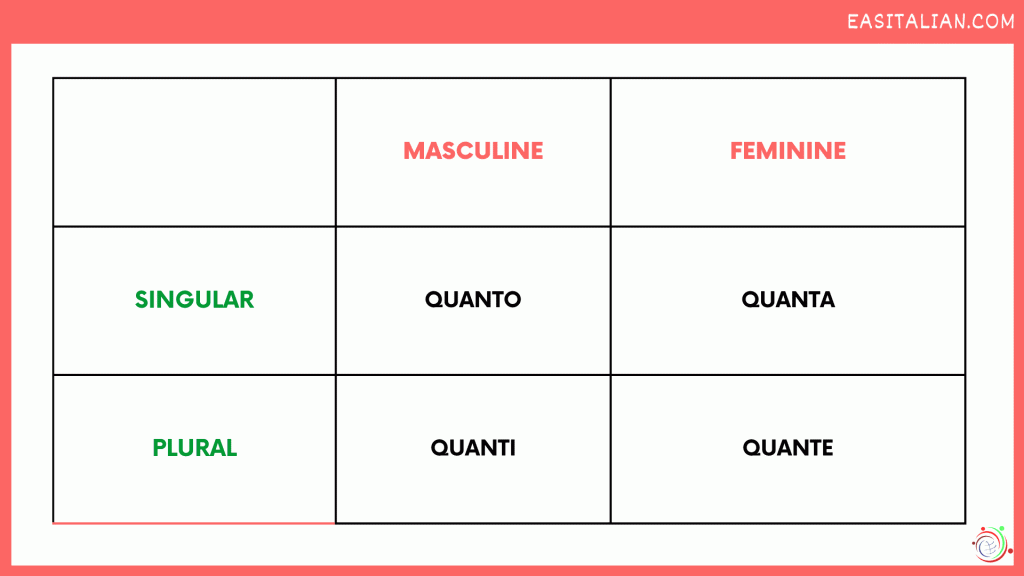
For example:
Quanti libri?(How many books?) -libriis masculine plural.Quante persone?(How many people?) -personeis feminine plural.
We won't go deep into this now, but it's useful to recognize why you see these different forms.
2. Understanding the Answer: Decoding Prices
You've asked the question, now comes the answer. Thanks to our last lesson, you know the numbers. Now let's look at the structure of how prices are said.
First, let's nail the pronunciation of the key words.
How to Say PRICES and MONEY in Italian Language + Euro Pronunciation | Italian Numbers
The video 'How to Say PRICES and MONEY in Italian' by Italy Made Easy has an excellent start on pronunciation.
Watch from the beginning to 01:15. Pay close attention to the pronunciation of 'euro' (E-U-RO) and 'centesimi' (chen-TEH-zee-mee).
Now that you can say euro and centesimi like a native, let's see how they're combined with numbers. There's the "long form" and, more importantly for casual conversation, the "short form".
Let's say something costs €12.30.
- Formal/Long Form:
Dodici euro e trenta centesimi.(Twelve euros and thirty cents.) - Common Form 1:
Dodici euro e trenta.(Twelve euros and thirty.) - Common Form 2 (most frequent):
Dodici e trenta.(Twelve and thirty.)
In a shop or café, you will almost always hear one of the shorter forms. The context makes it clear you're talking about money.
This next video explains these different forms very clearly.
How to Say PRICES and MONEY in Italian Language + Euro Pronunciation | Italian Numbers
Let's return to the Italy Made Easy video to see how these different price structures are used in practice.
Watch from 02:01 to 06:50. The video will first show prices with whole euros, then the 'proper' way to say prices with cents, and finally the much more common 'slangy' or shortened ways. This last part is the most important for your goal of casual conversation.
For example, the price for a coffee, €1.10, is almost always said as:
Uno e dieci(One and ten).
3. Putting it all together: A Dialogue
Let's see these phrases in a natural conversation. The italki article you read earlier has two perfect examples.
Scenario 1: At the Café
- You:
Buongiorno! Quanto costa un cappuccino?(Good morning! How much does a cappuccino cost?) - Barista:
Costa un euro e cinquanta.(It costs €1.50.) - You:
Bene. Allora prendo un cappuccino e una brioche.(Great. Then I'll have a cappuccino and a croissant.) - (After you finish, at the counter...)
- You:
Quant'è, per favore?(How much is it, please?) - Barista:
In totale sono tre euro.(In total it's €3.)
Notice the smooth transition from asking about a specific item (Quanto costa...) to asking for the total bill (Quant'è...). This is exactly how you'll use it in Italy.
Test your understanding!
You hear a shopkeeper say, "cinque e venti." What is the price?
Show answer
€5.20. (cinque = 5, venti = 20)
Conclusion
Eccellente! You are now equipped with one of the most practical skills for any traveler. You know not only how to ask for a price but also which question to use in the right context, and you can understand the answer even when it's said in a colloquial way.
Key Takeaways:
- Ask for a specific item's price with
Quanto costa?(singular) orQuanto costano?(plural). - Ask for the total bill with
Quant'è?. - Prices are usually stated in a shortened form:
[euro number] e [cent number], for example,due e cinquantafor €2.50. - The pronunciation of
eurois key:EH-oo-ro.
In our next lesson, we will continue using your knowledge of numbers as we learn to tell and ask for the time. You'll see that the patterns you learned today will be very helpful.
A presto