Ciao! Welcome back to your Italian course.
In our last lesson, we mastered asking for prices, using your knowledge of numbers up to 100. We saw how the verb essere (to be) shows up in phrases like Quant'è? (How much is it?) and Sono tre euro (They are three euros). We also practiced the [number] e [number] structure for prices like uno e dieci for €1.10.
Today, we'll see how those same concepts make learning to tell time in Italian surprisingly straightforward. Our goal is to ask for and tell the time, using phrases like Che ore sono? and Sono le due. This is another essential skill for your travels and for making social plans.
1. Asking for the Time: Che ora è? vs. Che ore sono?
Just like with prices, there are a couple of ways to ask for the time. You can use either Che ora è? (singular) or Che ore sono? (plural). Both mean "What time is it?" and are used interchangeably in conversation.
This might seem a bit odd. Why the two forms? It helps to understand the Italian words for "time".
Master how to tell the time in Italian with this fun guide
The article 'Master how to tell the time in Italian' from Berlitz has a great explanation for this. It clarifies the difference between 'tempo' (time as a concept) and 'ora' (hour, or clock time), which is key to understanding why we ask about 'hours'.
Read the section 'How to ask what the time is in Italian?'. Focus on the explanation of 'tempo' vs. 'ora' and the two main questions in the first table.
As the article explains, when you ask for the time on a clock, you are literally asking about the "hours" (ore). Since "hours" is a plural noun, Che ore sono? makes perfect logical sense. Che ora è? is just a common, slightly less literal variation.
2. Telling Time on the Hour
Now for the answer. The structure directly mirrors the plural question Che ore sono?. For any hour other than one o'clock, you use the plural form Sono le....
There are a few important exceptions for 1:00, noon, and midnight. Let's watch a video that breaks this down clearly.
Telling Time in Italian: The Ultimate Guide for Beginners | Super Easy Italian 30
The 'Super Easy Italian' video 'Telling Time in Italian' provides a fantastic, conversational overview of the basic rules.
Watch from 01:11 to 05:28. The video will cover: The basic structure 'Sono le...' (from 01:11). The exception for one o'clock, 'È l'una' (from 03:42). The special terms for noon and midnight, 'mezzogiorno' and 'mezzanotte' (from 04:33).
Let's recap the grammar, which you appreciate having clearly laid out:
-
For hours 2 through 12: Use
Sono le+[number].Sono le due.(It's two o'clock.)Sono le dieci.(It's ten o'clock.)- The structure is plural (
sono) because we are talking about multiple "hours" (ore, which is feminine plural, hence the articlele).
-
The 1 o'clock exception: Use
È l'una.Èis singular because we are talking about only one hour (un'ora).- The noun
orais feminine, so we use the feminine numberuna, notuno. l'unais a contraction ofla una.
-
Noon and Midnight: Use
È+ the specific word.È mezzogiorno.(It's noon.)È mezzanotte.(It's midnight.)- These are considered single points in time, so we use the singular
è.
Test your understanding!
How would you say the following times?
- It's 4:00.
- It's 1:00.
- It's 11:00.
- It's noon.
Show answer
Sono le quattro.È l'una.Sono le undici.È mezzogiorno.
At What Time? A che ora?
A related, and very useful, question is "At what time...?". For this, you use A che ora...?.
A che ora parte il treno?(At what time does the train leave?)A che ora mangiamo?(At what time do we eat?)
The answer uses the prepositions alle (at the) for plural hours and all' for the singular l'una.
Alle due.(At two.)All'una.(At one.)A mezzogiorno.(At noon.)
3. Telling Time with Minutes
Adding minutes works very similarly to how you stated prices. You use the word e (and) to add minutes in the first half of the hour and, most commonly, meno (minus) to subtract minutes from the next hour.
Let's return to the video to see this in action.
Telling Time in Italian: The Ultimate Guide for Beginners | Super Easy Italian 30
The same 'Super Easy Italian' video explains how to add and subtract minutes in a very intuitive way, using a clock face.
Watch from 05:28 to 08:19. The video will show you: How to add minutes using 'e', including 'un quarto' (a quarter) and 'mezza' (half) (from 05:28). How to subtract minutes from the next hour using 'meno' (from 06:33).
Here is a summary of the rules:
-
Minutes 1-30 (Past the hour): Use
e(and).Sono le dieci e cinque.(It's 10:05.)- Special phrases:
... e un quartofor 15 minutes past (a quarter past).Sono le dieci e un quarto.(10:15)... e mezzafor 30 minutes past (half past).Sono le dieci e mezza.(10:30)
-
Minutes 31-59 (To the hour): Use
meno(minus).- This is a common pattern in many European languages. You state the next hour and subtract the minutes.
Sono le undici meno venti.(It's 10:40 - literally "eleven minus twenty".)- Special phrase:
... meno un quartofor 15 minutes to (a quarter to).Sono le undici meno un quarto.(10:45)
You can also just state the minutes (e.g., Sono le dieci e quaranta), but using meno is very common and will help you sound more natural.
This image provides a great visual summary of these phrases.

4. Adding Context: AM/PM and the 24-Hour Clock
In casual conversation, Italians use a 12-hour clock. So how do you know if Sono le otto means 8 in the morning or 8 in the evening? You add a phrase to specify the time of day. AM and PM are not typically used.
How to Tell the Time: Italian Grammar Lesson 15
The article 'How to Tell the Time' from Think in Italian gives a clear list of these contextual phrases.
Read the short section titled 'AM and PM in Italian'. It lists the four main phrases you can add after the time.
The key phrases are:
di mattina– in the morningdel pomeriggio– in the afternoondi sera– in the eveningdi notte– at night
So, you would say:
Sono le otto di mattina.(It's 8:00 AM.)Sono le otto di sera.(It's 8:00 PM.)
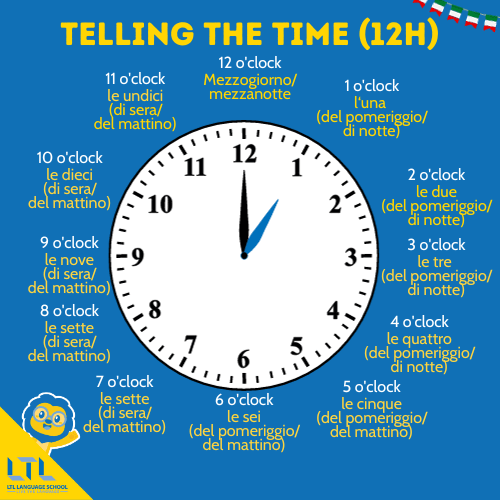
Of course, Italy also officially uses the 24-hour clock (l'orologio a 24 ore), especially for formal schedules like train timetables, TV guides, and business hours. In this case, you just read the number: Sono le diciassette (It's 17:00 / 5 PM). It's good to be familiar with it, but for your goal of casual conversation, the 12-hour system with context phrases is your priority.
Conclusion
Ottimo lavoro! You can now handle two of the most common questions you'll face when traveling: "How much is it?" and "What time is it?".
Key Takeaways:
- Ask for the time with
Che ore sono?orChe ora è?. - Answer with
Sono le...for most hours, but remember the exceptions:È l'una,È mezzogiorno, andÈ mezzanotte. - Add minutes with
e(e.g.,le due e dieci) and subtract them withmeno(e.g.,le tre meno dieci). - Use phrases like
e un quarto,e mezza, andmeno un quartofor common time markers. - Specify the time of day with
di mattina,del pomeriggio, ordi sera.
This lesson concludes our module on "Asking Questions & Getting By." You've built a solid foundation of practical phrases. In our next lesson, we will begin a new module, "Core Sentence Building Blocks," by taking a closer look at subject pronouns (io, tu, lui...). This will help you understand the structure of the sentences we've been using and give you the power to build your own.
A presto