Ciao! Welcome back.
In our last lesson, you mastered asking for and telling the time, which wrapped up our module on the essentials of getting by. You learned key phrases like Che ore sono? and the logic behind using Sono le due versus È l'una.
Today, we're opening a new, exciting chapter: Module 5: Everyday Actions: At the Café. This module is all about the practical language you'll need for one of Italy's most important social rituals. We'll start with the single most powerful tool for expressing actions: verbs. Your goal for this lesson is to learn how to conjugate regular -are verbs in the present tense. This is your first step toward moving beyond fixed phrases and starting to build your own sentences to say what you want to say.
1. Verbs and Conjugation: The Engine of Italian Sentences
So far, we've used verbs like essere (to be) mostly in set phrases. But to express a new action, like "I speak" or "they eat," you need to know how to adapt the verb to the person performing the action. This process is called conjugation.
In English, we do this too, but it's very simple (e.g., I speak, you speak, he/she speaks). In Italian, the verb ending changes for almost every subject. While this sounds complex, it's highly regular.
Italian verbs are typically grouped into three categories based on the ending of their dictionary form (the infinitive):
- Verbs ending in
-are(e.g.,parlare- to speak) - Verbs ending in
-ere(e.g.,prendere- to take) - Verbs ending in
-ire(e.g.,dormire- to sleep)
The great news is that the -are group is the largest and most regular. Once you learn the pattern for one, you've learned it for thousands.
Italian Present Tense (part 1) - Beginner Italian Course: Lesson 11
To start, let's watch a segment from the 'Italy Made Easy' channel. The instructor, Manu, gives an excellent overview of what conjugation means and why the Italian present tense is so versatile.
Watch from 00:52 to 05:04. Pay attention to: The concept of conjugation and the three verb groups. The many situations where the Italian present tense is used (it covers more ground than in English!).
As Manu explains, mastering the present tense is incredibly useful because it's used for things happening now, general truths, and even for future plans.
2. The -are Verb Pattern: A Simple Formula
The process of conjugating a regular -are verb is logical and consistent. Given your background, you can think of it as a simple algorithm:
- Start with the infinitive (e.g.,
parlare). - Remove the
-areending to find the stem (parl-). The stem carries the verb's meaning. - Add the correct ending based on the subject (who is doing the action).
Here are the present tense endings for regular -are verbs:
| Subject Pronoun | Ending | Example: parlare (to speak) |
|---|---|---|
| io (I) | -o | (io) parlo |
| tu (you) | -i | (tu) parli |
| lui/lei/Lei (he/she/you formal) | -a | (lui/lei) parla |
| noi (we) | -iamo | (noi) parliamo |
| voi (you all) | -ate | (voi) parlate |
| loro (they) | -ano | (loro) parlano |
A note on pronunciation: For the loro form, notice the stress is on the stem, not the ending: PAR-la-no, not par-la-NO.
This table gives a great visual overview. For now, just focus on the first column for -are verbs like parlare.
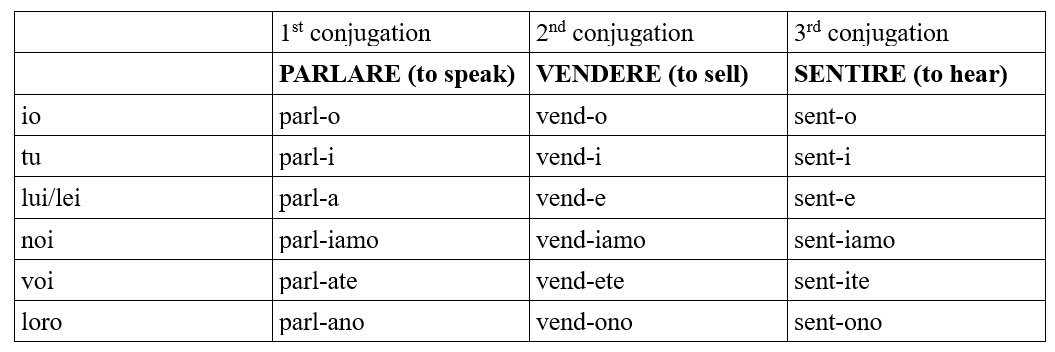
Let's see this pattern applied to a few more verbs.
Italian Present Tense (part 1) - Beginner Italian Course: Lesson 11
Let's return to the 'Italy Made Easy' video. Manu will walk you through the conjugation of 'parlare' in detail, with some helpful memory aids, and then apply the same rules to other verbs.
Watch from 05:04 to 16:10. This is the core of the lesson. Focus on: How to find the stem (from 05:04). The specific endings for each subject and the mnemonics he suggests (from 09:17). How the same pattern applies to 'cantare' (to sing) and 'pensare' (to think) (from 14:17).
3. Let's Practice Together
Now that you've seen the rule, let's apply it. Two verbs that will be very useful in this module are mangiare (to eat) and comprare (to buy).
Example 1: mangiare (to eat)
- Stem:
mangi- - io mangio (I eat)
- tu mangi (you eat)
- lui/lei mangia (he/she eats)
- noi mangiamo (we eat)
- voi mangiate (you all eat)
- loro mangiano (they eat)
Notice with mangiare, the stem ends in i. When the ending also starts with i (for tu and noi), you don't write a double ii. So, tu mangi (not mangii) and noi mangiamo (not mangi-iamo).
Example 2: comprare (to buy)
Let's confirm the conjugation for comprare with a quick reading.
Learn Hardcore Italian: Io compro il burro al mercato.
This brief Q&A from Elon.io directly provides the full present tense conjugation for 'comprare' (to buy).
Read only the answer to the second question: 'What tense and person is the verb compro in, and how is it related to the verb comprare?'.
Test your understanding!
Let's try a new verb: lavorare (to work). How would you conjugate it for the following subjects?
- io (I work)
- lei (she works)
- noi (we work)
- loro (they work)
Show answer
The stem is lavor-.
- (io) lavoro
- (lei) lavora
- (noi) lavoriamo
- (loro) lavorano
4. A Minor Rule Adjustment: Verbs ending in -care and -gare
There is one small, but important, spelling rule to know for -are verbs. Verbs whose stem ends in c or g (like pagare - to pay, or cercare - to search for) need a slight change to keep their "hard" sound.
Remember from our pronunciation lesson that c and g are hard (like in "car" and "go") before a, o, u, but soft (like in "cello" and "gel") before e and i.
To keep the hard sound in the tu (-i) and noi (-iamo) forms, an h is added.
cercare(to search for) -> tu cerchi (you search), noi cerchiamo (we search)pagare(to pay) -> tu paghi (you pay), noi paghiamo (we pay)
All other forms are regular (io pago, lei paga, voi pagate, loro pagano).
Italian Present Tense | Presente Indicativo Italiano | Master the verbs!
The channel 'Learn Italian with Francesca' has a very clear and quick explanation of this rule.
Watch from 03:29 to 04:41. She uses the example 'pagare' to demonstrate how and why the 'h' is added for the 'tu' and 'noi' forms.
This is a phonetic spelling rule more than a grammar one. You'll get the hang of it quickly as you see more verbs.
Conclusion
Ottimo! You've just unlocked a fundamental piece of Italian grammar. By learning this one pattern, you can now correctly use thousands of verbs.
Key Takeaways:
- Italian verbs are conjugated, meaning their endings change based on the subject.
- The largest and most regular group of verbs are
-areverbs. - To conjugate them, you remove
-areto find the stem and add one of six endings: -o, -i, -a, -iamo, -ate, -ano. - For verbs ending in
-careand-gare, add anhto thetuandnoiforms to preserve the hard sound (e.g.,paghi,paghiamo). - Practice by making small, real sentences (
(io) parlo italiano) rather than just drilling lists of verbs.
In our next lesson, we will put this new skill to immediate use. We'll start learning how to recognize common food and drink items from a menu. You'll be able to say things like (Io) mangio la pasta (I eat pasta) and understand what you're ordering at the café.
A presto