Ciao! Welcome back to your Italian studies.
In the last lesson, we learned how to ask for information using key question words like Dove? (Where?), Quando? (When?), and Quanto? (How much?). You can now confidently ask Quanto costa? in a shop, which is a fantastic step towards your goal of navigating Italy.
Today, we'll focus on understanding the answer. This lesson is dedicated to learning how to count from 0 to 100. Having a solid grasp of numbers is essential not just for prices, but also for telling time, understanding addresses, and exchanging phone numbers. We'll start with the basics (0-20), then uncover the simple patterns—and important exceptions—for building all the numbers up to one hundred.
1. The Building Blocks: Numbers 0 to 20
The numbers from 0 to 20 are the foundation. Many of them are irregular, so they require some memorization. Let's break them down.
Numbers 0-10
First, the absolute essentials.
- 0 - zero
- 1 - uno
- 2 - due
- 3 - tre
- 4 - quattro
- 5 - cinque
- 6 - sei
- 7 - sette
- 8 - otto
- 9 - nove
- 10 - dieci
A quick note on uno (1): as you might guess from your knowledge of indefinite articles (un, uno, una), the word for "one" changes depending on what you're counting. The video below explains this clearly.
How to Count to 100 in Italian | Super Easy Italian 20
The video 'How to Count to 100 in Italian' from the Easy Italian channel provides a great explanation for the number 'one'.
Watch from the beginning to 01:25. The host explains the difference between using 'uno' when counting abstractly, and 'un' or 'una' when counting specific masculine or feminine objects (e.g., 'un microfono', 'una macchina').
Numbers 11-20
The "teen" numbers are also mostly irregular.
- 11 - undici
- 12 - dodici
- 13 - tredici
- 14 - quattordici
- 15 - quindici
- 16 - sedici
- 17 - diciassette
- 18 - diciotto
- 19 - diciannove
- 20 - venti
Notice a pattern shift? From 11 to 16, the single digit comes first (e.g., quattro -> quattordici). From 17 onwards, the "ten" (dici-) comes first (diciassette). Recognizing this small change can help with memorization.
Now, let's hear all these numbers to get the pronunciation right.
Italian Number 1 to 100 - CORRECT PRONUNCIATION (Italian native speaker)
The video 'Italian Number 1 to 100' from Italy Made Easy is perfect for pronunciation practice. The presenter says each number slowly and clearly.
Watch from 01:40 to 02:20 to hear the numbers from 1 to 20. Repeat each number out loud after the speaker.
2. The Pattern: Numbers 21 to 100
Great news! Once you know the numbers 1-9 and the tens, you can construct almost any number up to 100.
First, learn the tens:
- 20 - venti
- 30 - trenta
- 40 - quaranta
- 50 - cinquanta
- 60 - sessanta
- 70 - settanta
- 80 - ottanta
- 90 - novanta
- 100 - cento
The general rule is simple: combine the ten and the unit into one word.
trenta(30) +due(2) =trentadue(32)quaranta(40) +cinque(5) =quarantacinque(45)sessanta(60) +nove(9) =sessantanove(69)
However, there are two important exceptions to this rule. As someone with a background in programming, you can think of these as "if-then" conditions for pronunciation.
Exception 1: Numbers ending in uno (1) or otto (8)
When a ten (venti, trenta, quaranta, etc.) is combined with uno or otto, the final vowel of the ten is dropped. This makes the number flow more smoothly.
venti+uno→ventuno(21) (NOTventiuno)trenta+otto→trentotto(38) (NOTtrentaotto)cinquanta+uno→cinquantuno(51)ottanta+otto→ottantotto(88)
This next video explains this rule very effectively.
How to Count to 100 in Italian | Super Easy Italian 20
Let's return to the Easy Italian video. The presenter clearly demonstrates this vowel-dropping rule.
Watch from 04:38 to 05:45. Pay close attention to how 'venti uno' becomes 'ventuno' and 'venti otto' becomes 'ventotto', and how this rule applies to all the following tens.
Exception 2: Numbers ending in tre (3)
When a number ends in tre, an accent is added to the e (tré). This indicates that the final syllable should be stressed.
venti+tre→ventitré(23)quaranta+tre→quarantatré(43)settanta+tre→settantatré(73)
For a clear written explanation of both exceptions, the following resource is very helpful.
Numbers from 1 to 100 in Italian
The article 'Numbers from 1 to 100 in Italian' from Woodward Italian provides a concise summary of these two important rules.
Read the section titled 'Numbers from 20 to 100 in Italian'. Focus on the two 'EXCEPTION' callouts for numbers ending in 1/8 and 3.
3. Putting It All Together: Practice and Reference
You now have all the rules! The final step is to practice and make it automatic. Below is a complete chart for quick reference.
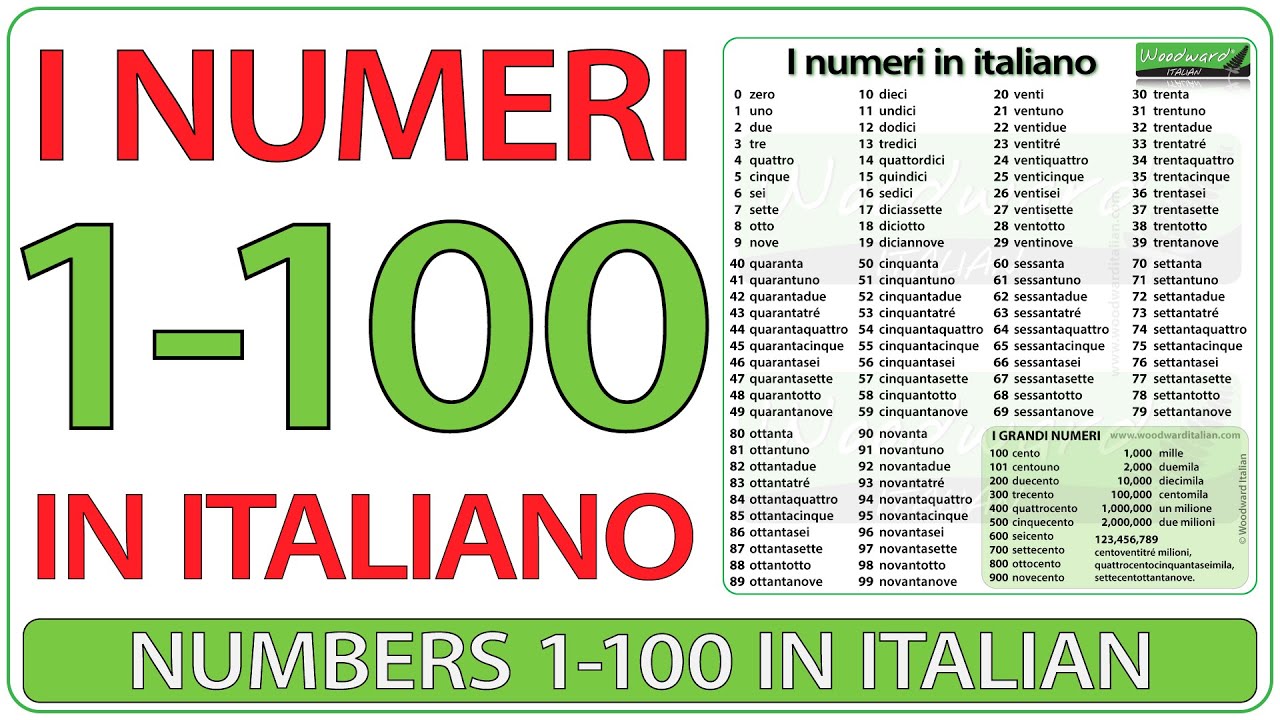
To truly master the numbers, you need to hear them and say them. Let's go back to the Italy Made Easy video and listen to the full sequence.
Italian Number 1 to 100 - CORRECT PRONUNCIATION (Italian native speaker)
This is your main pronunciation workout. Listen and repeat as the presenter counts all the way to 100.
First, listen from 01:40 to 06:15 as the presenter counts slowly. Try to say the numbers along with him. Then, for a challenge, listen from 06:15 to 08:28 where he counts at a more natural, faster pace.
Test your understanding!
Write the following numbers in Italian words. Pay attention to the exceptions!
- 28
- 43
- 51
- 76
- 98
Show answer
ventotto(vowel is dropped)quarantatré(accent is added)cinquantuno(vowel is dropped)settantasei(standard rule)novantotto(vowel is dropped)
Conclusion
Ottimo lavoro! You have now learned the system for counting all the way to 100 in Italian. This is a fundamental skill that opens up many new conversational possibilities.
Key Takeaways:
- Numbers 0-20 are mostly irregular and need to be memorized.
- For 21-99, you generally combine the ten with the unit (e.g.,
trenta+due=trentadue). - Rule 1: When adding
uno(1) orotto(8), drop the final vowel of the ten (ventuno,ventotto). - Rule 2: When adding
tre(3), add an accent to the finale(ventitré).
In our previous lesson, you learned to ask Quanto costa?. Now, you can understand the answer! In our next lesson, "Ask for and understand prices," we will combine these skills and practice the complete transaction, from asking the price to handing over the correct amount.
A presto