Introduction
In our previous lesson, we mapped the three strategic domains of financial regulation: financial crime compliance, data privacy, and operational resilience. We established that for a technology leader, these are not abstract legal concepts but direct drivers of system architecture, risk management, and business strategy. We now turn our attention to the second of these pillars—data privacy—to examine one of the most influential and far-reaching regulations in the world.
This lesson will provide a detailed look at the European Union's General Data Protection Regulation (GDPR). Our goal is to move beyond a surface-level summary and understand its core principles and its profound impact on how financial institutions must manage customer data. For anyone aspiring to a leadership role at the intersection of technology and finance, mastering GDPR is non-negotiable. It dictates how you design products, what data you can use for analytics and AI, and the governance structures required to demonstrate compliance and avoid severe penalties.
What is GDPR and Why it Matters in Finance?
The General Data Protection Regulation (GDPR) is the EU's landmark framework for protecting the personal data and privacy of its residents. A critical point for any global financial institution or FinTech is its extraterritorial scope: the regulation applies to any company that processes the personal data of EU residents, regardless of where the company itself is located. An Indian FinTech firm with customers in Germany, for example, is subject to GDPR.
Financial institutions are particularly scrutinized under GDPR because the data they process—account details, identification documents, transaction records, and even biometric information—is considered highly sensitive and high-risk. This places a greater burden of responsibility on these firms to ensure their data handling practices are transparent, secure, and lawful.
The following reading explains why GDPR is not just a compliance hurdle but a core strategic consideration for building trust and navigating the dual layers of financial and data protection regulation.
GDPR for Financial Services: Best Practices for Compliance
This article from InnReg sets the stage by explaining GDPR's specific relevance to the financial services industry.
Please read the first two main sections. Start with "What GDPR is and Why it Matters in Financial Services" to grasp the regulation's scope and why financial data is considered high-risk. Then, continue to the section Why the GDPR Matters for Fintechs?, which explains the dual regulatory scrutiny these companies face.
As the article notes, for innovative FinTechs that leverage customer data for services like AI-driven lending or personalized financial products, GDPR's requirements move from a background concern to a central design constraint.
The Seven Core Principles of GDPR
The entire GDPR framework is built upon seven fundamental principles articulated in Article 5 of the regulation. These principles are not just a checklist; they are the guiding philosophy that must inform every activity involving personal data. As a technology leader, your systems, processes, and policies must all be designed to uphold them.
The infographic below provides a high-level overview of these seven principles.
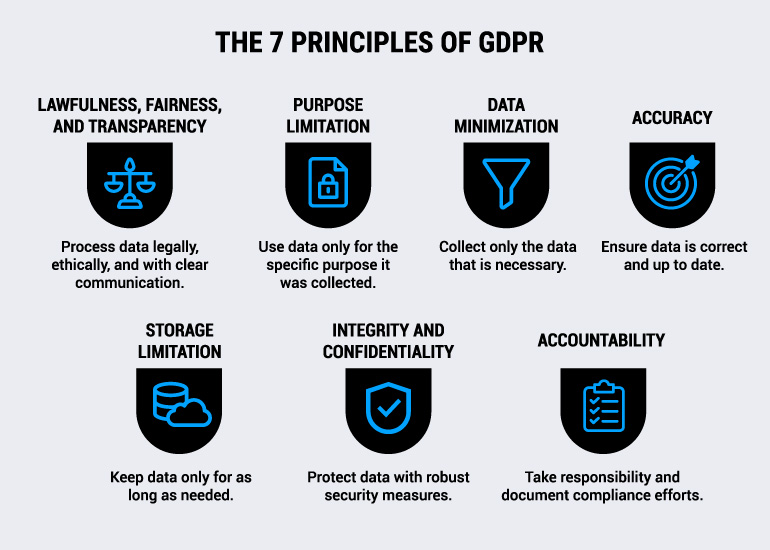
To understand what these principles mean in practice, the following video offers a clear and concise explanation of each one.
What are the 7 principles of GDPR?
This video from the Privacy Kitchen channel breaks down each of the seven principles in an accessible way.
Please watch the segments explaining each of the core principles: Lawfulness, Fairness, and Transparency: This principle requires you to have a legal basis for processing data and to be open about it. Purpose Limitation: This principle means you can only use data for the specific, declared purpose you collected it for. Data Minimization: This principle dictates that you should only collect data that is strictly necessary. Accuracy: This principle requires data to be kept correct and up-to-date. Storage Limitation: This principle states you must not keep personal data for longer than needed. Integrity and Confidentiality (Security): This principle is the requirement to secure the data. Accountability: This final principle holds you responsible for demonstrating compliance with all the others.
The Accountability principle is the most significant addition brought by GDPR compared to previous directives. It fundamentally shifts the burden of proof. It's no longer sufficient to be compliant; you must be able to demonstrate compliance through documentation, audits, and well-defined governance. This is where your interest in governance becomes critical. Accountability transforms technical controls and privacy policies from static documents into a living, auditable management system.
Impact on Customer Data Management: Rights and Obligations
These principles are not just abstract ideals; they grant specific, enforceable rights to individuals and place concrete obligations on organizations. From a system design and operational standpoint, this is where the regulation's impact is most keenly felt.
The diagram below summarizes the key rights GDPR provides to individuals, often called "data subjects."

Let's explore what these rights mean for a financial institution.
Data Subject Rights and Their Challenges
Implementing processes to handle these rights is a significant operational and technical task. For instance, the Right of Access and Right to Data Portability mean your systems must be capable of collating and exporting all the personal data you hold on a specific customer in a "structured, commonly used, and machine-readable format." This has direct implications for database design and API development.
Perhaps the most challenging right is the Right to Erasure (also known as the "right to be forgotten"). A customer can request that you delete their personal data. For a bank or FinTech, this creates an immediate conflict with other regulations.
GDPR for Financial Services: Best Practices for Compliance
This article highlights the practical difficulties that arise when data subject rights meet the complex realities of financial regulation.
First, read the section on Data Subject Rights to understand the general challenge. Then, focus on the specific conflict described in the subsection Recordkeeping vs. Right to Erasure Conflicts. This explains how Anti-Money Laundering (AML) laws, which mandate data retention for several years, clash with deletion requests.
This conflict between data deletion rights and data retention mandates is a perfect illustration of the complex legal environment you must navigate. A technology leader can't simply build a "delete user" function. The system must be intelligent enough to distinguish between data that can be deleted (e.g., marketing preferences) and data that must be retained for legal reasons (e.g., transaction records for AML compliance).
Operationalizing GDPR Compliance
Knowing the principles and rights is the first step. The next is embedding them into your organization's DNA. This involves a combination of technical design, legal process, and governance.
Privacy by Design
A core tenet of GDPR is "Privacy by Design and by Default." This means privacy cannot be an afterthought. It must be integrated into the design and architecture of your systems from the very beginning. For someone with a background in UI/UX and computer science, this concept should be familiar—it's essentially user-centered design, but with a focus on privacy. This includes:
- Limiting data collection to only what is essential for a feature to work.
- Setting the most privacy-friendly options as the default for any new service.
- Conducting Data Protection Impact Assessments (DPIAs) for high-risk projects, such as launching a new AI-based credit scoring model.
Defining Roles: Data Controller vs. Data Processor
GDPR defines two key roles for organizations handling data: Data Controller and Data Processor. The distinction is crucial for defining responsibility and liability, especially when working with third-party vendors and partners.
- A Data Controller determines the "purposes and means" of the processing. It's the entity that decides why and how personal data should be processed. A bank is typically the controller for its customers' data.
- A Data Processor processes personal data on behalf of the controller. A cloud hosting provider (like AWS) or a third-party KYC verification service are classic examples of processors.
Understanding these roles is fundamental to vendor risk management. When a FinTech partners with other companies, it's essential to legally define who is the controller and who is the processor, as this dictates contractual obligations and liability in case of a breach.
[PDF] GDPR Compliance in Fintech: Defining Roles and Contractual ...
This legal insight from Tsibanoulis & Partners provides clear definitions of these roles using examples directly relevant to the FinTech ecosystem.
Please read the first two sections of this document. The section on Data Controllers & Processors defines the primary roles. The following section on Joint vs. Independent Controllers explains more complex partnership scenarios, such as those found in open banking.
Conclusion
In this lesson, we dissected the GDPR, moving from its high-level purpose to its foundational principles and practical consequences for customer data management in financial services. Understanding GDPR is a cornerstone of modern technology leadership in finance, blending legal requirements with technical architecture and strategic governance.
Key Takeaways:
- GDPR's Core Principles: The regulation is built on seven principles: Lawfulness, Fairness, and Transparency; Purpose Limitation; Data Minimization; Accuracy; Storage Limitation; Integrity and Confidentiality (Security); and Accountability.
- Accountability is Key: GDPR requires organizations not only to comply but to be able to demonstrate compliance, making governance, documentation, and auditable processes essential.
- Impact on System Design: Individual rights, such as the right to access, portability, and erasure, create significant technical challenges and must be considered from the initial stages of product development ("Privacy by Design").
- Balancing Competing Obligations: Financial institutions must constantly balance GDPR requirements (like the right to erasure) with other regulatory mandates (like AML data retention), requiring sophisticated, rule-based systems.
- Controller vs. Processor: This distinction is fundamental to defining responsibility and liability in the complex, interconnected FinTech ecosystem.
In our previous lessons, we identified threat vectors and mapped the regulatory landscape. Now, having explored a key privacy regulation, our next lesson will examine a regulation designed to promote data sharing: the Revised Payment Services Directive (PSD2). We will explore how PSD2 enables open banking and analyze its profound implications for FinTech architecture and security, setting up the fascinating tension between data protection and data access.