Introduction
In our last lesson, we explored the General Data Protection Regulation (GDPR), a framework centered on protecting customer data and limiting its use. We now pivot to a regulation that, in many ways, represents the other side of the coin: the Revised Payment Services Directive (PSD2). Where GDPR locks data down, PSD2 mandates that it be securely opened up. This lesson examines the purpose of this pivotal open banking regulation and unpacks its profound implications for FinTech architecture and security.
For a technology leader, understanding the interplay between data protection (GDPR) and data access (PSD2) is fundamental. It defines the central strategic challenge of modern finance: how to foster innovation through data sharing while upholding the highest standards of security and privacy. This lesson will equip you with the foundational knowledge of PSD2, moving beyond compliance to see it as an engineering and strategic driver of the entire FinTech ecosystem.
The Purpose of PSD2: Security and Innovation
At its core, PSD2 is a European Union directive designed to achieve two primary goals. The first is to make payments safer and more secure. The second is to promote innovation and competition by breaking the traditional banks' monopoly on customer account data and payment services.
To achieve this, PSD2 legally obligates banks—referred to in the regulation as Account Servicing Payment Service Providers (ASPSPs)—to grant secure access to customer data for licensed Third-Party Providers (TPPs) via open Application Programming Interfaces (APIs).
The following reading provides a concise overview of PSD2's purpose and the strategic opportunity it created.
FinTech Development for Open Banking: Building PSD2-Compliant API Infrastructure - 6B
This article from 6B Finance explains how PSD2 mandates secure access to customer data and payments, aiming to enhance consumer protection while stimulating innovation.
Please read the introductory section, "Understanding PSD2 and the Strategic Opportunity of Open Banking." Pay close attention to how it frames the directive as creating a "new infrastructure layer in the financial ecosystem."
This "new infrastructure layer" enabled the rise of two new categories of regulated FinTech players, fundamentally changing the financial services landscape.
The New Players: AISPs and PISPs
PSD2 formally defines and regulates two key types of Third-Party Providers (TPPs) that can access bank infrastructure:
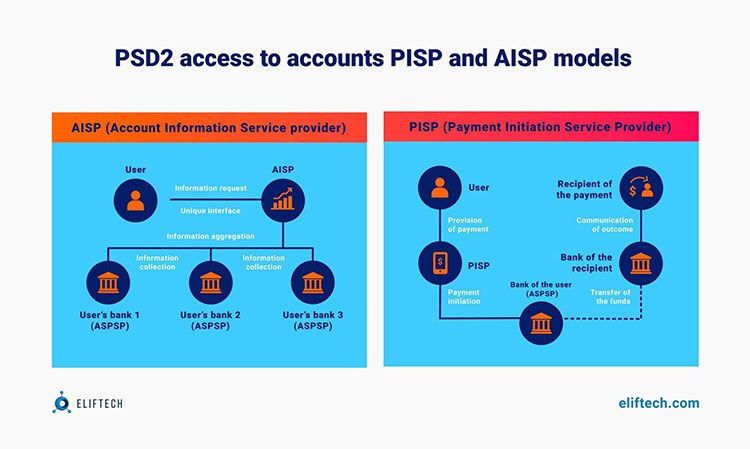
- Account Information Service Providers (AISP): These are services that, with the user's consent, can retrieve account data from one or more banks. This allows them to provide customers with a consolidated view of their finances, analytics on their spending, or financial advice. Think of a budgeting app that pulls in transaction data from your various bank accounts.
- Payment Initiation Service Providers (PISP): These services can, with the user's consent, initiate a payment directly from the user's bank account to a merchant or another individual. This allows for direct bank-to-bank payments, bypassing traditional card networks.
The diagram below illustrates the flow for both models. Given your background in UI/UX, you'll appreciate how these models introduce new user journeys that disintermediate the bank's direct interface.
These two models are the engine of open banking, and their existence has massive implications for the underlying technology architecture.
Implications for FinTech Architecture
PSD2 is far more than a legal hurdle; it's a deep engineering challenge that dictates how financial systems are designed and built. From a technology leader's perspective, it's crucial to view PSD2 integration as a core architectural problem.
PSD2 Integration for CTOs: Real-World Challenges and Architecture Insights | Scaler
This article from Scaler Agency effectively frames PSD2 as an "engineering problem" rather than just a compliance task, which is the correct strategic viewpoint for a technology leader.
Please read the introduction and the first section, "It’s Not Just About Compliance — It’s an Engineering Problem." This sets the stage for understanding the technical complexity involved.
The architectural blueprint for an open banking platform is complex, involving multiple layers to handle security, communication, and integration. The diagram below provides a high-level view.

Let's break down some of the key architectural components and considerations that arise directly from PSD2's requirements:
- API Gateway: As seen in the diagram, this is the gatekeeper. It handles incoming requests from TPPs, enforcing security policies, managing traffic (rate limiting), and routing requests to the correct internal services. It's the front door to the bank's core systems.
- Abstraction Layer: PSD2 standards are fragmented across Europe (e.g., Berlin Group, STET, UK Open Banking). A FinTech aiming to operate across markets cannot afford to build bespoke integrations for every single bank. A critical architectural pattern is to build an abstraction layer that normalizes these different API standards into a single, canonical internal format. This allows your core business logic to remain clean and agnostic of which bank API it is communicating with.
- Observability: When you provide an API, you are providing a product with an implicit service level agreement (SLA). PSD2 regulators mandate minimum performance and availability. Therefore, robust monitoring, logging, and distributed tracing are not optional; they are essential for compliance, debugging, and maintaining trust with TPPs.
- Consent Management Service: A dedicated, auditable service to manage the lifecycle of customer consent (granting, renewing, revoking) is a central architectural component. This service must track precisely what data a user has consented to share, with which TPP, and for how long.
Security Implications of PSD2
While fostering innovation, PSD2's primary goal is to enhance security. This introduces several non-negotiable security requirements that have become pillars of modern FinTech security architecture.
Strong Customer Authentication (SCA)
The most significant security mandate in PSD2 is Strong Customer Authentication (SCA). It requires authentication using at least two of the following three independent factors:
- Knowledge: Something only the user knows (e.g., a password or PIN).
- Possession: Something only the user possesses (e.g., their mobile phone, verified via a one-time code or app notification).
- Inherence: Something the user is (e.g., a fingerprint or facial recognition).
This short video provides a clear, concise explanation of SCA and its scope.
This video from Adyen explains the purpose of PSD2, its scope, the concept of Strong Customer Authentication (SCA), and the consequences of non-compliance.
Watch the full video. Pay attention to its explanation of SCA factors here and the examples of compliant technologies like 3D Secure and digital wallets here.
From an architectural standpoint, implementing SCA is a major challenge. It involves complex user redirection flows using protocols like OAuth 2.0 and OpenID Connect (OIDC). For payments, it also requires dynamic linking, where the authentication process cryptographically binds the authentication to the specific transaction amount and payee, preventing man-in-the-middle manipulation.
Common and Secure Communication
PSD2 mandates that all communication between TPPs and banks must be secure. This goes beyond standard web security. The regulation requires:
- A dedicated API interface: Banks cannot just allow TPPs to use the same channels as their retail customers (like screen scraping). They must provide robust, dedicated APIs.
- Mutual TLS (mTLS): Both the TPP and the bank must cryptographically prove their identity to each other.
- eIDAS Certificates: To facilitate this, TPPs must use special digital certificates defined under the EU's eIDAS regulation. There are two types:
- QWAC (Qualified Website Authentication Certificate): Used to identify the TPP and secure the communication channel.
- QSealC (Qualified Electronic Seal Certificate): Used to "seal" data or requests, ensuring their integrity and origin.
Validating these certificates in real-time is a critical security function, often handled by the API Gateway or a dedicated microservice.
The following reading delves into the architectural and security challenges, including SCA and certificate management, from a CTO's perspective.
PSD2 Integration for CTOs: Real-World Challenges and Architecture Insights | Scaler
This article provides a practical, engineering-focused look at the hardest parts of PSD2 implementation.
Please read the following three sections: Identity, Consent, and SCA: This explains why SCA is so challenging, touching on OAuth2 and the consent lifecycle. TPP Enablement: Focus on the role of eIDAS certificates (QWAC/QSealC). Best Practices for Architecture: This summarizes key architectural patterns for a robust system.
Finally, it's important to place these specific PSD2 security measures within the broader context of general API security.
Explaining Open Banking and API Security
This F5 DevCentral video provides an excellent high-level overview of the security layers needed to protect open banking APIs.
Watch the section from the architectural diagram through the discussion of bot protection. This will help you connect specific PSD2 controls to standard cybersecurity tools like Web Application Firewalls (WAFs), rate limiting, and payload validation. Then, watch the final part on the importance of authentication and a central control plane.
Conclusion
This lesson has dissected the purpose and impact of PSD2, a regulation that has fundamentally reshaped the architecture and security posture of the European financial industry. It acts as a powerful catalyst for innovation by mandating data access, but balances this with stringent security requirements. For a technology leader, mastering PSD2 is not about memorizing articles of a directive; it's about understanding its deep-seated influence on system design, security strategy, and competitive positioning.
Key Takeaways:
- PSD2's Dual Purpose: It aims to simultaneously increase payment security and foster competition and innovation through open APIs.
- New Roles, New Architecture: PSD2 created the regulated roles of AISP and PISP, driving an architectural shift towards API-centric, modular, and observable platforms.
- SCA is Paramount: Strong Customer Authentication is the cornerstone of PSD2 security, requiring multi-factor authentication and creating significant implementation challenges around user experience and technical flows (OAuth 2.0, dynamic linking).
- Secure Communication is Mandatory: Open banking relies on secure, dedicated API interfaces protected by mutual authentication using eIDAS certificates (QWACs and QSealCs).
- From Compliance to Strategy: A mature approach to PSD2 treats it not as a compliance task but as the foundation for a scalable, resilient, and future-proof platform strategy that can evolve towards Open Finance.
So far in this module, we have mapped the overall regulatory landscape and taken a deep dive into two key—and somewhat conflicting—regulations: GDPR for data protection and PSD2 for data access. We now have a solid understanding of what the rules are. In the next module, we will begin exploring how organizations build systems to comply with them by examining industry-standard Governance, Risk, and Compliance (GRC) Frameworks like the NIST Cybersecurity Framework and ISO 27001.