Introduction
In our last lesson, we surveyed the landscape of cybersecurity threats targeting financial institutions, from social engineering and ransomware to sophisticated attacks on APIs and the supply chain. We now understand the adversaries and their methods. However, a financial institution's defense strategy isn't crafted in a vacuum; it is shaped and compelled by a dense, intricate web of legal and regulatory obligations. Understanding this framework is paramount for any technology leader, as it dictates the "must-do's" that underpin all security and risk decisions.
This lesson will categorize the primary domains of financial regulation that a technology leader must navigate. We will move beyond a simple list of laws to understand the strategic purpose behind them. Our focus will be on three core pillars: financial crime compliance, data privacy and cybersecurity, and the increasingly critical field of operational resilience. For you, at the intersection of technology, business, and security, this is about learning to translate regulatory mandates into concrete technology strategies, risk management frameworks, and resilient product designs.
The Rationale for Regulation
Financial services are among the most heavily regulated industries in the world, and for good reason. The stability of the entire economy, the protection of consumer savings, and the integrity of global commerce depend on it. When compliance fails, the consequences are severe, extending far beyond a slap on the wrist.
11 Cyber-Security Compliance Regulations for Financial Services
This article from Metomic provides a concise summary of why compliance is not just a legal hurdle but a core business necessity.
Please read the introductory sections, starting with the bulleted list of core regulations and focusing on the section titled "Why Is Compliance Essential in Financial Services?". This will frame our discussion by highlighting the tangible risks of non-compliance: hefty fines, loss of customer trust, and operational disruption.
As the article highlights, compliance is fundamentally about maintaining trust. For a technology leader, this means ensuring that the systems you build and manage are not only innovative but also demonstrably secure and compliant by design. Let's now break down the key domains where these obligations lie.
Domain 1: Financial Crime Compliance
The first domain is dedicated to protecting the integrity of the financial system itself. Its primary goal is to prevent financial networks from being used for illicit purposes.
A broad range of illegal acts falls under the umbrella of "financial crime." The following video provides a clear definition and categorizes the most common types.
What is Financial Crime | Anti-Money Laundering | Governing Bodies Who Protect From Financial Crime
This video from KYC Lookup | AML Accredited Training clearly defines financial crime and its main typologies.
Please watch the first few minutes, from the definition of financial crime to the explanation of its common types, including fraud, money laundering, corruption, insider trading, and terrorism financing.
The two most prominent areas of focus for regulators are Anti-Money Laundering (AML) and Counter-Terrorism Financing (CTF). These regulations compel institutions to actively monitor their systems for suspicious behavior.
This isn't just a reactive process. A robust financial crime compliance program involves several key, proactive components, as shown in the infographic below.
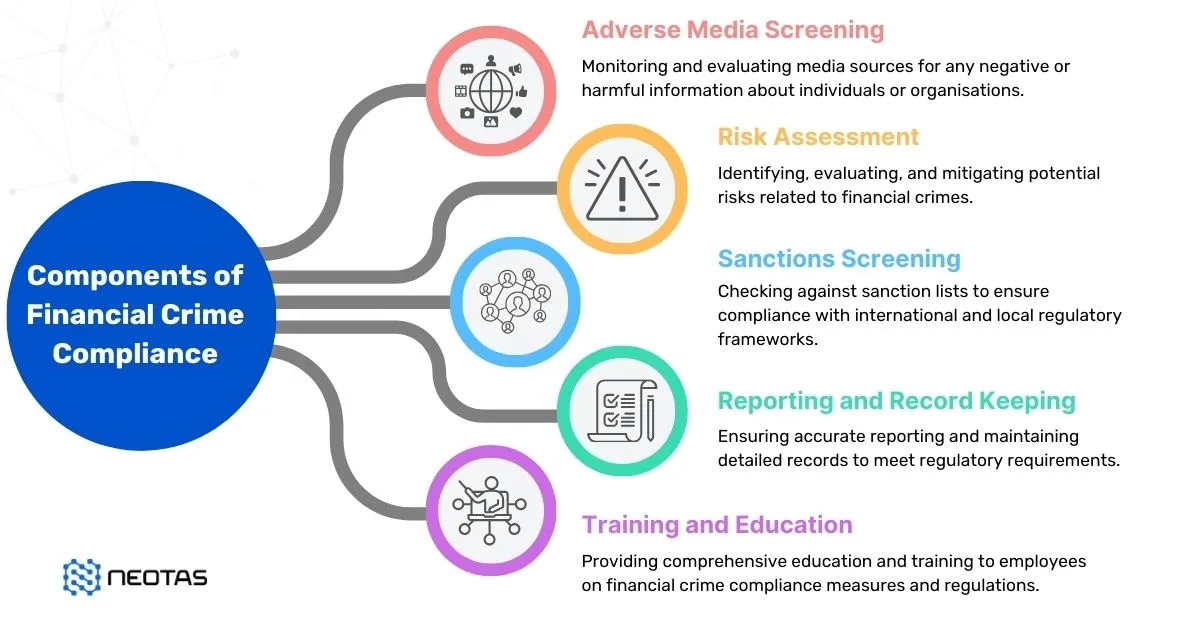
Let's break down what these mean from a technology and process perspective:
- Risk Assessment: Before a customer is even onboarded, the institution must assess their potential risk. This involves analyzing factors like their location, profession, and expected transaction patterns.
- Adverse Media & Sanctions Screening: This is the process of checking a customer's name against global sanctions lists (e.g., from the UN, US Treasury's OFAC) and screening for negative news that might indicate involvement in illicit activities. This is typically an automated process integrated into the customer onboarding workflow.
- Reporting and Record Keeping: Institutions are legally required to report suspicious transactions to the authorities, such as a country's Financial Intelligence Unit (FIU). This requires systems capable of flagging unusual activity and generating structured reports, like Suspicious Activity Reports (SARs).
The following reading provides more detail on how these components come together within a FinTech compliance framework.
Fintech compliance: Your guide to navigating regulatory ...
This guide from Scrut.io explains the key areas of FinTech compliance, starting with the crucial domain of AML and CTF.
Please read the section titled "AML and counter-terrorism financing (CTF)". Pay close attention to how it describes the AML value chain, from client risk rating and screening to transaction monitoring and reporting. This section explicitly mentions key processes like Customer Due Diligence (CDD) and Enhanced Due Diligence (EDD), which we will explore in a future lesson.
This domain is governed by a network of global and national bodies. The Financial Action Task Force (FATF) sets the international standards, while national bodies like the Financial Crimes Enforcement Network (FinCEN) in the US or the Financial Conduct Authority (FCA) in the UK enforce them.
Domain 2: Data Privacy and Cybersecurity
While financial crime compliance protects the system, this second domain focuses on protecting the customer. In the last lesson, we saw how data breaches are a prime threat. This regulatory domain is the direct answer to that threat, mandating how financial institutions must collect, store, process, and protect customer data.
The core principles are generally consistent across jurisdictions:
- Lawfulness, Fairness, and Transparency: Data collection and processing must have a legitimate basis and be clearly communicated to the user.
- Purpose Limitation: Data can only be used for the specific purpose for which it was collected.
- Data Minimization: Only data that is strictly necessary for that purpose should be collected.
- Security: Institutions must implement robust technical and organizational measures to protect the data.
- Breach Notification: In the event of a breach, institutions must notify regulators and affected individuals, often within a strict timeframe (e.g., 72 hours under GDPR).
Many specific regulations fall into this domain. The article from Metomic provides a helpful list of key examples from around the world.
11 Cyber-Security Compliance Regulations for Financial Services
This section of the article details several specific cybersecurity and data privacy regulations. It demonstrates how different jurisdictions tackle the same core problem.
Please review the list under the heading "What Are the 11 Cyber Security Compliance Regulations...". You don't need to memorize each one, but focus on understanding the purpose of a few key examples: PCI DSS: Specifically for securing payment card data. This is highly technical and prescriptive. GLBA (US): A broad US law requiring information security programs to protect customer financial information. NYDFS Part 500 (New York, US): A landmark regulation that mandates a comprehensive, risk-based cybersecurity program, including a CISO, regular assessments, and third-party security policies. This is a model for modern cybersecurity regulation. PSD2 (EU): While about open banking, it includes strict security requirements like Strong Customer Authentication (SCA) to protect payments.
For a technology leader, this domain translates directly into architectural and operational requirements: implementing encryption, managing access controls, running vulnerability assessments, and having a well-rehearsed incident response plan. We will dive deeper into GDPR as a specific case study in our next lesson.
Domain 3: Operational Resilience
The final domain is a more recent but equally critical evolution in financial regulation. It moves beyond simply protecting data or preventing crime to ensuring the firm itself can survive and continue to serve its customers through severe operational disruptions, including—but not limited to—cyberattacks.
Operational Resilience is the ability of an institution to prevent, adapt to, respond to, recover from, and learn from disruptions. The key insight is that disruptions are inevitable. The focus, therefore, is on maintaining the continuity of Important Business Services (IBSs)—those services whose disruption would cause significant harm to consumers or market stability.
The framework below illustrates the cyclical process that regulators now expect firms to follow.

The process involves:
- Identifying Important Business Services: What are our most critical functions from a customer's perspective (e.g., making payments, checking balances)?
- Setting Impact Tolerances: For each IBS, what is the maximum acceptable level of disruption (e.g., downtime in hours, number of affected customers)?
- Mapping and Testing: Mapping all the people, processes, and technology—including third-party vendors—that support the IBS, and then conducting realistic scenario testing (e.g., a cloud provider outage, a ransomware attack) to see if the impact tolerance can be met.
- Remediating: Identifying and fixing the vulnerabilities discovered during testing.
The flagship regulation for this domain in Europe is the Digital Operational Resilience Act (DORA). It codifies these principles into law for all financial entities in the EU. The following video gives an excellent overview of DORA's scope and purpose.
Digital Operational Resilience Act (DORA) Compliance through Vendor and Contract Management
This video from Gatekeeper provides a manager's perspective on DORA, focusing on its goals and key pillars.
Watch the first few minutes to understand what DORA is and why it was created. Focus on the introduction what Dora is and the list of the five key areas of focus. Note how "ICT third-party risk" is a central pillar—this directly reflects the supply chain threats we discussed previously and emphasizes the importance of vendor risk management, a topic we will cover in a dedicated module.
As the video highlights, DORA formalizes requirements for ICT risk management, incident reporting, resilience testing, and crucially, managing risk from third-party technology providers. This is a strategic shift, forcing technology leaders to look beyond their own walls and take responsibility for the resilience of their entire digital supply chain.
Conclusion
In this lesson, we have organized the complex world of financial regulation into three primary domains. Each addresses a different fundamental risk, but they work in concert to build a safer financial ecosystem.
Key Takeaways:
- Financial Regulation Domains: The regulatory landscape is built on three pillars: Financial Crime Compliance (protecting system integrity via AML/CTF), Data Privacy & Cybersecurity (protecting customer data via rules like GDPR and PCI DSS), and Operational Resilience (ensuring service continuity via frameworks like DORA).
- From Law to Strategy: For a technology leader, these regulations are not legal abstractions. They are direct drivers for technology architecture, security controls, risk management processes, and vendor relationships.
- Financial Crime Compliance: Requires robust systems for customer screening (KYC), transaction monitoring, and reporting to authorities to prevent money laundering and other illicit activities.
- Data Privacy & Cybersecurity: Mandates strong technical and organizational controls to protect sensitive data, governed by principles of consent, data minimization, and breach notification.
- Operational Resilience: Represents a strategic shift towards assuming disruption will occur and focusing on the ability to maintain critical business services within pre-defined tolerance levels, with a heavy emphasis on third-party risk.
We have now mapped the threats and the high-level rules that govern our response. In the next lesson, we will begin to zoom in, starting with a deeper look at one of the most influential data privacy regulations in the world: the GDPR. We will describe its core principles and analyze its profound impact on how financial institutions manage customer data.