Introduction
In our first lesson, we established the strategic imperative for a technology leader in finance: to act as a bridge between business objectives and cybersecurity risk. We focused on the "why"—translating technical risk into financial terms and integrating security into the firm's strategic and financial planning. Now, we turn our attention to the "what." To effectively protect a financial institution, you must first understand the complex systems that power it.
This lesson will provide a high-level map of the architecture of modern digital banking systems and FinTech platforms. Drawing on your background in computer science, we will deconstruct these systems into their core components, examining how they interact and where critical functions reside. For a leader, this architectural understanding is not just a technical exercise; it's the foundation for identifying systemic risks, assessing attack surfaces, and making informed decisions about where to invest in security controls. We will explore the fundamental split between slow-moving core systems and agile digital platforms, and then assemble a layered model of a modern FinTech, from its regulatory foundations to its customer-facing applications.
The Foundational Divide: Core Banking vs. Digital Banking
The most fundamental concept in modern banking architecture is the separation between the core banking system and the digital banking platform. Understanding this distinction is crucial because it explains the two-speed nature of financial technology: the slow, deliberate pace of the system of record versus the rapid, iterative pace of customer-facing innovation.
A simple but powerful analogy is to think of the Core Banking system as the bank's "Engine Room"—the heavy machinery that ensures financial integrity. The Digital Banking platform is the "Customer Experience"—the sleek, user-friendly interface through which customers interact with the bank's services.
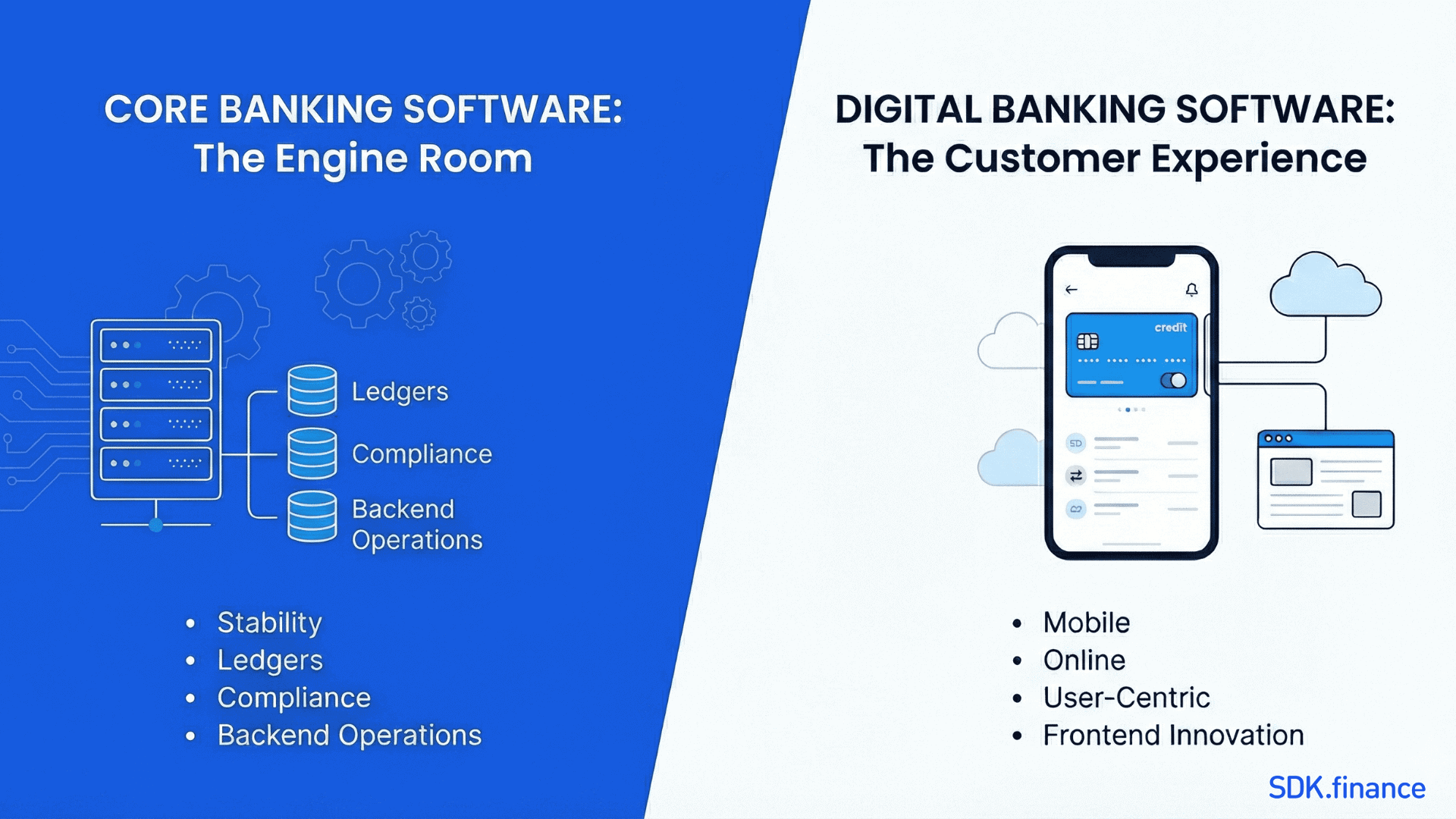
To formalize this concept, let's explore an article that breaks down these layers from an architectural and governance perspective.
Core Banking Software vs Digital Banking Software
This article provides a clear, architect-focused distinction between the two primary software layers in a modern bank, explaining their different purposes, design philosophies, and roles in compliance and security.
Please read the following sections to grasp the key differences: Start with the definitions of Core Banking Software and Digital Banking Software. Review the list of typical functions for each layer. Then, read the section on Architectural Differences, focusing on the contrast between ledger-centric and experience-centric design. Finally, pay close attention to the section on Compliance, Security, and Operational Control. This part is especially relevant to your career goals, as it clarifies which layer is responsible for financial compliance (the core) versus operational compliance like KYC/AML workflows (the digital layer).
As the article makes clear, these two systems are designed with fundamentally different goals:
- Core Banking System: This is the authoritative system of record. Its primary responsibility is financial correctness, stability, and regulatory compliance. It manages the ledger, calculates interest, processes loans, and ensures every transaction is accurately recorded. Change is slow, methodical, and heavily governed.
- Digital Banking Platform: This is the orchestration and interaction layer. Its purpose is to deliver services to customers through various channels (mobile, web) in a scalable and user-friendly way. It is API-first, modular, and built for rapid evolution. It handles workflows like customer onboarding, payment initiation, and user authentication, coordinating with the core system in the background.
This separation allows banks to innovate quickly on the customer-facing side without jeopardizing the stability and integrity of the core financial ledger. From a security leader's perspective, it also means the risk profiles and required controls for each layer are vastly different.
Inside the "Engine Room": A Look at Core Banking Architecture
Now that we understand its role, let's briefly look inside the core banking system. While modern implementations are evolving, the fundamental structure often follows a similar pattern. The following video provides a concise overview of the typical architectural zones.
How does a typical Core banking Solution architecture looks like ?
This video from "The Fintech Techie" channel breaks down a typical core banking solution into four logical zones, showing how various components connect and communicate.
Please watch the entire video (4 minutes). As you watch, focus on these key components and their interactions: Channel Layers: How user-facing channels like mobile banking, internet banking, and ATMs connect to the system. Enterprise Service Bus (ESB): Its role as a central hub for routing messages and requests from different channels. Application & Database Layers: The separation between the application servers handling business logic and the core database acting as the central data store. External Integrations: Note the mention of critical external systems like Swift for international payments and Kafka for event-driven communication.
The video illustrates a classic enterprise architecture. A key takeaway is the central, heavily guarded nature of the core database. It is the crown jewel, and protecting it is paramount. The use of an ESB or similar middleware is a common pattern to decouple the many channels from the core application logic, but it can also become a critical point of failure or a target for attack if not properly secured.
Architecting FinTech: Microservices and Payment Processing
While traditional banks are built around a monolithic core, FinTechs and neobanks start with a digital-first, modular approach. Their architecture is typically based on microservices, a concept you'll be familiar with from your computer science studies. This architectural style structures an application as a collection of loosely coupled, independently deployable services.
A global payment processor like PayPal is an excellent case study for this type of architecture. Let's analyze its system design.
System Design Global Payment Processing | Paypal
This video from the "ByteMonk" channel provides a detailed system design walkthrough for a global payment processing system, highlighting the use of microservices and asynchronous communication.
Please watch the following segments: First, get an overview of the three key layers: Client, Service, and Data. Next, focus on the breakdown of the Service Layer, which explains the different microservices (User, Payment, Account, Fraud Detection) and their roles. Understand how data is managed in the Data Layer using the "database per service" pattern. See how these services communicate asynchronously using Kafka queues. Finally, watch the walkthrough of a typical payment flow to see how all these components interact to process a single transaction.
This design highlights several key principles of modern FinTech architecture:
- Decomposition: Complex business functions are broken down into small, focused microservices (e.g., Payment Service, Account Service, Notification Service, Fraud Detection Service).
- Asynchronous Communication: Services communicate via a message broker like Kafka. This decouples the services, improving resilience (if one service is down, others can continue processing) and scalability.
- Data Segregation: Each service owns its own database. This prevents tight coupling and allows each service to use the database technology best suited for its needs (e.g., a relational database for transactions, a NoSQL database for logs).
- Dedicated Security Services: Notice that "Fraud Detection" is not just a feature but a dedicated service with its own data and models. This reflects the "compliance as infrastructure" principle we will discuss next.
A Layered Blueprint for Neobanks and FinTechs
To build a more comprehensive model, we can look at a neobank's architecture as a series of distinct layers, each with critical engineering and security considerations. This layered view is invaluable for a leader trying to map risks and capabilities.
Neobank Architecture Guide: 6 Layers Every Digital Bank Must Engineer Correctly - Trio
This guide provides a strategic, layered view of neobank architecture, moving from the foundational regulatory decisions to the core engineering components for payments and compliance.
Please read the sections describing the following architectural layers: Layer 0: The Licensing Mode: This is a strategic business decision that dictates the entire technical and compliance architecture. Layer 1: Core Banking: This revisits the core, but from a FinTech's perspective of "build vs. buy vs. BaaS (Banking-as-a-Service)." Layer 2: Identity and KYC: Focus on the concept of KYC as an engineered "state machine," which is critical for preventing fraud and meeting AML obligations. Layer 4: Payment Rails Orchestration: Understand how a FinTech must manage and orchestrate various payment networks. Layer 5: Compliance as Infrastructure: This is a key concept for your goals. It argues that compliance functions like transaction monitoring and suspicious activity reporting must be built as automated, scalable engineering systems, not manual processes.
The "compliance as infrastructure" concept is particularly vital. It means that for a FinTech operating at scale, AML transaction monitoring, sanctions screening, and regulatory reporting cannot be manual, after-the-fact processes. They must be automated, event-driven services integrated directly into the payment and account event streams. This is where your interests in AI for fraud detection, cybersecurity, and financial risk converge.
Tying It All Together: A Real-World Reference Architecture
We've discussed separated cores, microservices, and layered FinTech platforms. Let's conclude by looking at a real-world reference architecture that combines these concepts. The diagram below shows how a bank might use Amazon Web Services (AWS) to build a modern Open Banking platform, securely exposing its services to third-party FinTechs.

Let's dissect this diagram using the concepts from this lesson:
- Bank's IT Environment (Box 4): This represents the traditional, on-premise datacenter. Inside, you see the "System of records," which is the Core Banking System we discussed. It connects to the cloud environment via secure connections like AWS Direct Connect or a VPN.
- Open Banking API Account (Center): This is the Digital Banking Platform, built with a cloud-native, microservices architecture. You can see distinct services for "Account Information Services" and "Payments Services." It also includes shared data stores for consents and aggregated data.
- API Gateway (Top Center): Just as in the PayPal design, an API Gateway serves as the single, secure entry point for all external requests from third parties.
- Security Services (Distributed): Notice the abundance of security components. AWS WAF (Web Application Firewall) protects the API Gateway from common web exploits. AWS Security Hub, GuardDuty, and Inspector provide threat detection and vulnerability management. AWS IAM and Secrets Manager control access and credentials. This demonstrates how security is layered throughout the architecture, not bolted on.
- Integration Services (Bottom Right): Services like Amazon SQS, SNS, and EventBridge are used for asynchronous, event-driven communication between microservices, fulfilling the same role as Kafka in our earlier example.
This architecture is a concrete blueprint for the systems you will be tasked with securing and managing. It shows how legacy systems are integrated with modern cloud platforms and how security and compliance are engineered into the solution from the ground up.
Conclusion
In this lesson, we have mapped the high-level architecture of modern financial systems. We moved from the foundational separation of Core and Digital banking to the microservices-based design of FinTech platforms, culminating in a real-world cloud reference architecture.
Key Takeaways:
- Modern banking IT operates at two speeds: a stable, record-keeping Core Banking system and an agile, customer-facing Digital Banking layer.
- FinTech and neobank architectures are typically built on microservices, prioritizing modularity, scalability, and rapid, independent development cycles.
- These architectures are layered, with distinct components for core logic, identity (KYC), payment orchestration, and compliance. The strategic decision of "build vs. buy vs. BaaS" is critical at each layer.
- APIs serve as the contracts between services, while asynchronous messaging (e.g., Kafka, SQS) provides the resilient communication backbone for distributed systems.
- For modern platforms, compliance is not just a process but "Compliance as Infrastructure"—an automated, scalable set of engineered services for functions like AML monitoring and reporting.
Now that we have a map of the territory, our next lesson will focus on the adversaries. We will identify the primary cybersecurity threat vectors targeting financial institutions, analyzing how attackers exploit the components and connections we've just outlined.