Welcome to our final lesson on the integumentary system. In our last session, we explored how the skin responds to injury and the effects of aging. We will now apply that knowledge to a specific, critical type of injury: burns. Assessing burns is a fundamental skill in nursing, as it dictates immediate treatment priorities, including the need for specialized care and fluid resuscitation.
This lesson will equip you with the knowledge to classify burns by their severity and to estimate the total body surface area affected. By the end of our session, you will be able to classify burns by degree and estimate their extent using the "rule of nines"—a vital skill for both exams and clinical practice.
Part 1: Classifying Burns by Depth
A burn is tissue damage caused by excessive heat, electricity, radiation, or chemicals. The first step in managing a burn patient is to determine its severity, which is primarily based on the depth of the injury—that is, how many layers of skin are affected.
Clinically, burns are classified based on their depth. You may hear older terminology like "first-," "second-," and "third-degree" burns. However, a more descriptive and current classification system refers to the thickness of the skin involved: superficial, partial-thickness (which is subdivided), and full-thickness.
This chart provides an excellent overview of the four main classifications, showing which skin layers are involved and the typical appearance of the burn.
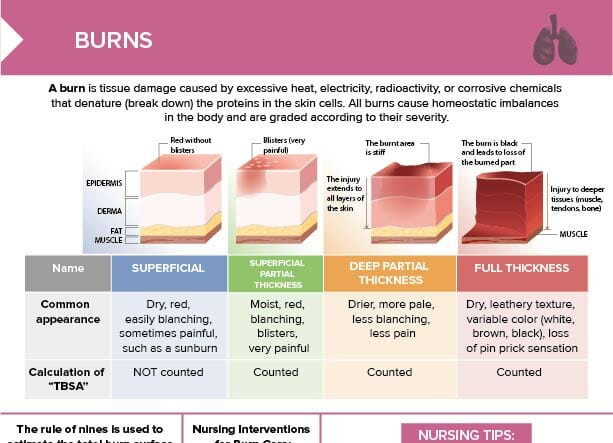
This image illustrates the layers of skin affected by each type of burn and provides a summary of their appearance and characteristics.
To understand the pathophysiology and distinguishing features of each type, let's turn to a detailed video explanation.
Burns (DETAILED) Overview - Types, Pathophysiology, TBSA
This video from Armando Hasudungan provides a detailed overview of the different burn classifications, explaining the specific layers of skin involved and the resulting clinical signs.
Please watch the segment from the beginning of the classification section. As you watch, pay close attention to the key features that help differentiate the types of burns: Superficial (First-Degree): Involves only the epidermis. Note the description of redness and pain, similar to a sunburn. Superficial Partial-Thickness (Second-Degree): Extends into the upper (papillary) dermis. Focus on the formation of painful blisters and the fact that the skin still blanches (whitens) with pressure. Deep Partial-Thickness (Second-Degree): Reaches the deeper (reticular) dermis. Notice the key differences: blisters rupture easily, the surface may be pale, and it is often less painful and non-blanching due to nerve and blood vessel damage. Full-Thickness (Third-Degree): Destroys all layers of the skin, potentially extending into the fat and muscle below. Observe the description of a dry, leathery, or charred appearance with a complete loss of sensation.
As you can see, the clinical signs—pain, blistering, and blanching—are directly related to the depth of tissue and nerve damage. Some sources also refer to fourth-degree burns, which extend even deeper to damage underlying muscle and bone, as mentioned in the 68W Combat Medic Textbook resource.
Crucially, for calculating the severity of a burn, superficial burns like a typical sunburn are not included in the total body surface area calculation. Only partial-thickness and full-thickness burns are counted.
Part 2: Estimating Burn Extent with the Rule of Nines
After classifying the burn's depth, the next critical step is to estimate its size, or the Total Body Surface Area (TBSA) affected. This percentage is not just an academic measurement; it is essential for guiding treatment. As a nurse, you will see it used to determine if a patient needs to be transferred to a specialized burn unit and to calculate the massive amounts of intravenous fluids required to prevent life-threatening hypovolemic shock.
A rapid and widely used method for estimating TBSA in adults is the Rule of Nines.
Rule of Nines for Burns in Adults Nursing NCLEX Lecture w/ Examples
This video from RegisteredNurseRN explains why calculating TBSA is so important in the immediate care of a burn patient.
Please watch the first part of this video, from the introduction, to understand the clinical rationale behind calculating TBSA, particularly its role in fluid replacement using formulas like the Parkland formula.
The Rule of Nines divides the adult body into regions that each represent 9% (or a multiple of 9%) of the total body surface. The perineum makes up the final 1%.

This diagram visually breaks down the adult body into sections, assigning a percentage value to each for calculating the total body surface area affected by a burn.
To learn how to apply this rule, let's return to the RegisteredNurseRN video. It provides a clear, practical walkthrough perfect for nursing students.
Rule of Nines for Burns in Adults Nursing NCLEX Lecture w/ Examples
This segment details how the body is divided for the Rule of Nines calculation, emphasizing the importance of distinguishing between anterior and posterior surfaces.
Now, watch the detailed explanation from how to calculate the Rule of Nines. As you watch, I recommend jotting down the percentages for each body part: Head and Neck: 9% total (4.5% anterior, 4.5% posterior) Each Arm: 9% total (4.5% anterior, 4.5% posterior) Trunk: 36% total (18% anterior, 18% posterior) Each Leg: 18% total (9% anterior, 9% posterior) Perineum: 1% For small or scattered burns, clinicians may use the Palmar Method, where the surface area of the patient's palm (including fingers) is estimated to be 1% of their TBSA. Part 3: Putting It All Together - Practice Problems Now it's time to apply what you've learned. The best way to master the Rule of Nines is through practice. First, watch a guided example.
For small or scattered burns, clinicians may use the Palmar Method, where the surface area of the patient's palm (including fingers) is estimated to be 1% of their TBSA.
Part 3: Putting It All Together - Practice Problems
Now it's time to apply what you've learned. The best way to master the Rule of Nines is through practice.
First, watch a guided example.
Rule of Nines for Burns in Adults Nursing NCLEX Lecture w/ Examples
The same RegisteredNurseRN video provides a step-by-step walkthrough of a sample NCLEX-style question.
Watch the practice problem from the guided example. Follow along as the presenter calculates the TBSA for a patient with burns on multiple body parts.
Now, it's your turn to solve a problem. The following resource provides a scenario for you to work through.
Estimate burn size using the Rule of Nines or Rule of Palm.
This document from the 68W Combat Medic Textbook includes practice scenarios to test your knowledge.
First, read question 8 in the "Check on Learning" section, which describes a patient who fell asleep at the beach. You can find it by searching for the scenario. Based on the description of "painful, red, and blistered," answer these two questions: Question 8a: What classification of burn does this soldier have? Question 8b: Using the Rule of Nines, calculate the percentage of TBSA burned. (The burns are on his posterior trunk, posterior arms, and posterior legs). Once you have your answers, check your work using the answer key at the end of the document. Find the answers under the answer key.
How did you do? The correct answers are a second-degree (partial-thickness) burn and a TBSA of 45% (18% for posterior trunk + 9% for posterior arms + 18% for posterior legs). If you got it right, great job! If not, review the percentages and try the calculation again.
Conclusion
This lesson concludes our module on the integumentary system. You've learned to assess two of the most important aspects of a burn injury: depth and extent. These are essential skills that directly impact patient outcomes.
Here are the key takeaways:
- Burn Classification: Burns are classified by depth into superficial, superficial partial-thickness, deep partial-thickness, and full-thickness. Each has distinct clinical signs related to the layers of skin destroyed.
- Rule of Nines: This is a rapid method for estimating the Total Body Surface Area (TBSA) of burns in an adult. The body is divided into regions of 9% or multiples of 9.
- Clinical Significance: TBSA calculation is critical for determining the need for specialized care and for guiding fluid resuscitation to prevent shock.
With this, we have completed our study of the body's protective outer layer. In our next module, we will move deeper into the body to explore its structural framework: osseous tissue and bone structure. We will begin by learning how to classify the different types of bones that make up the human skeleton.