Hello! In our last lesson, we explored the various glands of the skin and their roles. We're now going to build on that foundation by examining how the integumentary system as a whole deals with challenges over time.
This lesson focuses on the dynamic physiological responses of the skin to injury and the cumulative effects of aging. Understanding these processes is fundamental in a clinical setting. As a nursing student, you'll constantly be assessing skin integrity, managing wounds, and caring for patients—particularly older adults—whose skin is more vulnerable. Your experience in a retirement home has likely given you firsthand observations of many of the age-related changes we'll discuss.
By the end of this lesson, you will be able to explain how the skin repairs itself after an injury and describe the structural and functional changes it undergoes as we age.
The Body's Response to Tissue Injury
When the skin is breached, the body initiates a beautifully orchestrated, four-stage process to repair the damage. Let's start by looking at the initial reaction.
Inflammation: The First Response
Any injury, from a small papercut to a major wound, triggers inflammation. This is the body's standard, immediate response. Its purpose is to contain the damage, eliminate the cause of injury (like bacteria), and set the stage for repair.
You may be familiar with the four cardinal signs of inflammation, first documented in ancient Rome: redness, swelling, pain, and local heat. A fifth sign, loss of function, can also occur. These signs are the outward manifestation of a cascade of physiological events.
To understand this initial phase, let's review the key steps.
4.6 Tissue Injury and Aging – Anatomy & Physiology 2e
This reading from the OpenStax Anatomy & Physiology textbook provides a concise overview of the inflammatory response.
Please read the first four paragraphs of the "Tissue Injury and Repair" section, from the beginning. As you read, focus on the roles of vasodilation and histamine in creating the signs of inflammation.
As you just read, damaged cells release chemical signals that cause local blood vessels to widen (vasodilation) and become more permeable, or "leaky." This allows immune cells and fluid to move from the blood into the injured tissue, leading to the characteristic swelling and redness.
The Four Phases of Wound Healing
Following the initial inflammatory response, the body proceeds through a more complex healing cascade. We can break this down into four overlapping phases:
- Hemostasis: Stopping the bleeding.
- Inflammation: Cleaning the wound.
- Proliferation: Rebuilding the tissue.
- Maturation (Remodeling): Strengthening the new tissue.
The diagram below provides a great visual overview of the major phases.
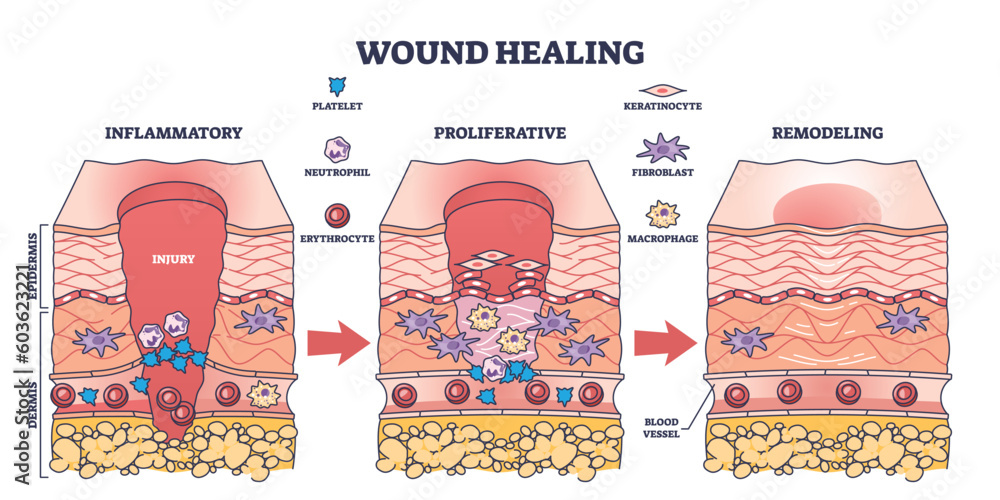
To get a complete picture of this intricate process, the following video provides a detailed step-by-step explanation.
This video from Osmosis from Elsevier clearly breaks down each stage of wound healing, from the initial blood clot to the final remodeling of the scar tissue.
Please watch the following segments: Hemostasis: Note how the platelet plug and fibrin mesh work together to form a clot. Inflammation: Focus on the role of immune cells in cleaning debris and microbes. Proliferation: Pay attention to the formation of new epidermis (epithelialization) and the red, bumpy granulation tissue in the dermis. Maturation: Understand how collagen remodeling and wound contraction strengthen the healed area.
This healing process is remarkably effective, but its success depends on many factors. The video mentioned several things that can impair healing, such as poor blood flow and infection. From a nursing perspective, it's also crucial to understand a wide range of risk factors that can turn a simple acute wound into a chronic, non-healing problem.
This next reading from a nursing textbook expands on these factors. It's a great resource that connects the physiology of healing directly to patient care.
INTEGUMENTARY - Nursing Fundamentals - NCBI Bookshelf
This textbook excerpt details the phases of wound healing and outlines the major risk factors that can delay or prevent it, which is essential knowledge for clinical practice.
First, read the section on the four phases to reinforce your understanding. Then, skim the section titled Risk Factors. You don't need to memorize every detail, but be familiar with the main categories: circulation, immune function, diabetes, nutrition, obesity, moisture, and smoking.
The Effects of Aging on the Integumentary System
Now, let's shift our focus to the second part of our learning outcome: aging. The process of wound healing we just discussed is significantly impacted by age. Your work in a retirement home has likely shown you that the skin of older adults is different—it appears thinner, is often drier, and may bruise or tear more easily. These are all visible signs of underlying physiological changes.
This diagram summarizes the most common age-related changes in the skin.

Let's explore these changes and their clinical implications in more detail with a video designed for nursing students.
Immune & Integumentary Changes in Aging Adults: Gerontology - Fundamentals of Nursin | @LevelUpRN
This video from Level Up RN provides a practical overview of the integumentary changes in older adults and why they matter in a clinical context.
Please watch from the start of the section on the integumentary system. As you watch, take note of the consequences of these changes, such as: Increased risk of skin tears due to thinning skin. Higher risk for pressure injuries and hypothermia due to loss of subcutaneous tissue. Tendency to overheat due to reduced sweat gland activity. Slower wound healing.
The video highlighted how multiple changes compound to make the skin more fragile and healing more difficult. The thinning of the epidermis and dermis, decreased elasticity from collagen and elastin loss, reduced blood supply, and a less robust immune and inflammatory response all play a part.
At a cellular level, aging means that cells regenerate less efficiently. The protective telomeres at the ends of chromosomes shorten with each cell division, limiting the number of times a cell can replicate. This leads to a slower replacement of cells in the epidermis and dermis.
The following text provides a more detailed explanation of how these factors contribute to the signs of aging.
4.6 Tissue Injury and Aging – Anatomy & Physiology 2e
This reading delves deeper into the systemic and cellular effects of aging on body tissues, including the skin.
Please read the section titled Tissue and Aging. Focus on how the loss of collagen, decreased muscle tone, and reduced cell division efficiency contribute to the visible signs of aging and slower wound repair.
Ultimately, these age-related changes mean that an injury that might be minor in a younger person can be a significant medical issue for an older adult, requiring careful nursing assessment and intervention.
Conclusion
In this lesson, we have connected the skin's baseline anatomy to its dynamic responses to injury and aging. These concepts are not just for exams; they are at the heart of patient care, from managing a surgical incision to preventing a pressure injury in an elderly patient.
Here are the key takeaways from our session:
- Wound healing is a four-phase process: hemostasis stops bleeding, inflammation cleans the site, proliferation rebuilds tissue with granulation and new epidermis, and maturation remodels and strengthens the scar.
- The success of wound healing is influenced by factors like circulation, nutrition, and immune status.
- Aging significantly alters the skin, making it thinner, drier, and less elastic due to reduced cell regeneration, collagen loss, and decreased gland activity.
- These age-related changes lead to increased skin fragility, a higher risk of injury, and clinically significant delays in wound healing.
In our final lesson on the integumentary system, we will apply our knowledge of skin injury to a specific clinical topic: burns. We will learn how to classify them by severity and use the "rule of nines" to estimate the extent of a burn, a critical skill for emergency medical assessment.