Welcome to our new module on the skeletal system. In our previous lessons, we completed our study of the integumentary system by examining how to assess burn injuries. We will now move from the body's protective covering to its internal framework: the bones.
This lesson begins our exploration of osseous tissue and bone structure. We will start with the fundamentals by learning how to classify the 206 bones of the adult skeleton. By the end of our session, you will be able to classify bones according to their shape—long, short, flat, irregular, and sesamoid—and provide an example of each. This foundational knowledge will be essential as we delve into the anatomy of the entire skeleton in later modules.
The Five General Shapes of Bones
Anatomists classify bones into five categories based on their shape. This classification is useful because a bone's shape is directly related to its function. For example, some bones are built for leverage and movement, while others are designed for protection or stability.
Let's begin with a visual overview of these categories. The following illustration shows the human skeleton with examples of each major bone type.
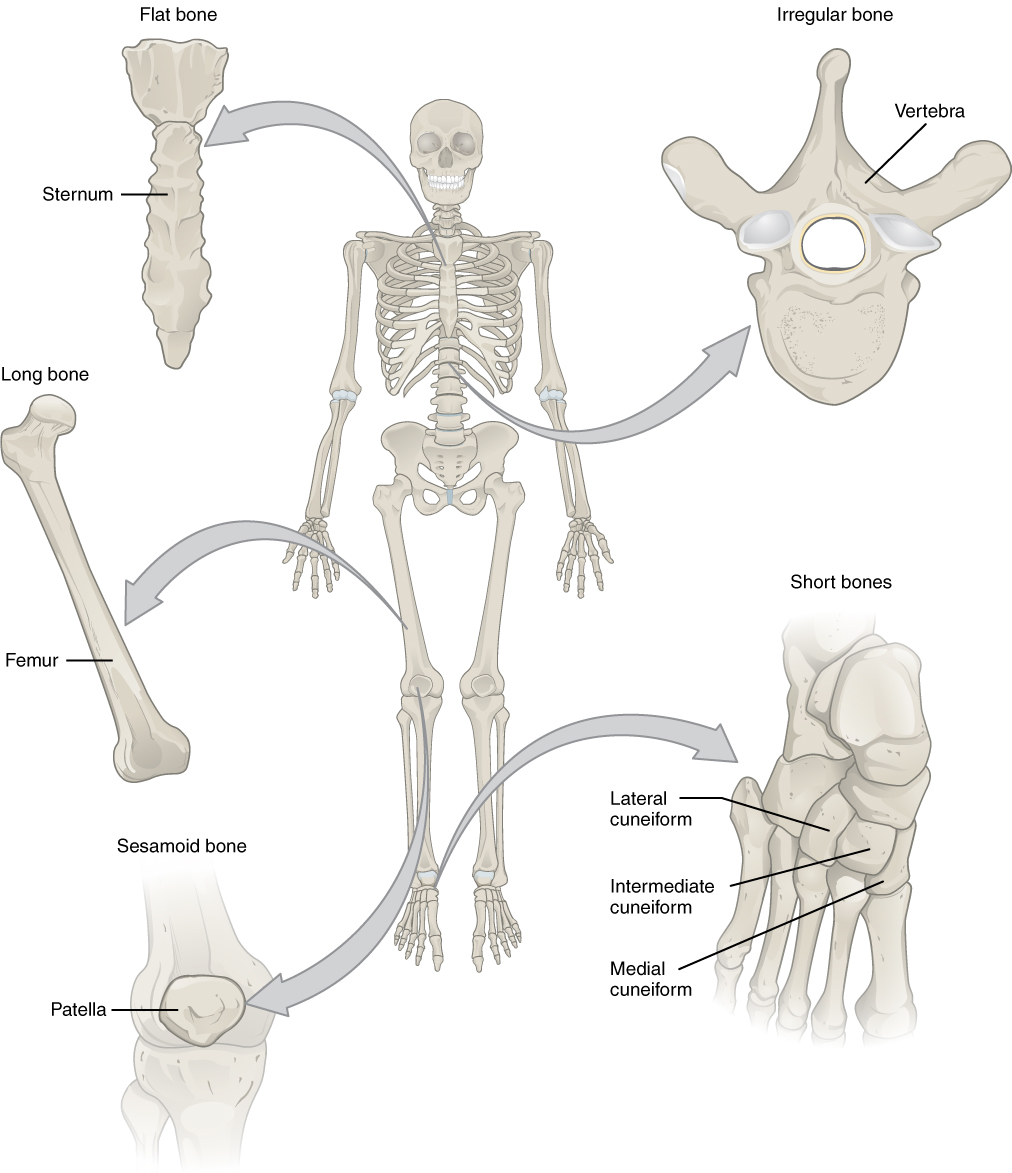
To understand the defining characteristics and functions of each bone type, we will watch a video created by RegisteredNurseRN, a channel that provides content specifically for nursing students like you.
Types of Bones Anatomy: Long, Short, Flat, Irregular, Sesamoid, Sutural
This video offers a clear and concise overview of the different types of bones, which is perfect for building a solid foundation on this topic.
We will go through this video section by section. First, watch the introduction and the segment on long bones from the beginning to the end of the long bones section. Pay close attention to the defining characteristic of a long bone—that it's longer than it is wide—and its primary function as a lever.
Long bones are the most common type in the body. As you just learned, their key feature is not their absolute size, but their shape: they are longer than they are wide. They consist of a long cylindrical shaft (diaphysis) with two bulky ends (epiphyses).
- Function: They act as levers that move when muscles contract.
- Examples: The femur (thigh bone), humerus (upper arm bone), and even the small phalanges (finger and toe bones) are all long bones.
Now, let's continue with the next two categories.
Types of Bones Anatomy: Long, Short, Flat, Irregular, Sesamoid, Sutural
The video continues by explaining short bones and a special sub-category, sesamoid bones.
Please watch from the start of the short bones section. Note the cube-like shape of short bones and how sesamoid bones are unique because they are embedded within tendons.
Short bones are roughly cube-shaped, meaning their length, width, and thickness are approximately equal.
- Function: They provide stability and support, as well as some limited motion.
- Examples: The carpals of the wrist and the tarsals of the ankle.
Sesamoid bones are small, round bones shaped like sesame seeds. They are a special type of short bone that forms within tendons, especially where a great deal of pressure is generated.
- Function: They protect tendons from compressive forces and improve the mechanical advantage of muscles.
- Example: The patella (kneecap) is the largest and most well-known sesamoid bone.
Next up are flat bones. As you'll see, the name can be slightly misleading.
Types of Bones Anatomy: Long, Short, Flat, Irregular, Sesamoid, Sutural
This segment describes flat bones, highlighting their protective role.
Watch the section on flat bones from this segment. Notice that these bones are often curved, not perfectly flat.
Flat bones are typically thin and often have a curve. They consist of a layer of spongy bone sandwiched between two thin layers of compact bone, an arrangement often called a "diploe."
- Function: They serve as broad points of attachment for muscles and often protect vital internal organs.
- Examples: The cranial bones that protect the brain, the sternum (breastbone) and ribs that protect the heart and lungs, and the scapulae (shoulder blades).
Finally, we have the bones that don't fit into any other category.
Types of Bones Anatomy: Long, Short, Flat, Irregular, Sesamoid, Sutural
The video concludes with the final category: irregular bones.
Watch the last main segment on irregular bones from this section.
Irregular bones have complex shapes that don't conform to the other categories. Their shapes are often highly specialized for their particular function.
- Function: Varies widely depending on the bone; often includes protection of internal organs or supporting multiple structures.
- Examples: The vertebrae, which protect the spinal cord and support the trunk, and many of the facial bones.
Consolidating Your Knowledge
Now that you've been introduced to each category, let's reinforce these concepts with a quick reading and a helpful summary table. This text provides the same information in a written format, which is a great way to review.
Bone Classification | Anatomy and Physiology I
This resource from Lumen Learning provides concise definitions for each bone classification and a very useful summary table.
First, read through the definitions for each bone type to solidify your understanding: Long Bones Short Bones Flat Bones Irregular Bones Sesamoid Bones After reading the definitions, focus on the table titled "Bone Classifications" at the end of the text. You can find it by searching for the header Table 1. This table is an excellent study tool that neatly summarizes the features, functions, and examples for each category.
As a nursing student who has worked in a retirement home, you may have seen how different types of fractures can affect mobility and quality of life. Understanding these bone classifications is the first step in appreciating why a fracture in a long bone like the femur has different implications than a fracture in the short bones of the wrist.
Conclusion
In this lesson, we laid the groundwork for our study of the skeletal system by classifying bones based on their shape. This system of classification helps us understand the relationship between a bone's structure and its specific role in the body.
Here are the key takeaways:
- Bones are classified into five main shapes: long, short, flat, irregular, and sesamoid.
- Long bones (e.g., femur) are longer than they are wide and act as levers.
- Short bones (e.g., carpals) are cube-shaped and provide stability.
- Flat bones (e.g., sternum) are thin and curved, serving to protect organs and provide attachment sites for muscles.
- Irregular bones (e.g., vertebrae) have complex, specialized shapes.
- Sesamoid bones (e.g., patella) are a special type of short bone embedded in tendons to protect them from compressive forces.
In our next lesson, we will look more closely at the surfaces of these bones. We will learn to identify and define common bone markings, the various projections, depressions, and openings that serve as landmarks for the entire musculoskeletal system.