Welcome to your next lesson on the appendicular skeleton. In our previous session, we did a deep dive into the anatomy of a single hip bone, the os coxa, identifying its three fused parts—the ilium, ischium, and pubis—and their important landmarks.
Today, we will build directly on that knowledge. We'll examine how two os coxae articulate with the sacrum to form the complete pelvic girdle and address our main goal: to compare the key structural differences between the male and female pelvis. These differences are not random; they are significant functional adaptations, primarily related to childbirth in females. Understanding these distinctions is crucial not only for anatomy but also for clinical fields like obstetrics and forensic science.
The Pelvis: True and False
Before we compare male and female structures, it's helpful to define two regions of the pelvis. The entire pelvis is divided into a "false" (or greater) pelvis and a "true" (or lesser) pelvis by an oblique line called the pelvic brim or pelvic inlet.
- The false pelvis is the superior portion, enclosed by the wing-like iliac bones. It supports the lower abdominal organs.
- The true pelvis is the inferior portion that contains the pelvic cavity and its organs. The fetus must pass through the true pelvis during childbirth.
The video "Coxa & Pelvis Anatomy" from Ninja Nerd offers a quick and clear definition of these two regions.
Please watch the segment from this clip to understand the distinction between the true and false pelvis, separated by the pelvic brim.
Key Differences: An Overview
The most significant anatomical differences between the male and female pelvis are driven by the female's role in pregnancy and parturition (childbirth). Generally, the female pelvis is broader, lighter, and has a larger, more circular pelvic outlet to facilitate the passage of a baby. Let's explore these differences systematically.
The following video provides an excellent, detailed comparison of the key features. We will work through it section by section.
Male vs Female Pelvis Differences Anatomy Skeleton Shape
This video, "Male vs Female Pelvis Differences" from RegisteredNurseRN, will be our primary guide for this topic.
First, watch from the beginning to this point. The presenter will introduce the topic and discuss the overall differences in weight, width, and height. Notice how the wider female pelvis relates to the greater distance between the anterior superior iliac spines, a landmark you learned in the last lesson.
The Pelvic Inlet and Pubic Arch
Two of the most reliable indicators for determining the sex of a pelvis are the shape of the pelvic inlet and the angle of the pubic arch.
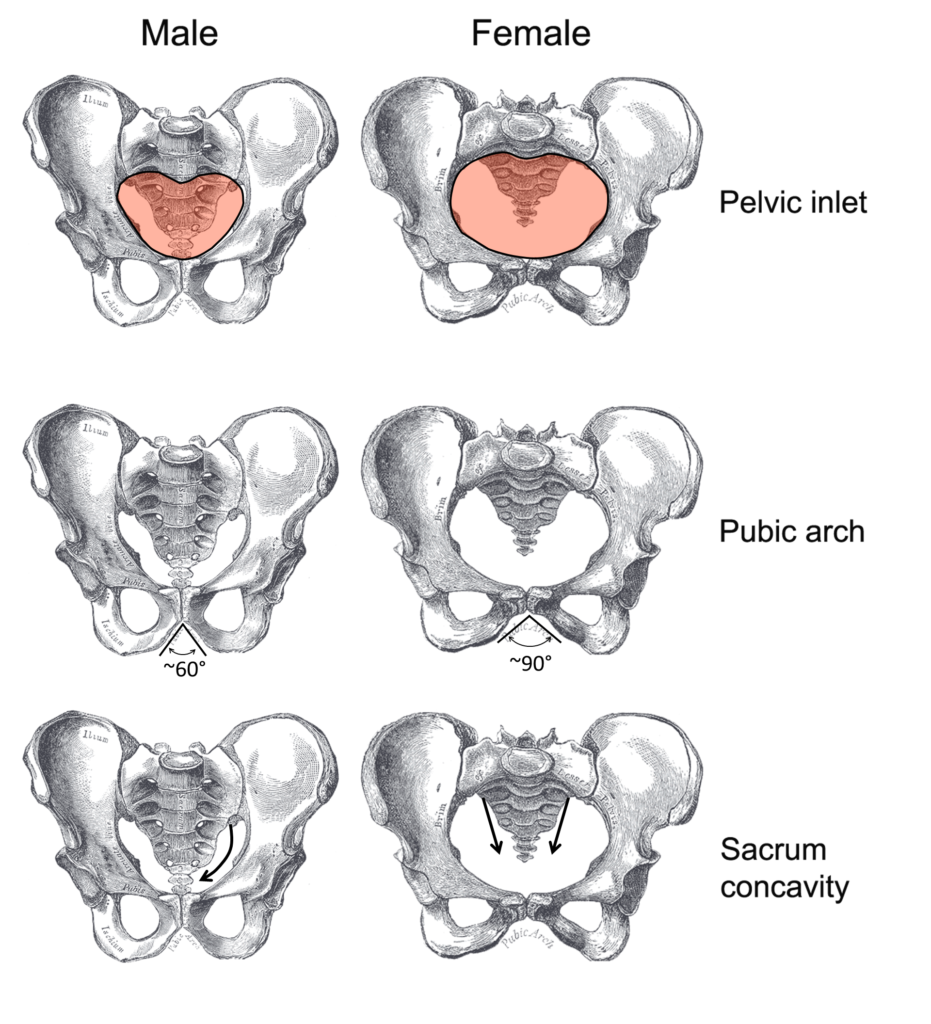
- Pelvic Inlet: The male pelvic inlet is characteristically narrow and heart-shaped. In contrast, the female pelvic inlet is wider and more oval or circular, creating a more spacious opening into the true pelvis.
- Pubic Arch (Subpubic Angle): This is the angle formed by the inferior pubic rami just below the pubic symphysis. In females, this angle is broad, typically greater than 80 degrees (). In males, it is much more acute, usually less than 70 degrees ().
Let's continue with the video to see these features explained.
Male vs Female Pelvis Differences Anatomy Skeleton Shape
Now, let's focus on the pelvic inlet and pubic arch.
Watch the next two segments of the video. The first part covers the pubic arch, and the second covers the pelvic inlet. The presenter offers helpful mnemonics to remember the differences.
The images below provide excellent visual comparisons of these key features. Notice the distinct heart shape of the male pelvic inlet versus the wider, oval shape in the female. Also, observe the stark difference in the subpubic angle.

Other Important Distinctions
Beyond the pelvic inlet and pubic arch, several other features differ between the sexes. These include the sacrum, the greater sciatic notch, and the obturator foramen.
Male vs Female Pelvis Differences Anatomy Skeleton Shape
Let's look at a few more important differences using the same video.
Watch the segments covering the sacrum and coccyx, the greater sciatic notch, and the obturator foramen. Pay attention to how each feature contributes to the overall wider and more open structure of the female pelvis.
In summary:
- Sacrum: The female sacrum is shorter, wider, and less curved anteriorly than the male sacrum. This prevents it from obstructing the pelvic outlet.
- Greater Sciatic Notch: This notch, which you identified on the ilium in the last lesson, is much wider and shallower in females.
- Obturator Foramen: In males, this foramen tends to be round, whereas in females, it is more oval-shaped.
Bringing It All Together: A Summary for Review
To consolidate these concepts for your exam preparation, a side-by-side comparison is incredibly useful. The following resource provides a concise textual summary and an excellent table that organizes the key differences.
The Pelvic Girdle and Pelvis | Anatomy and Physiology I
This reading from Lumen Learning's Anatomy and Physiology course provides a perfect summary of everything we've discussed.
Please read the section titled Comparison of the Female and Male Pelvis. Then, carefully study the Table 1. Overview of Differences between the Female and Male Pelvis. This table is a high-yield summary that will be very helpful for your exam review.
Conclusion
In this lesson, we have moved from the individual os coxa to the complete pelvic girdle, comparing the significant structural differences between males and females. These variations are a classic example in anatomy of how structure is intimately linked to function, with the female pelvis being expertly adapted for the demands of childbirth.
Key Takeaways:
- The female pelvis is generally wider, lighter, and smoother than the male pelvis, which is narrower, heavier, and more robust.
- The female pelvic inlet is oval or rounded; the male's is heart-shaped.
- The female subpubic angle is wide (greater than 80°); the male's is narrow (less than 70°).
- The female sacrum is shorter, wider, and less curved.
- The female greater sciatic notch is wider and shallower.
With this knowledge, you can now confidently distinguish between male and female pelvic structures. In our next lesson, we will continue our journey down the lower limb by identifying the femur and patella, the bones of the thigh and kneecap. We'll see how the large, round head of the femur fits into the acetabulum of the os coxa to form the hip joint.