Introduction
In our last lesson, we navigated the various ways of measuring a nation's income, distinguishing between aggregates like GDP, GNP, NNP, and NDP. We learned that these figures give us the monetary value of economic activity. However, the value of money itself isn't constant; it changes over time. This brings us to a concept that you encounter daily, one that is central to the mission of the Reserve Bank of India: inflation.
This lesson will define inflation and distinguish between the two primary indices used to measure it in India: the Wholesale Price Index (WPI) and the Consumer Price Index (CPI). Understanding these concepts is not just about memorizing definitions for your exam; it's about grasping the very metric that the RBI uses to formulate its monetary policy. We will break down what each index measures, who publishes it, and why one is considered more important for policy decisions.
What is Inflation?
At its simplest, inflation is the rate at which the general level of prices for goods and services is rising, and subsequently, purchasing power of currency is falling. If an apple costs ₹10 today and ₹11 next year, that 10% price increase is a form of inflation. It means your ₹10 can't buy as much as it used to.
The following short video provides a clear and concise explanation of this fundamental concept.
Consumer Price Index (CPI) Vs Wholesale Price Index (WPI) | Differences and Comparison
This video from the Key Differences channel offers a straightforward definition of inflation and its impact on the cost of living.
Watch the initial segment that defines inflation, from the beginning until 00:51. Focus on how it's described as a sustained rise in the overall price level.
To measure this economy-wide phenomenon, economists don't track every single price. Instead, they create a representative "basket" of goods and services and monitor how the total price of this basket changes over time. The change is expressed as an index. In India, there are two major indices that do this from different perspectives.
Two Lenses on the Economy: WPI and CPI
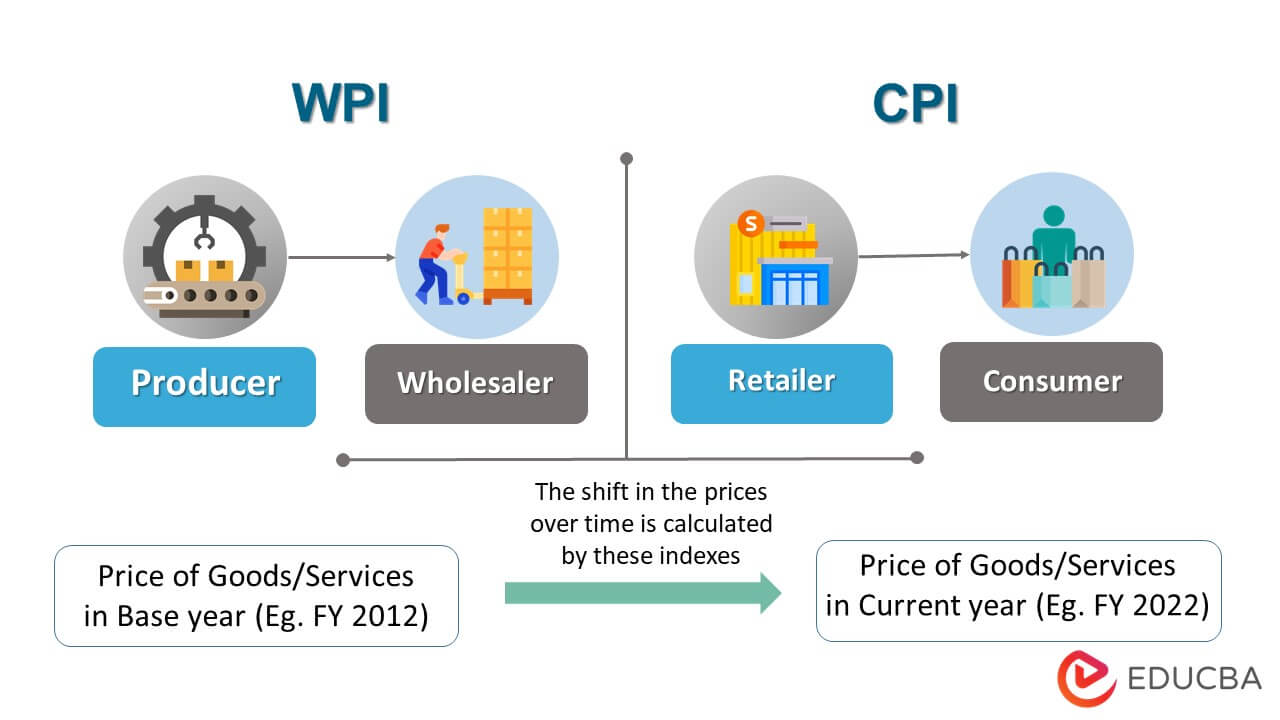
Imagine a product's journey, from the factory to your home. Prices are measured at different points along this supply chain. This is the fundamental difference between the Wholesale Price Index (WPI) and the Consumer Price Index (CPI).
- WPI measures prices at the wholesale level—the price at which goods are traded in bulk between businesses (e.g., from producer to wholesaler).
- CPI measures prices at the retail level—the price that you, the final consumer, pay at the shop.
The image below provides a simple visual for this distinction.
Let's examine each index in more detail.
The Wholesale Price Index (WPI)
The WPI tracks the average change in the prices of goods sold in the wholesale market. It is considered an indicator of producer-side or supply-side inflation. Since it captures prices at an early stage of the distribution process, changes in the WPI often signal future changes in the CPI.
Here are its key features:
- What it measures: Price changes of goods traded in bulk. Crucially, it does not include services.
- Major Components: The WPI basket is divided into three main groups:
- Primary Articles (e.g., food articles, minerals)
- Fuel & Power
- Manufactured Products (This group has the highest weightage, over 64%)
- Published by: The Office of the Economic Adviser, which is part of the Ministry of Commerce and Industry.
- Base Year: 2011-2012.
The Consumer Price Index (CPI)
The CPI measures the average change in retail prices of goods and services that households purchase for their daily consumption. It is often called the cost-of-living index because it directly reflects the inflation experienced by the general public.
Here are its key features:
- What it measures: Price changes of both goods and services purchased by consumers. This is a critical difference from WPI.
- Major Components: The CPI basket is broad and includes items like:
- Food and Beverages (This group has the highest weightage, over 45% in the combined index)
- Housing
- Fuel and Light
- Clothing and Footwear
- Miscellaneous (includes services like education, healthcare, transport)
- Published by: The National Statistical Office (NSO), under the Ministry of Statistics and Programme Implementation.
- Base Year: 2012.
WPI vs. CPI: The Definitive Comparison
Now that we have a foundational understanding of both indices, let's dive into a detailed, point-by-point comparison. This is a high-yield topic for your exam, and the differences are often tested.
CPI vs WPI - Indian Economy Notes
This article from Prepp provides an excellent table that systematically compares the CPI and WPI across all relevant parameters. It also explains why the RBI prioritizes CPI.
Focus on the table under the heading "Difference between CPI and WPI". Go through each parameter—Meaning, Published by, Base Year, Coverage, etc.—and make sure you understand the distinction. After the table, read the short conclusion, which explains the policy relevance of CPI for the RBI.
To reinforce what you've just read, let's summarize the most critical distinctions:
- Coverage: This is arguably the most important difference. WPI tracks only goods, while CPI tracks both goods and services. Since services like education, healthcare, and transport are a huge part of household budgets, CPI provides a much more comprehensive picture of the cost of living.
- Stage of Transaction: WPI measures prices at the first stage (wholesale), while CPI measures prices at the final stage (retail).
- Weightage: The composition of the baskets is different. WPI is dominated by manufactured goods, while CPI gives the highest weightage to food items. This means that a spike in food prices will have a much more immediate and significant impact on the CPI figure.
- Policy Relevance: For years, WPI was India's main inflation measure. However, in 2014, the RBI, under Governor Raghuram Rajan, formally adopted CPI as its anchor for monetary policy. Why? Because CPI directly reflects the prices faced by citizens, and controlling the cost of living is the primary goal of inflation targeting.
Inflation and RBI Policy in the Real World
To see how this works in practice, look at the following chart. It plots India's CPI inflation rate against the RBI's main policy interest rate.

As you can see, the RBI's policy rate responds to the level of CPI inflation. When inflation rises and stays above the target range, the RBI tends to increase its policy rate to cool down the economy and control prices. When inflation falls, it creates room for the RBI to lower rates. This graph is a powerful illustration of the direct link between the CPI data we've discussed and the actions of the central bank.
Conclusion
In this lesson, we moved from measuring the size of the economy to measuring the change in the value of the money within it. You now have a clear framework for understanding how inflation is defined and measured in India.
Here are the key takeaways:
- Inflation is the rate of increase in the general price level, which erodes the purchasing power of money.
- The Wholesale Price Index (WPI) measures inflation at the producer/wholesale level. It only covers goods and is published by the Ministry of Commerce and Industry.
- The Consumer Price Index (CPI) measures inflation at the retail level. It covers both goods and services, reflecting the cost of living for households. It is published by the National Statistical Office (NSO).
- The most critical differences between WPI and CPI are their coverage (goods vs. goods & services), the stage of measurement, and the weightages assigned to different item groups.
- The RBI uses CPI as its primary target for monetary policy because it more accurately reflects the inflation faced by the general public.
Now that we know how to define and measure inflation, our next lesson will delve into its origins. We will explore the primary causes of inflation (demand-pull and cost-push) and deflation, and their broader effects on the economy.