Introduction
Welcome to the next lesson in our journey through macroeconomics. In our previous sessions, we defined Gross Domestic Product (GDP) and explored the three distinct methods used to calculate it—Product, Income, and Expenditure. This gave us a robust framework for understanding how to measure the total economic output within a country's borders.
Today, we will build upon this foundation to differentiate between key national income aggregates: GNP, NNP, NDP, and Per Capita Income. GDP is just one piece of the puzzle. By learning about its "relatives," you'll gain a more nuanced understanding of a nation's economic health, distinguishing between production located within a country and income earned by its citizens. This is crucial for correctly interpreting economic reports and data, a key skill for the RBI Grade B exam. We will approach this systematically, using two simple adjustments—one for depreciation and one for international income flows.
From GDP to Other Aggregates: The Core Concepts
To move from GDP to other aggregates, we need to understand two fundamental distinctions:
- Gross vs. Net: This involves accounting for the "wear and tear" of capital assets.
- Domestic vs. National: This involves accounting for income flows between countries.
The following video from StudyIQ IAS provides an excellent primer on these concepts. It methodically contrasts GDP with GNP and introduces the idea of depreciation.
National income - GDP GNP NDP NNP Explained - Indian Economy Part 11 - Concepts of Macro Economics
This video clearly explains the conceptual difference between production within a territory (Domestic) and production by residents (National), and then introduces the concept of depreciation to differentiate between Gross and Net values.
First, watch the segment from 07:41 to 11:18 which contrasts GNP with GDP. Focus on the examples used to understand who is producing versus where they are producing. Next, watch the explanation of depreciation from 15:00 to 16:34. This will clarify the difference between 'Gross' and 'Net' values.
Now, let's formalize these two adjustments.
1. Adjustment for Depreciation: Gross vs. Net
The term "Gross" in Gross Domestic Product implies that we are looking at the total value produced without making any allowance for the capital equipment that was used up in the process. Think of it like a company reporting its total revenue without subtracting the cost of wear and tear on its machinery.
Depreciation, also known as the Consumption of Fixed Capital (CFC), represents the reduction in the value of a country's capital stock (like factories, machines, and infrastructure) due to wear, tear, and obsolescence over a year.
To get a "Net" value, which reflects the sustainable level of production after maintaining the existing capital stock, we simply subtract depreciation. The relationship is straightforward:
This rule allows us to convert GDP into Net Domestic Product (NDP) and Gross National Product (GNP) into Net National Product (NNP).
2. Adjustment for International Income: Domestic vs. National
The term "Domestic" in GDP means we are measuring all production that happens within the geographical boundaries of a country, regardless of who owns the factors of production.
The term "National," by contrast, refers to the income earned by the normal residents of a country, regardless of where in the world they earned it.
To move from "Domestic" to "National," we must account for international income flows using Net Factor Income from Abroad (NFIA).
NFIA is calculated as:
NFIA = Factor income earned by residents from abroad - Factor income paid to non-residents in the domestic territory.
Let's break this down:
- Factor income from abroad (Inflow): Profits from an Indian-owned company in the UK, salary of an Indian citizen working in Canada.
- Factor income to abroad (Outflow): Profits sent to its home country by a foreign company operating in India, salary of a foreign national working for a company in India.

The relationship is:
For India, NFIA has historically been negative. This means that the income paid to foreigners operating in India is greater than the income earned by Indians from abroad. Consequently, India's GNP is typically lower than its GDP.
Defining the National Income Aggregates
With these two adjustments in hand, we can now define and connect the four main aggregates: GDP, NDP, GNP, and NNP. The following reading provides a clear and structured overview.
4 Kinds of National Income Accounting: GDP, GNP, NNP, NDP
This article from ccsupsc.com systematically defines each of the four aggregates and explains their significance, showing how they are interrelated.
Please read the following parts of the article: Start with the initial overview to get the basic formulas. Review the section on GDP for context. Read the section on NDP, noting its use as an internal indicator. Read about GNP, focusing on its components and utility. Finally, read the definition of NNP, which is considered the purest form of national income.
To summarize and visualize these relationships, let's look at a flowchart. You can start at any point and follow the arrows, adding or subtracting the relevant component to move to the next aggregate.
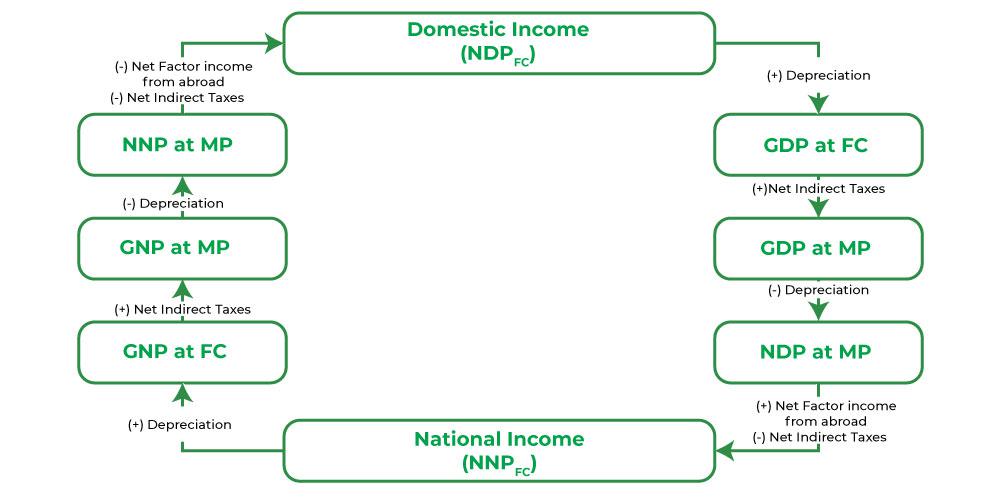
Let's walk through the logic:
-
GDP to NDP: To account for wear and tear on capital, we subtract depreciation.
NDP gives a better picture of sustainable domestic output but is not used for international comparisons because depreciation rates vary across countries. -
GDP to GNP: To shift focus from "where it's produced" to "who produced it," we add NFIA.
GNP measures the total income accruing to a country's residents. The IMF uses GNP for rankings based on Purchasing Power Parity (PPP). -
GNP to NNP: From the gross income of nationals, we subtract depreciation to find the net income.
NNP is considered the purest measure of national income. Net National Product at Factor Cost (NNP at FC) is officially designated as the National Income of India.
Per Capita Income: An Average Measure
While aggregates like GDP and NNP tell us about the total size of the economy, they don't tell us about the average income of individuals. For that, we use Per Capita Income (PCI).
The concept is simple: it's the national income divided by the country's total population.
National Income Accounting - RBI Grade B Study Notes
This note from Oliveboard provides a concise, exam-focused definition of Per Capita Income and its significance.
Read the section on Per-Capita Income. Pay attention to how it's calculated and its use as a measure of standard of living and in the Human Development Index (HDI).
The formula is:
PCI is a powerful tool for comparing the standard of living between different countries or tracking progress over time. However, it's important to remember that it is an average. It does not reveal anything about income distribution or inequality within the country.
Conclusion
In this lesson, we expanded our understanding of national income beyond the single measure of GDP. We've seen how a few logical adjustments can provide different and valuable perspectives on a nation's economy.
Here are the key takeaways:
- Gross vs. Net: The difference is Depreciation (wear and tear of capital). Net figures provide a more sustainable view of economic output.
- Domestic vs. National: The difference is Net Factor Income from Abroad (NFIA). Domestic measures production within a country's borders, while National measures income earned by a country's residents.
- Key Aggregates:
- NDP = GDP - Depreciation
- GNP = GDP + NFIA
- NNP = GNP - Depreciation (or NDP + NFIA). NNP at Factor Cost is India's official National Income.
- Per Capita Income (PCI): This is the National Income divided by the population. It serves as an average measure of the standard of living but hides income disparities.
Having mastered how economic activity is measured, our next lesson will shift focus. We will explore inflation, the rate at which the general level of prices for goods and services is rising, and introduce the two main indices used to measure it in India: the Wholesale Price Index (WPI) and the Consumer Price Index (CPI).