Introduction
Welcome to our third lesson. In the previous session, we explored the foundational microeconomic model of supply and demand, understanding how prices are set in individual markets. We saw how this simple framework could explain complex real-world events like a sudden spike in onion prices. Now, we will shift our focus from a single market to measuring the output of the entire economy, a core concern of macroeconomics.
Today, we will tackle one of the most fundamental concepts in economics. Our learning outcome is to define Gross Domestic Product (GDP) and distinguish between nominal GDP and real GDP. GDP is the most widely used metric for the size and health of a country's economy. You will frequently encounter GDP figures in RBI publications, financial news, and policy discussions. Understanding the difference between its 'nominal' and 'real' values is crucial for accurately interpreting economic growth and is a common topic in the RBI exam.
What is Gross Domestic Product (GDP)?
At its core, Gross Domestic Product (GDP) represents the total monetary value of all final goods and services produced within a country's borders during a specific period, typically a quarter or a year. Let's break down this definition, as each part is significant.
- Monetary Value: GDP sums up millions of different products and services into a single number using their market prices.
- Final Goods and Services: To avoid double-counting, GDP only includes the value of final products. For example, the price of a loaf of bread is counted, but the value of the flour used to make it is not, because the flour's value is already included in the bread's price. The flour is an intermediate good.
- Within a Country's Borders: GDP measures production that occurs geographically within a country, regardless of who owns the production facilities. For instance, the output of a car factory owned by a Japanese company but located in India contributes to India's GDP. This is distinct from Gross National Product (GNP), which measures the output produced by a country's residents, regardless of where they are located.
- Specific Period: GDP is a flow concept, meaning it is measured over a period of time, not at a single point in time.
To get a formal overview of these points, the following reading from the International Monetary Fund (IMF) provides a concise and authoritative explanation.
Gross Domestic Product: An Economy's All
This article from the IMF's "Back to Basics" series clearly defines GDP and its components. It's a great starting point for building a solid definition.
Read the first three paragraphs of the section Measuring GDP. Focus on understanding the definition of GDP, the distinction between GDP and GNP, and what is excluded from GDP calculations (like unpaid work).
The Problem of Rising Prices: Nominal vs. Real GDP
Imagine an economy produces 1,000 apples at ₹10 each in Year 1. Its GDP is . In Year 2, it produces the same 1,000 apples, but now the price is ₹12 each. The GDP is . The GDP number grew by 20%, but did the economy actually produce more? No. The entire increase was due to a rise in prices (inflation).
This simple example reveals a major challenge in comparing GDP over time. We need a way to separate the change in output that is due to an increase in production (what we care about) from the change that is merely due to an increase in prices.
This is where the distinction between Nominal GDP and Real GDP becomes critical.
- Nominal GDP measures output using current prices. In our example, the ₹10,000 for Year 1 and ₹12,000 for Year 2 are both nominal GDP figures. It reflects changes in both quantity and price.
- Real GDP measures output using constant prices from a selected "base year". This strips out the effect of inflation and shows us the change in the actual volume of production. If we use Year 1 as our base year, the Real GDP for Year 2 would still be . Comparing the Real GDP of Year 1 (₹10,000) and Year 2 (₹10,000), we correctly conclude that real economic output did not grow.
The following Khan Academy video provides an excellent mathematical and visual breakdown of this concept. Given your background in computer science, you might appreciate how it frames GDP as a product of price and quantity, systematically isolating the quantity variable to measure real growth.
Real GDP and nominal GDP | GDP: Measuring national income | Macroeconomics | Khan Academy
This video uses a simple "apple economy" to build the intuition for why we need Real GDP and then calculates it step-by-step.
First, watch the initial setup of the problem from 00:00 to 01:43, which explains why nominal figures can be misleading. Next, pay close attention to the visual explanation from 01:50 to 03:08, where GDP is shown as an area (Price × Quantity). Then, see how Real GDP is calculated by holding prices constant from 03:17 to 06:31. Finally, the video formally defines Nominal and Real GDP.
A Side-by-Side Comparison
To consolidate your understanding, let's look at a direct comparison. Economists, policymakers, and especially central banks like the RBI are almost always interested in the growth of Real GDP as it reflects the true performance of the economy.
The infographic below gives a quick visual summary of the key differences.
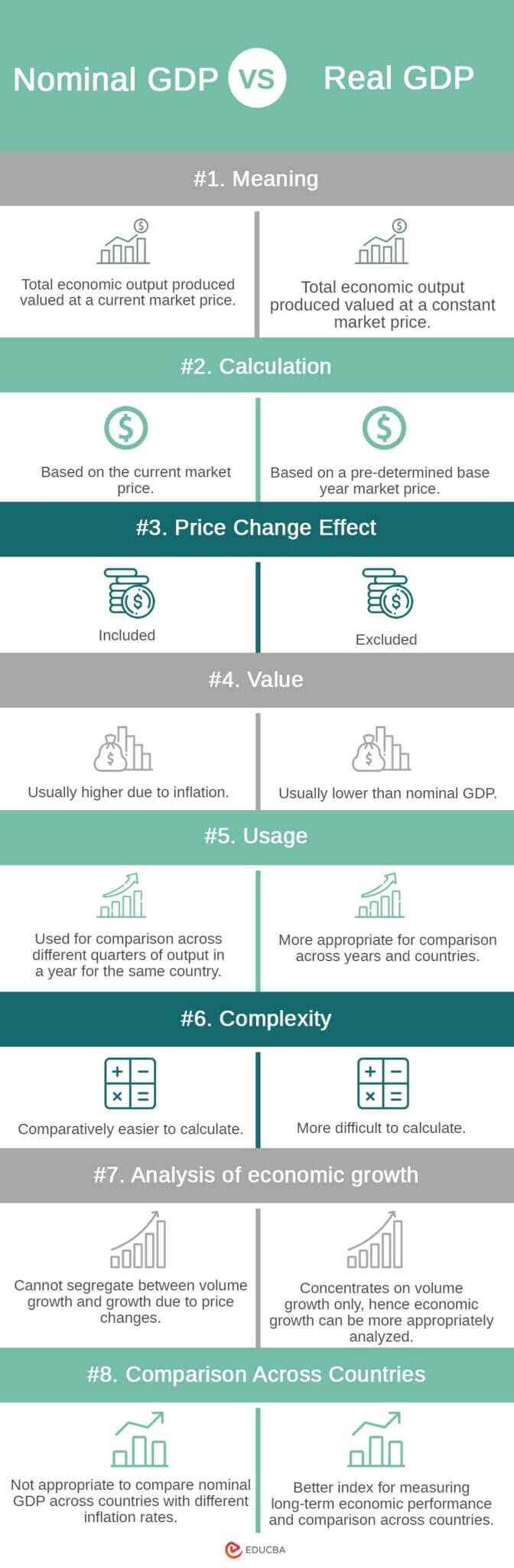
This infographic provides a side-by-side comparison of Nominal GDP and Real GDP across eight key attributes, from their basic meaning and calculation to their usage in economic analysis.
For a more detailed breakdown suitable for your exam preparation, the table in the following reading is very useful.
Difference Between Nominal GDP and Real GDP - Indian Economy ...
This resource from Prepp is tailored for civil service exams and presents the information in a clear, comparative format.
Read the section with the heading "Difference between Nominal GDP and Real GDP" and study the comparison table. This table neatly summarizes the key distinctions you need to know.
The GDP Deflator: Adjusting for Inflation
The tool used to convert Nominal GDP to Real GDP is a price index called the GDP Deflator. It measures the overall change in the price level of all goods and services produced in an economy. The relationship is expressed by a simple formula:
Think of the GDP Deflator as a factor that "deflates" the nominal figure to remove the inflationary component, leaving only the "real" component. When you hear in the news that "the economy grew by 7%," they are referring to the percentage change in Real GDP.
The following short video uses real-world data to show the stark difference between the growth of Nominal and Real GDP over time, demonstrating why this adjustment is so important.
This video from Marginal Revolution University clearly distinguishes between a nominal "mirage" and real growth, using actual data from the US economy as an example.
Watch the explanation of how GDP can increase through prices vs. production. Note the definition of Real GDP as a measure that controls for inflation. Observe the graph of Nominal GDP and how it shows massive growth. Finally, compare this with the graph of Real GDP, which tells a more accurate story of economic growth.
Exam-Oriented Practice
To tie this all together and prepare for your exam, let's review some questions related to this topic. The following resource contains frequently asked questions and multiple-choice questions that mirror what you might encounter.
Difference Between Nominal GDP and Real GDP - Indian Economy ...
This part of the article is excellent for testing your understanding and getting a feel for how these concepts are framed in exams.
First, carefully read the questions and answers in the FAQs section. Then, test yourself with the five questions in the MCQs section before looking at the answers. Finally, review the previous year questions to see how this topic has appeared in past exams.
Conclusion
In this lesson, we have defined Gross Domestic Product and, more importantly, unraveled the crucial distinction between its nominal and real measures. This is not just an academic exercise; it is fundamental to understanding any discussion about economic growth, performance, and policy.
Here are the main takeaways:
- GDP is the total monetary value of all final goods and services produced within a country's borders in a given period.
- Nominal GDP is calculated using current market prices and is inflated by price changes.
- Real GDP is calculated using constant base-year prices, thereby removing the effects of inflation to show the actual change in an economy's output.
- The growth rate of Real GDP is the standard measure of a country's economic growth.
- The GDP Deflator is the price index used to convert nominal GDP into real GDP.
We now have a robust measure for the economy's total output. In our next lesson, we will delve deeper into how this number is actually calculated. We will explore the three methods of calculating national income: the Product (Value-Added) Method, the Income Method, and the Expenditure Method. Understanding these will provide a comprehensive view of the economy's structure from different angles.