¡Hola! Welcome back.
In our last lesson, we focused on expressing opinions, using phrases like me parece que... and the verb gustar. You learned how to say things like, "I think the music is excellent" (Pienso que la música es excelente). This is a crucial skill for small talk.
Today, we're going to add a new layer to that skill. We'll dive into the specific dialect of your destination: Colombian Spanish. The goal of this lesson is to help you recognize and use common Colombian colloquialisms and expressions for social situations. Learning these colombianismos will make your Spanish sound more natural and help you connect more easily with native speakers at the wedding. Think of it as moving from a standard library to a highly-optimized, specialized one for a specific task.
We'll cover four key areas:
- Essential social phrases for greetings and politeness.
- Versatile words like
chévereandvainato describe things and situations. - The ubiquitous use of diminutives (
-ito/-ita) to add politeness and affection. - Filler words (
muletillas) likepuesto make your speech flow more naturally.
1. Foundational Social Phrases: Sounding Like a Local
Certain phrases are staples of daily interaction in Colombia. Using them correctly is a fast track to sounding friendly and polite.
First, let's adjust some basic conversational building blocks you already know.
The Most Common Expressions You'll Come Across In Colombia!
The video 'The Most Common Expressions You'll Come Across In Colombia!' by How To Expat provides excellent context for three of the most important phrases. The conversational format makes them easy to grasp.
Please watch the following clips: 01:23 - 01:57 for qué pena (how to say 'sorry' or 'excuse me'). 02:28 - 03:03 for con mucho gusto (how to say 'you're welcome'). 04:19 - 05:16 for ¿qué más? (a common way to say 'how are you?'). Notice how the speakers explain not just the meaning, but the feeling behind the words.
Let's summarize and solidify these key phrases:
- Greeting:
¿Qué más?- Instead of just
¿Cómo estás?, you will hear¿Qué más?constantly. It literally means "What else?" but functions as "What's up?" or "How's it going?". It's a perfect, friendly ice-breaker. You can even combine them:Hola, ¿cómo estás? ¿Qué más?
- Instead of just
- Politeness (You're welcome):
Con mucho gusto- While
de nadais correct,con mucho gusto("with much pleasure") is far more common and warmer in Colombia. It reflects a culture that values hospitality. If someone thanks you (gracias), responding withcon mucho gustois the local standard.
- While
- Politeness (Sorry/Excuse me):
Qué pena- This is a crucial one. It translates to "what a shame/pity," but it's used for everything from bumping into someone (
¡Uy, qué pena!) to expressing regret. It conveys a sense of being slightly embarrassed by the inconvenience, making it softer than a directperdón.
- This is a crucial one. It translates to "what a shame/pity," but it's used for everything from bumping into someone (
2. Expressing Opinions and Describing "Things"
In the last lesson, you learned to say Me parece interesante. Now, let's learn the Colombian shortcuts for expressing "cool," "awesome," or "too bad."
21 Essential Colombian Spanish Phrases for Social Interactions
The article '21 Essential Colombian Spanish Phrases for Social Interactions' from Digital Polyglot gives clear, concise definitions for some of the most versatile slang words.
Please read the sections covering the following phrases: Chévere: The most important word for 'cool'. Chimba: A more intense, but trickier, version of 'cool'. Paila: For when things go wrong. Vaina: The ultimate multi-purpose word.
Let's break these down:
Chévere/Bacano: These are your go-to words for "cool," "great," or "fantastic." They are safe to use in almost any social context.- A:
¿Qué te parece la música?(What do you think of the music?) - B:
¡Está muy chévere!(It's really cool!)
- A:
Chimba: This word is extremely common but has a dual meaning. It can mean "awesome" (¡Qué chimba de fiesta!- "What an awesome party!") or something of poor quality depending on tone and context. As a beginner, it's best to stick withchévereto be safe, but it's essential to recognizechimbawhen you hear it.Paila: Use this when something has gone wrong or you're out of luck. It's like saying "too bad" or "you're toast."Se acabó el postre.(The dessert is all gone.)¡Uy, paila!(Oh, too bad!)
- The catch-all
Vaina: This is one of the hallmarks of Colombian (and Caribbean) Spanish. It means "thing," "stuff," "matter," or just about anything you can't or don't want to name. Given your background, you can think of it as a pointer to a generic object; its value is determined entirely by context.Pásame esa vaina.(Pass me that thing.)¿Qué es esa vaina?(What is that thing/situation?)La vaina es complicada.(The matter is complicated.)
Here is a video that introduces more of these terms. You don't need to memorize them all, but listen for the pronunciation and rhythm.
COLOMBIAN SPANISH AND COLOMBIAN EXPRESSIONS
This video, 'COLOMBIAN SPANISH AND COLOMBIAN EXPRESSIONS' from Learn Spanish World, is a rapid-fire introduction to many common terms. We'll use it as an exposure tool.
Watch from 01:27 to 02:27. Focus on hearing chévere and paila in context. You will also hear other words; just focus on getting a feel for the sound of Colombian slang.
Test your understanding!
What Colombian phrase would you use in these wedding scenarios?
- Someone thanks you for holding a door for them. You say: __________
- You try a piece of cake and it's delicious. You tell your friend:
¡El pastel está muy \_\_\_\_\_\_\_\_\_\_! - You accidentally bump into someone on the dance floor. You say:
¡Uy, \_\_\_\_\_\_\_\_\_\_! - You see a friend and want to greet them informally. You say:
Hola, ¿\_\_\_\_\_\_\_\_\_\_?
Show answer
Con mucho gustochévere(orrico/deliciosofrom the last lesson!)qué penaqué más
3. The Art of the Diminutive: -ito and -ita
One of the most charming and important features of Colombian Spanish is the frequent use of diminutives. Adding -ito (for masculine words) or -ita (for feminine words) does more than just mean something is small.
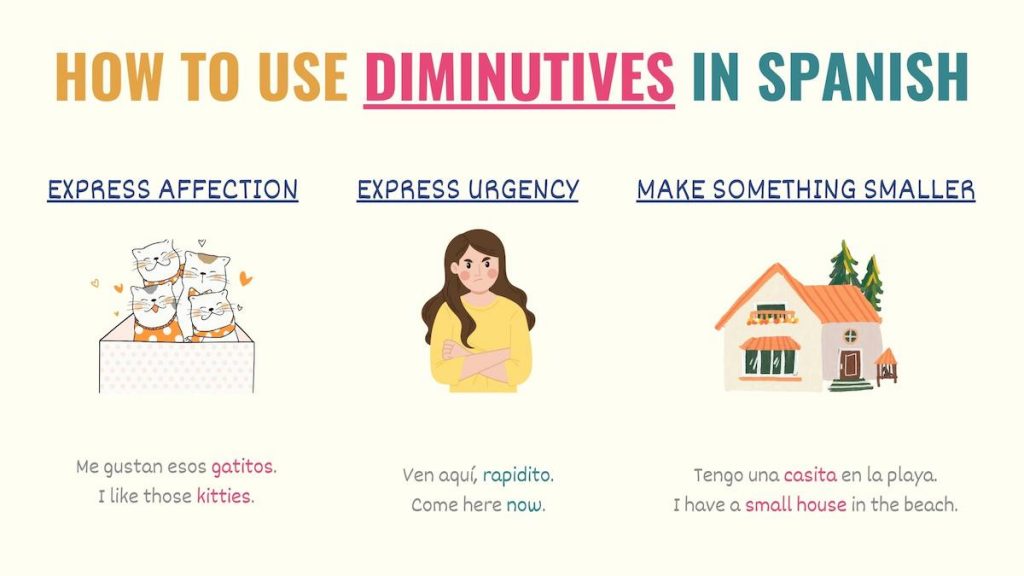
In Colombia, the politeness and affection aspects are paramount. It softens requests and makes interactions warmer. At the wedding, you will hear this everywhere.
- Instead of
café->un cafecito(a little coffee, offered warmly) - Instead of
ahora->ahorita(right now, but in a softer, less demanding way) - Instead of
un momento->un momentico(just a moment, please) - Instead of
una cerveza->una cervecita(a beer, in a friendly, casual way)
Rule of thumb: When in doubt, adding -ito/-ita to a noun when offering something or making a small request is a great way to sound friendly and polite. For example, asking ¿Quieres un vinito? (Want a little wine?) is much warmer than ¿Quieres vino?.
4. Sounding Fluent with Filler Words (Muletillas)
Every language has filler words—like "um," "like," or "well" in English. In Spanish, these are called muletillas. Using them correctly is a key part of "learning how to learn" because they give you time to think and make your speech sound less robotic.
The most common and useful filler word in Colombia is pues.

You can use pues at the start of a sentence to buy a second to think.
¿Qué te pareció la ceremonia?(What did you think of the ceremony?)**Pues**... me pareció muy bonita.(Well... I thought it was very beautiful.)
Another common one is bueno, which also works like "well" or "okay" to start a sentence or transition.
The 20 most common Spanish filler words or "muletillas"
For a more structured look at this concept, the article 'The 20 most common Spanish filler words or "muletillas"' from Learn More Than Spanish provides an excellent overview.
Please read the introduction to understand what 'muletillas' are. Then, focus on the section '“Muletillas” used to buy time to think or to re-phrase', specifically the explanations for Pues and Bueno.
Don't worry about learning all 20 muletillas. For now, just try to notice when you hear pues and bueno, and practice using pues to give yourself a moment before answering a question.
Conclusion
Great job today! We've moved beyond standard textbook Spanish and added some authentic Colombian flavor to your vocabulary. These expressions are the kinds of details that show you've made an effort to connect with the local culture, which will be greatly appreciated at the wedding.
Key Takeaways:
- For greetings and politeness, prioritize:
¿Qué más?,con mucho gusto, andqué pena. - To express "cool," your safest and most useful word is
chévere. - The word
vainais a versatile placeholder for "thing" or "stuff." - Use diminutives (
-ito,-ita) likeun cafecitoto sound warmer and more polite. - Use
puesas a filler word to give yourself a moment to think and sound more natural.
Preview of the Next Lesson:
Now that you've learned some informal expressions, it's crucial to understand the formal side of the coin. In our next lesson, we will cover the prevalent use of usted in formal and informal Colombian contexts. This is a critical piece of the social puzzle and will help you address everyone from the bride's grandmother to your peers with the correct level of respect. ¡Nos vemos