¡Hola! Welcome back.
In our last lesson, we dove into the world of Colombian colloquialisms, learning how to sound more natural with phrases like chévere, qué pena, and ¿qué más?. We focused on the friendly, informal side of conversations. Today, we'll address the other, equally crucial, side of that coin: showing respect and understanding social hierarchy.
This lesson directly tackles a key nuance of Colombian Spanish. We will explore the prevalent use of 'usted' in both formal and informal contexts. While most Spanish courses teach a simple formal/informal split, the reality in Colombia—your destination—is more complex and interesting. Mastering this will be a significant step in your goal to "learn how to learn" Spanish effectively for this specific context, allowing you to navigate wedding conversations with confidence and politeness.
1. The Standard Rule: Tú vs. Usted
First, let's establish the baseline rule that applies across the Spanish-speaking world. Spanish has two ways to say "you" (singular): tú (informal) and usted (formal).
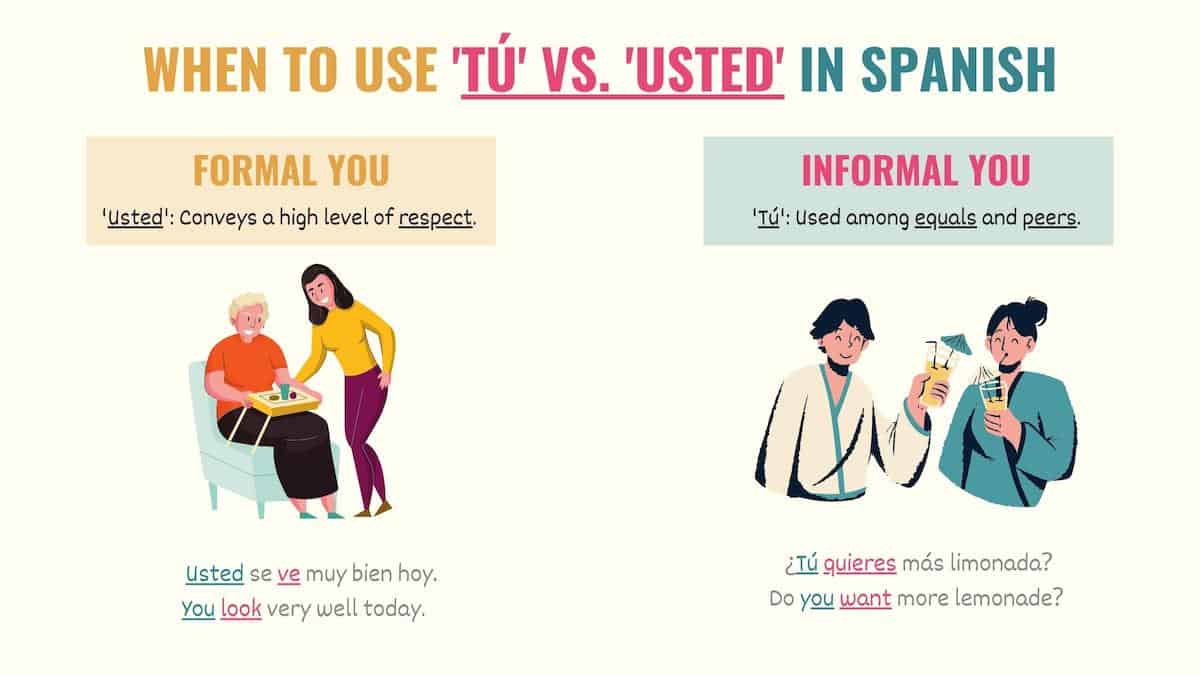
This general distinction is the foundation for everything else. To see this rule explained clearly, let's watch a short video.
When and How to Use Usted in Spanish [Tú vs Usted / Informal vs Formal]
The video 'When and How to Use Usted in Spanish' from the channel Spanish and Go provides a great overview of the standard distinction between the informal 'tú' and the formal 'usted'.
Please watch the following segments: 00:38 - 01:18: When to use the informal tú. 01:18 - 02:26: When to use the formal usted. 02:26 - 03:53: How people might invite you to switch from usted to tú and the golden rule: 'When in doubt, use usted.' Focus on the types of relationships associated with each pronoun.
To summarize, the standard rule is:
- Use
túwith friends, people your own age or younger, family members, and colleagues you are familiar with. - Use
ustedwith older people, authority figures (a boss, a professor), people you've just met, and in service encounters (e.g., with a waiter).
This principle of using usted to show respect is your safest starting point.
2. The Grammatical Shift
Choosing between tú and usted isn't just about picking a pronoun; it changes the verb conjugation. This is a systematic rule that should fit well with your engineering background.
The key rule is: Usted uses the same verb conjugations as the third-person singular (él/ella - he/she).
This is why you've learned phrases like ¿Cómo estás? (with an -s for tú) and ¿Cómo está? (no -s, for usted).

You don't need to memorize this entire chart right now, but recognize the pattern. Let's see how this applies to the basic introductory questions.
Learn Spanish - Should I use Tú or usted in Spanish? (informal vs. formal)
The video 'Learn Spanish - Should I use Tú or usted in Spanish?' by Señor Jordan clearly demonstrates how basic questions change from the 'tú' form to the 'usted' form.
Watch from 01:16 to 02:53. Pay close attention to how these three questions transform: ¿Cómo estás? → ¿Cómo está usted? ¿Cómo te llamas? → ¿Cómo se llama usted? ¿De dónde eres? → ¿De dónde es usted?
Notice that the speaker often adds the word usted at the end of the question. This is common for clarity, especially when you are first establishing the formal relationship.
3. The Colombian Context: Where Usted Is King
Now we get to the most important part for your trip. In many parts of Colombia, especially the Andean region which includes Bogotá, usted is used far more broadly than in other countries, often replacing tú even in informal situations.
This is a crucial cultural and linguistic detail. Using usted is not necessarily about being formal or distant; it's a deeply ingrained sign of respect that permeates everyday interactions.
Tu vs Usted: TÚ or not to TÚ? That IS the question!
To understand this nuance, let's read an article from The Bogotá Post, which does an excellent job of explaining the cultural weight of 'tú' vs. 'usted' in Colombia.
Please read the following two sections from the article: Start at the beginning with 'Tú vs usted: the basics'. This introduces the idea that 'usted' is the default for men in central Colombia. Continue with the next section, which starts with 'Tú is a way to address someone that entails higher proximity...'. This explains the fascinating idea of 'linguistic distance' and why 'usted' is so common. Focus on the concept that using 'tú' can feel overly familiar, almost like physical touching.
This idea of usted creating a "linguistic distance" is a powerful mental model. Even among close friends or family, usted is often used as the default respectful way of speaking. To see this with clear examples, let's look at another resource.
Pronouns in Colombian Spanish: A Quick Guide
The article 'Pronouns in Colombian Spanish: A Quick Guide' by Digital Polyglot provides concise, practical examples of this phenomenon.
Read the section titled '“Usted” and the Culture of Respect in Colombia'. Pay attention to the examples of 'usted' being used between friends and family.
As you can see from the examples like ¿Usted ya almorzó? ("Have you had lunch yet?" between friends) or Mamá, ¿usted me ayuda con la tarea? ("Mom, can you help me with my homework?"), the use of usted in Colombia goes far beyond simple formality.
Test your understanding!
Imagine you are in Bogotá. You hear a young man ask his friend, also a young man, a question. Based on what you've just learned, which of these two phrases is he more likely to use?
¿Tú quieres ir al cine?(Do you want to go to the movies?)¿Usted quiere ir al cine?(Do you want to go to the movies?)
Show answer
¿Usted quiere ir al cine?
In the Bogotá region, it is very common for men to use usted with each other, even as friends. Using tú could be seen as unusual or overly familiar.
4. A Practical Guide for the Wedding
So, what does this all mean for you at the wedding? How do you decide which pronoun to use when talking to a new person?
The best approach is to be observant and start respectfully.
Tu vs Usted: TÚ or not to TÚ? That IS the question!
The Bogotá Post article we looked at earlier has an excellent, pragmatic checklist for foreigners. This is your go-to guide.
Please read the section titled 'Which pronoun should I use?'. This is a list of bullet points with practical advice for navigating conversations in Colombia.
Here is a summary of your strategy for the wedding:
- When in doubt, always start with
usted. It is always polite and can never be wrong. - Use
ustedwith the parents/grandparents of the bride and groom, anyone significantly older than you, or any authority figure. For example:Señora, ¿usted quiere algo de tomar?(Ma'am, would you like something to drink?). - Listen carefully. Pay attention to how the person you're speaking with addresses you. If they use
túwith you, it's generally a signal that you can usetúwith them. This is called being "tuteado." - If you are speaking with another man around your age, using
ustedis a very safe and common choice. - Romantic partners and very close friends often use
tú, but don't assume.Ustedis still common even in close relationships.
Conclusion
Fantastic work today. You've just learned one of the most important and nuanced aspects of communicating effectively in Colombia. Understanding the expanded role of usted moves you beyond generic "textbook" Spanish and into a more authentic, culturally aware way of speaking.
Key Takeaways:
- Globally,
túis informal andustedis formal. Ustedis conjugated likeélorella(e.g.,usted habla,usted come).- In Colombia,
ustedis the default pronoun for showing respect, and is used very frequently even in informal settings among friends and family. - Your strategy at the wedding should be: Start with
ustedand listen to how people address you to know if you can switch totú.
Preview of the Next Lesson:
Now that you have a solid framework for how to address people respectfully (usted), you're ready to learn what to say at the celebration. In our next lesson, we will focus on the vocabulary and phrases for offering congratulations, giving compliments, and expressing good wishes at a celebration. ¡Hasta la próxima