¡Hola! Welcome back.
In our last lesson, you mastered one of the most important social nuances of Colombian Spanish: the prevalent use of usted to show respect. You now have the framework for how to address people politely at the wedding. Today, we'll build directly on that foundation by learning what to say.
This lesson is designed to give you the exact phrases you'll need to participate in the celebration. We'll cover how to offer congratulations, give compliments, and express good wishes. In line with your preference for a structured approach, we won't just memorize phrases; we'll break them down into reusable patterns that you can adapt, with a constant focus on using the respectful usted form.
1. Offering Congratulations
A wedding is all about celebrating the couple. Let's start with the most essential phrases you'll need.
The Core Phrases: Felicidades vs. Felicitaciones
You'll hear two common words for "congratulations": ¡Felicidades! and ¡Felicitaciones!. They are often used interchangeably, but there's a subtle distinction that's useful to know.
Congratulations in Spanish: Phrases For Every Occasion
The article 'Congratulations in Spanish: Phrases For Every Occasion' from Baselang gives a clear explanation of this nuance.
Read the first few paragraphs of the article, down to the table of 'Most Commonly Used Words'. Focus on the distinction made between when to use '¡Felicidades!' and '¡Felicitaciones!'.
To summarize:
¡Felicidades!is used for major life events, happiness, and celebrations like birthdays, anniversaries, and—most importantly for you—weddings.¡Felicitaciones!is often used to praise someone for an achievement that resulted from effort, like a graduation or a promotion.
For the wedding, ¡Felicidades! is your go-to word.
Customizing Your Congratulations
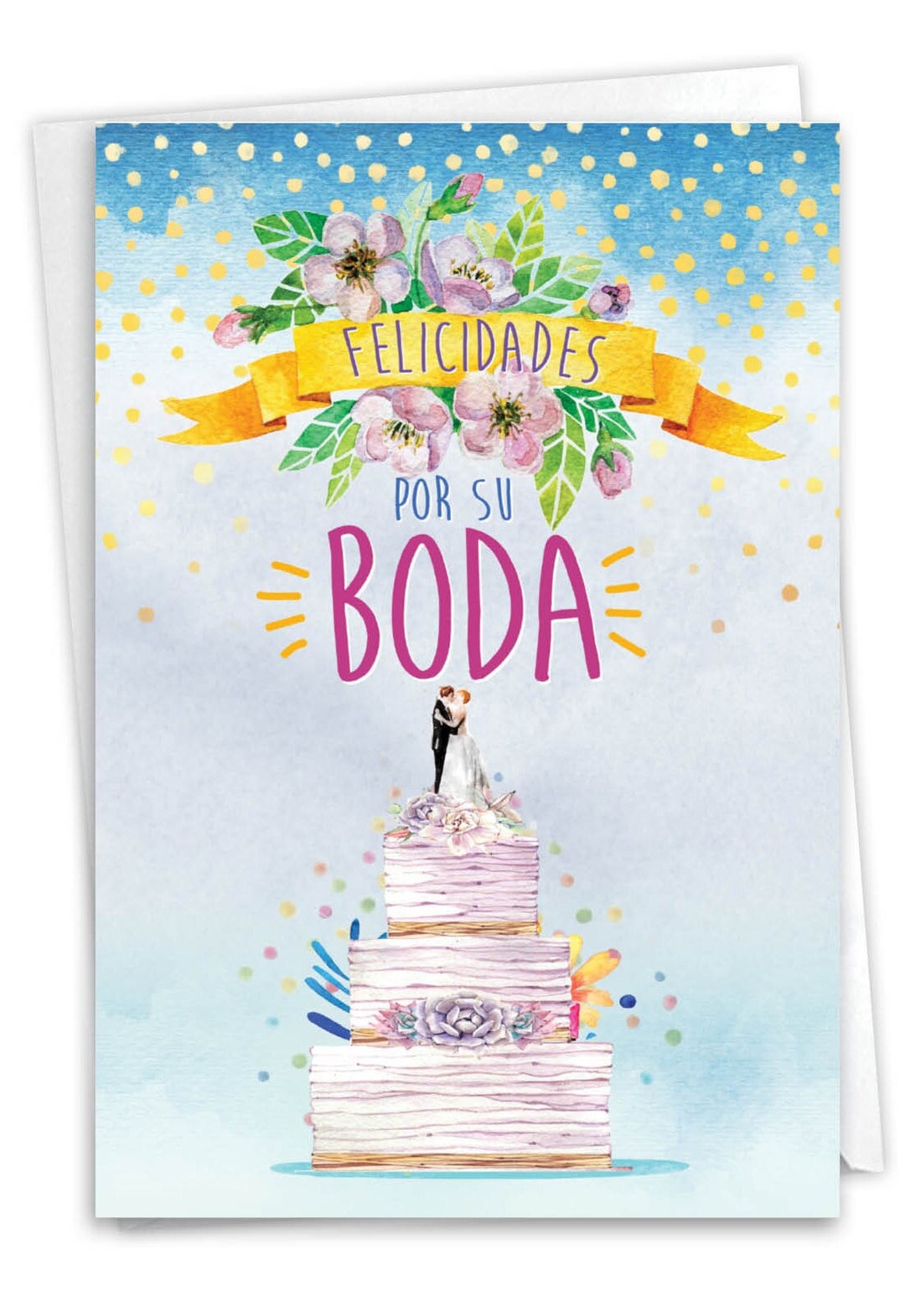
A simple ¡Felicidades! is good, but being more specific is even better. The system for this is straightforward: you use the preposition por (for).
Formula: Felicidades + por + [the event]
The article below provides more examples of this powerful structure.
The Best Ways to Say Congratulations in Spanish
The article 'The Best Ways to Say Congratulations in Spanish' from SpanishVIP explains this pattern well.
Please read the section titled 'Felicidades por'. Notice how this simple structure allows you to congratulate someone on a variety of specific events.
So, at the wedding, you can say:
¡Felicidades por la boda!(Congratulations on the wedding!)¡Felicidades por su matrimonio!(Congratulations on your marriage!)
More Elaborate Phrases
For a more formal or heartfelt touch, you can use a longer phrase. Here are some excellent options, perfect for a wedding card or a toast.
| Spanish | English |
|---|---|
¡Felicidades en esta nueva etapa de sus vidas! |
Congratulations on this new phase of your lives! |
¡Felicidades por su boda! |
Congratulations on your wedding! |
¡Les deseo lo mejor en su vida de casados! |
I wish you the best in your married life! |
(These phrases are from the Baselang article LINK we looked at earlier.)
The pronoun les in Les deseo means "to you (plural)," which is perfect for addressing the couple together.
2. Expressing Good Wishes
After congratulating the couple, it's natural to wish them well for their future. The key verb here is desear (to wish).
Formula: Le/Les deseo + [good wish]
Le deseo...= I wish you... (to one person, usingusted)Les deseo...= I wish you... (to two or more people, i.e., the couple)
Let's watch a short video that introduces a fundamental phrase for this.
How to congratulate someone in Spanish
The video 'How to congratulate someone in Spanish' by Butterfly Spanish introduces a key phrase for wishing someone the best.
Watch from 05:27 to 06:22. The presenter uses the informal 'te deseo'. Remember that to speak to someone using 'usted', you will change 'te' to 'le'.
As the video explains, a wonderful, all-purpose phrase is Te deseo todo lo mejor. To adapt this for the usted form, you simply change the object pronoun te to le:
- To one of the newlyweds:
Le deseo todo lo mejor.(I wish you all the best.) - To the couple together:
Les deseo todo lo mejor.(I wish you [plural] all the best.)
You can also be more specific:
Les deseo una vida llena de felicidad.(I wish you a life full of happiness.)Le deseo mucho éxito en su matrimonio.(I wish you much success in your marriage.)
Test your understanding!
You are speaking to both the bride and groom at the same time. How would you say, "Congratulations on the wedding! I wish you all the best."?
Show answer
¡Felicidades por la boda! Les deseo todo lo mejor.
You use Felicidades por la boda for the event and Les deseo because you are addressing them as a couple (plural).
3. Giving Compliments
Small talk at a wedding is full of compliments—about the ceremony, the venue, the food, or how people look. This is a great chance to practice your conversation skills. We'll use a systematic approach to build compliments.
Let's watch a video that presents a large number of compliments. A quick note: the video uses the informal tú forms (eres, tienes). This is a perfect opportunity for you to actively practice what you learned in the last lesson by mentally converting them to the formal usted form.
Master the Art of Giving Compliments in Spanish
The video 'Master the Art of Giving Compliments in Spanish' from Spanish Mastery is a fantastic resource. It's structured in the systematic way you prefer, grouping phrases by verb.
Watch from 00:18 to 08:08. As you watch, pay close attention to the three main patterns used: eres + adjective (e.g., eres muy amable) tienes + noun (e.g., tienes un gran corazón) me encanta/gusta + noun (e.g., me encanta tu estilo) Your task is to think about how to adapt each pattern for a conversation using usted.
Great. Now let's break down how to convert those patterns to the formal usted form.
Pattern 1: Usted es... + Adjective
The video uses eres (you are, informal). For usted, this becomes es.
Eres muy amable(You are very kind) →Usted es muy amable.Eres muy elegante(You are very elegant) →Usted es muy elegante.
Remember that adjectives must agree in gender. For example, to compliment a woman you would say Usted es muy simpática (friendly), and for a man, Usted es muy simpático.
Pattern 2: Usted tiene... + Noun Phrase
The video uses tienes (you have, informal). For usted, this becomes tiene.
Tienes un gran sentido del humor(You have a great sense of humor) →Usted tiene un gran sentido del humor.Tienes una gran personalidad(You have a great personality) →Usted tiene una gran personalidad.
Pattern 3: Using Me gusta / Me encanta
This pattern, meaning "I like / I love," is extremely useful for complimenting things. The verb (gusta/encanta) doesn't change based on who you're talking to, but the possessive adjective does.
tu(your, informal) →su(your, formal)
Examples:
Me encanta tu vestido(I love your dress) →Me encanta su vestido.Me gusta tu traje(I like your suit) →Me gusta su traje.
We'll cover possessive adjectives like su in more detail later, but for now, just know that su is the correct form to use with usted.
Wedding-Specific Compliments:
- To the bride:
¡Qué vestido tan bonito!(What a beautiful dress!) orUsted se ve hermosa.(You look beautiful.) - To the groom:
Usted se ve muy elegante.(You look very elegant.) - About the celebration:
La comida está deliciosa.(The food is delicious.) or¡Qué fiesta tan increíble!(What an incredible party!)
Conclusion
Excellent work today. You've just equipped yourself with the essential vocabulary and grammatical structures for some of the most important interactions at a wedding. By understanding these patterns, you can go beyond memorization and begin to create your own appropriate and respectful phrases.
Key Takeaways:
- For Congratulations: Use
¡Felicidades!for life events. The key phrase is¡Felicidades por la boda!. - For Good Wishes: Use the structure
Le/Les deseo.... The most useful phrase isLes deseo todo lo mejorfor the couple. - For Compliments: Adapt informal phrases to the
ustedform:eres→usted estienes→usted tienetu→su(e.g.,Me encanta su...)
- Always default to
ustedto show respect.
Preview of the Next Lesson:
Today, we learned the specific building blocks for celebrating with others. In our next and final lesson of this module, we will put everything together. You will learn how to combine learned structures to navigate multi-turn conversations about introductions, travel, and personal experiences, simulating the kind of small talk you'll be having at the wedding. ¡Nos vemos