Introduction
Hello! Welcome to the final lesson in our module on the "Foundations of Parallel Architectures." Over the past few lessons, we have individually explored three fundamental parallel architectures:
- Shared-Memory Systems: Characterized by multiple processors sharing a single address space, typical of modern multi-core CPUs.
- Distributed-Memory Systems: Composed of independent nodes, each with its own private memory, connected by a network.
- GPU-based Systems: Specialized accelerators with thousands of simple cores designed for massive data parallelism.
In this lesson, we will synthesize this knowledge to achieve our learning outcome: to compare the primary trade-offs between shared-memory, distributed-memory, and GPU-based systems. Understanding these trade-offs is crucial for any engineer or scientist aiming to select the right tool for a given computational problem. We will compare these systems across several key dimensions, including their memory models, programming complexity, performance characteristics, and ideal application domains.
1. Architectural and Memory Model Comparison
The most fundamental difference between these systems lies in how their processors access memory. This architectural choice has profound implications for programming, communication, and scalability.
Shared vs. Distributed Memory
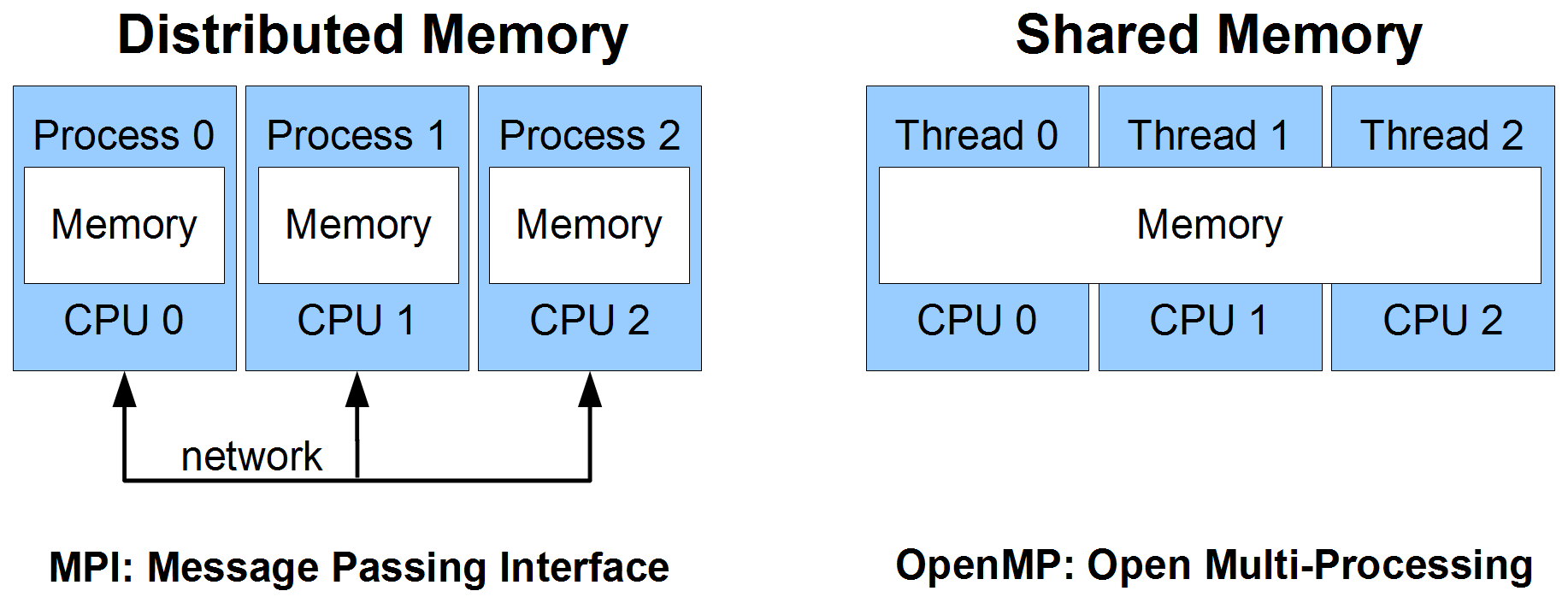
Let's start with a quick visual recap of the two primary CPU-based models.
-
Shared-Memory Systems:
- Architecture: All processor cores share a single global address space.
- Communication: Implicit and low-latency. One core writes to a memory location, and another core can read from it (managed by cache coherence protocols).
- Limitation: Scalability is limited. As you add more cores, the shared bus or interconnect becomes a bottleneck, and the overhead of keeping caches coherent increases. It's difficult to build a single system with thousands of cores sharing memory this way.
-
Distributed-Memory Systems:
- Architecture: Each processor (or node) has its own private memory. There is no global address space.
- Communication: Explicit and higher-latency. Processors communicate by sending and receiving messages over a network.
- Advantage: Highly scalable. You can connect thousands of nodes to build a massive supercomputer, as memory bandwidth and access are not a central bottleneck.
The GPU Model: A Specialized Hybrid
A GPU introduces a third, more complex model. It acts as a co-processor or accelerator attached to a CPU (the host).
- Architecture: The GPU (device) has its own, separate memory space (its onboard VRAM, called "global memory"). This memory is physically distinct from the CPU's main memory (RAM).
- Communication:
- Host-Device: Explicit and a major performance bottleneck. Data must be copied from CPU RAM to GPU VRAM before computation and results copied back after. This is typically done over a PCIe bus.
- On-Device: The GPU has its own sophisticated memory hierarchy, which you explored in the last lesson. Communication between threads on the GPU is managed through this hierarchy, with extremely fast on-chip shared memory being crucial for performance.
2. Programming Models and Complexity
The underlying architecture dictates the programming model used to harness its power. We'll associate these architectures with their most common programming APIs: OpenMP (shared), MPI (distributed), and CUDA (GPU).
A Comparative Analysis of MPI, OpenMP, and CUDA
The research paper 'A Comparative Analysis of MPI, OpenMP, and CUDA' provides an excellent summary of the trade-offs. We'll start by focusing on the programming complexity and key characteristics.
Please review Table I and read the short section III.E, 'Ease of Use and Development Effort'. Focus on how each model's approach (directives, message passing, kernels) influences programming complexity and development time.
As you've just read, there's a clear spectrum of complexity:
- Shared Memory (OpenMP): Generally considered the easiest to use. You can often parallelize existing C++ code incrementally by adding compiler directives (
#pragma omp ...) to loops. Communication is implicit—you just use shared variables. The main challenge is correctly using synchronization primitives (likecritical,atomic,barrier) to prevent race conditions. - Distributed Memory (MPI): The most complex model. You are responsible for everything: partitioning the data across processes, explicitly sending and receiving data with functions like
MPI_SendandMPI_Recv, and ensuring processes are synchronized. The potential for deadlocks and the cognitive overhead of managing data flow is high. - GPU (CUDA): Has a steep learning curve. It requires you to think in terms of massive parallelism and write separate functions called kernels that execute on the GPU. The biggest challenge is managing the complex memory hierarchy—moving data between the CPU and GPU, and using on-chip shared memory effectively to minimize slow global memory access. This often requires significant code restructuring compared to a standard CPU algorithm.
3. Performance, Scalability, and Application Suitability
This is the heart of the trade-off. Each system is designed to excel at a different kind of task. A key distinction is between being latency-optimized (like a CPU) and throughput-optimized (like a GPU).
CPU vs GPU vs TPU vs DPU vs QPU
To reinforce this core concept, let's watch a video that contrasts the design philosophy of CPUs and GPUs.
Please watch from 05:17 to 06:06. Pay attention to the analogy used to describe the difference between a CPU and a GPU and their suitability for different types of tasks.
A CPU core is a "jack of all trades"—fast and versatile, designed to execute a single thread of complex, branching instructions with minimum delay (low latency). A GPU is a specialist, packed with thousands of simple cores that execute simple instructions in parallel to process massive datasets (high throughput).
Let's look at some quantitative data. Given your background in engineering, seeing the real-world performance impact will be insightful.
GPU applications for modelling, imaging, inversion and machine...
The following geophysical research paper provides a fantastic, practical comparison of these three models for a finite-difference modeling task. The results clearly illustrate the performance trade-offs.
Please read two short sections: Start at the section titled 'MODELING' and examine Figure 10. This figure directly compares CPU OpenMP (shared), a CPU hybrid model (distributed), and GPU CUDA. Next, read the section 'REVERSE TIME MIGRATION' and focus on the paragraph comparing the run time of a GPU desktop to a 10-node CPU cluster. Note the orders of magnitude in speedup.
The results from that paper are striking:
- In the finite-difference test, the GPU was 20 to 100 times more efficient than the hybrid CPU cluster model.
- For the Reverse Time Migration task, a single GPU on a desktop computer completed the job in 1/4 of the time it took a 10-node CPU cluster, at a fraction of the hardware cost and energy consumption.
This brings us to a summary of which problems fit each architecture best.
| Aspect | Shared-Memory (Multi-core CPU) | Distributed-Memory (Cluster) | GPU-based System |
|---|---|---|---|
| Primary Strength | Low-latency, task parallelism, ease of use. | Massive scalability, large memory capacity. | Massive data parallelism, high throughput. |
| Programming Model | Implicit communication (shared variables), directives (OpenMP). | Explicit communication (message passing, MPI). | Kernel-based, explicit host-device data management (CUDA). |
| Communication Cost | Low (on-chip), but synchronization can add overhead. | High (network latency), a primary performance limiter. | Very high host-device cost; extremely low on-chip (shared memory). |
| Scalability | Poor to moderate (tens of cores). Limited by memory bus contention. | Excellent (thousands of nodes). Designed for weak scaling. | Excellent on-chip parallelism, but scaling across multiple GPUs requires MPI. |
| Ideal Workloads | Irregular problems, task-based workflows, parallelizing sections of existing code. Ex: Web servers, desktop applications. | Coarse-grained problems where data can be split into large, independent chunks. Ex: Large-scale climate models, cosmological simulations. | Fine-grained, arithmetically intense data-parallel problems. Ex: Deep learning, linear algebra, image processing. |
4. The Rise of Hybrid Models
As you may have noticed, these architectures are not mutually exclusive. The most powerful supercomputers today are heterogeneous, combining the strengths of all three models. A typical high-performance computing (HPC) node consists of:
- Multiple CPUs with several cores each (a shared-memory system).
- One or more GPUs attached as accelerators.
- Many of these nodes are connected via a high-speed network (a distributed-memory system).
Programming these systems often involves a hybrid approach:
- MPI + OpenMP: MPI is used for communication between nodes, and OpenMP is used to exploit all the CPU cores within a single node.
- MPI + CUDA: MPI is used to distribute work across multiple nodes, each of which uses its GPU(s) to perform the heavy computation.
This allows developers to map the different levels of parallelism in their application to the most appropriate hardware level.
Conclusion
We've now completed our survey of the foundational parallel architectures. You should have a clear understanding of the critical trade-offs involved when choosing a parallel system.
Key Takeaways:
- No single "best" architecture exists. The optimal choice is driven by the problem's characteristics: its data size, communication patterns, and type of parallelism.
- Shared-memory systems (multi-core CPUs) are easy to program and are great for general-purpose, latency-sensitive, or task-based parallelism on a single machine.
- Distributed-memory systems (clusters) offer near-limitless scalability for problems too large for a single machine but come with high programming complexity due to explicit message passing.
- GPU-based systems provide unmatched computational throughput for massively data-parallel problems but require specialized programming and careful management of data movement.
- Modern scalable systems are often hybrid, combining these models to maximize performance.
Preview of the Next Lesson
Having established the "what" and "why" of parallel architectures, we will now transition to the "how." In the next module, "Principles of Parallel Algorithm Analysis," we will begin by learning how to formally analyze code to find opportunities and constraints for parallelization. Our first lesson will focus on identifying data dependencies (RAW, WAR, WAW), the fundamental constraints that determine whether a piece of code can be safely executed in parallel.