Hello! Welcome back to your course on Digital Marketing Basics.
In our first lesson, we mapped out the digital marketing landscape by identifying the key channels marketers use, such as SEO, email, and social media. We learned what the tools are. Today, we'll focus on the strategy of how and when to use them.
This lesson addresses the learning outcome: Explain the marketing funnel stages (Awareness, Consideration, Conversion, and Retention) in a digital context. The marketing funnel is one of the most fundamental concepts in marketing. It provides a framework for understanding the journey a person takes from being a complete stranger to your brand to becoming a loyal customer. By understanding this journey, you can deliver the right message through the right channel at the right time, which is the key to effective marketing.
What is the Marketing Funnel?
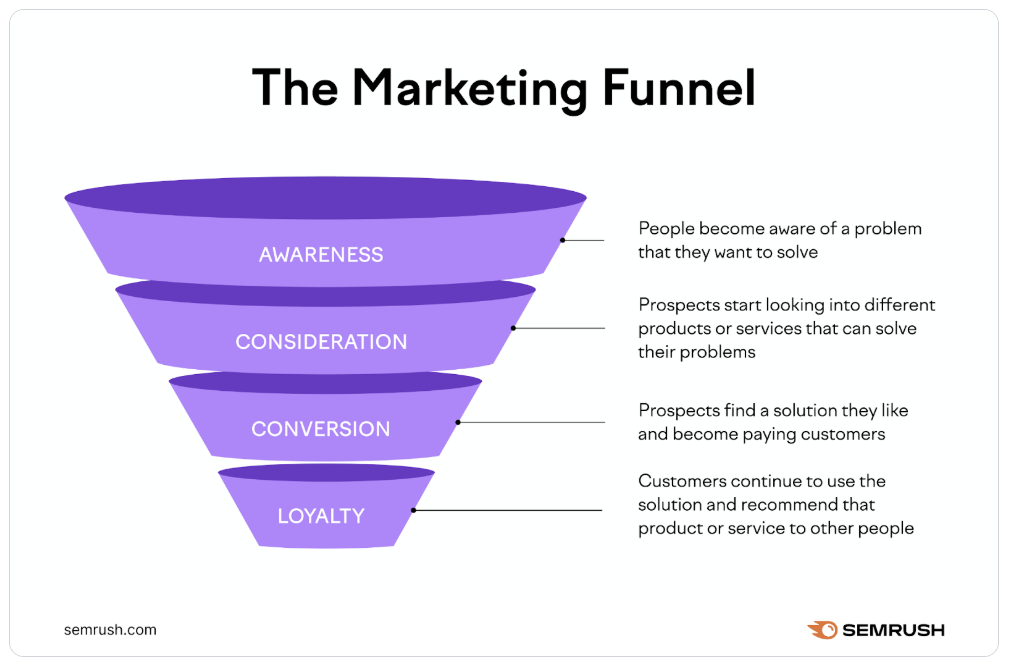
The marketing funnel (also known as a sales or conversion funnel) is a model that illustrates the customer journey. Imagine a real-world funnel—it's wide at the top and narrow at the bottom. In marketing, many potential customers enter the top of the funnel, but only a fraction of them make it all the way to the bottom to become a paying, loyal customer. Your job as a marketer is to guide as many people as possible through its stages.
To get a clear introduction to this concept, let's watch a short video from the Google Digital Marketing & E-commerce Certificate course.
The Customer Journey & the Marketing Funnel | Google Digital Marketing & E-commerce Certificate
This video provides a great overview of the marketing funnel and clearly defines each of its four core stages.
Please watch from 09:26 to 12:25. The first part (until 10:38) introduces the concept of the funnel itself. The second part (from 10:38) details the four stages we'll be focusing on: Awareness, Consideration, Conversion, and Loyalty.
As the video explained, the funnel helps a business plan how to move customers along their journey. Let's break down each of those stages in a digital context, connecting them to the channels we learned about in the last lesson.
The Four Stages of the Digital Marketing Funnel
We'll explore each stage from two perspectives: the customer's mindset and the marketer's goal.
1. Awareness Stage
- Customer's Mindset: "I have a problem/need/interest, and I'm looking for information," or simply, "Oh, this brand looks interesting." At this stage, a person has just discovered your brand. They may have found you through a social media post, a Google search, or an online ad. They are not ready to buy yet; they are just becoming aware that you exist.
- Marketer's Goal: To reach a broad audience and make them aware of the brand, its products, or its services. The aim is to capture attention and make a good first impression.
Digital Marketing Tactics for Awareness:
- Content Marketing: Writing blog posts that answer common questions (e.g., a pharmacy writing an article on "5 Ways to Boost Your Immune System").
- Social Media Marketing: Creating shareable content like infographics, short videos (Reels/TikToks), or interesting facts.
- Search Engine Optimization (SEO): Optimizing your website to appear in search results when people look for relevant topics.
- Paid Advertising: Running display ads on websites or paid social media ads to reach people who fit your target audience profile.
2. Consideration Stage
- Customer's Mindset: "I'm actively researching solutions to my problem and comparing different options." The potential customer now knows about your brand and is actively evaluating if your product or service is the right fit for them. They might be comparing your offerings to your competitors'.
- Marketer's Goal: To build trust, demonstrate value, and persuade the potential customer that your solution is the best one. You want to provide them with the detailed information they need to make an informed decision.
Digital Marketing Tactics for Consideration:
- In-depth Content: Offering more detailed resources like case studies, webinars, or downloadable guides that showcase your expertise.
- Email Marketing: Sending newsletters with helpful tips and product information to people who have subscribed.
- Social Media: Engaging directly with users in comments or DMs, and sharing customer testimonials or product demonstrations.
- Retargeting Ads: Showing specific ads to people who have already visited your website, reminding them of the products they viewed.
3. Conversion Stage
- Customer's Mindset: "I've decided on a solution and I'm ready to take action." This is the critical moment where a potential customer decides to become an actual customer.
- Marketer's Goal: To make the process of converting (e.g., making a purchase, signing up for a service) as simple and seamless as possible. Any friction or confusion here can cause them to abandon the process.
Digital Marketing Tactics for Conversion:
- Website Optimization: Ensuring a simple, fast, and secure checkout process.
- Strong Calls-to-Action (CTAs): Using clear and compelling buttons like "Buy Now," "Sign Up Today," or "Get Your Free Trial."
- Promotions: Offering a first-time buyer discount or free shipping to encourage the final decision.
- Email Marketing: Sending "abandoned cart" emails to remind people who started the checkout process but didn't finish.
4. Retention (or Loyalty) Stage
- Customer's Mindset: "I've made the purchase. I hope it was the right decision. Will I come back in the future?" The journey doesn't end at the sale. Now, the customer is evaluating their experience with your product and your company.
- Marketer's Goal: To turn a one-time buyer into a repeat customer and, ideally, a brand advocate who recommends you to others. It is often much cheaper to retain an existing customer than to acquire a new one.
Digital Marketing Tactics for Retention:
- Email Marketing: Sending thank-you emails, asking for reviews, and offering personalized recommendations for future purchases.
- Loyalty Programs: Rewarding repeat customers with points, discounts, or exclusive access.
- Social Media: Creating a community where customers can engage with the brand and each other. You could run contests for existing customers or feature user-generated content.
- Excellent Customer Service: Providing prompt and helpful support through channels like email, chat, or social media.
Test your understanding!
A new skincare brand is planning its digital marketing. Match the following tactics to the correct funnel stage (Awareness, Consideration, Conversion, Retention).
- An Instagram ad with a "Shop Now" button that leads to a product page.
- A blog post titled "The Beginner's Guide to Building a Skincare Routine."
- An email sent to existing customers with a 15% discount on their next order.
- A detailed video on YouTube comparing the brand's vitamin C serum to a competitor's product.
Show answer
- Conversion: The "Shop Now" button and direct link to a product page are designed to drive an immediate purchase.
- Awareness: This blog post helps people who are new to skincare, attracting a broad audience and making them aware of the brand as a helpful resource.
- Retention: The discount for existing customers is designed to encourage a repeat purchase and build loyalty.
- Consideration: The detailed comparison video helps potential customers who are actively evaluating their options and trying to decide which product is best for them.
The Funnel in Action: A Social Media Focus
Since your primary interest is social media, let's see how this funnel applies specifically to social platforms. The following article breaks down the funnel into stages that are particularly relevant for social media marketing.
5 Key Stages in Building a Profitable Social Media ...
The article '5 Key Stages in Building a Profitable Social Media Marketing Funnel' from Walkersands provides a practical look at how to apply the funnel concept directly to social media activities.
Please read the entire article. Notice how the stages it describes—Awareness, Consideration, Conversion, Engagement, and Advocacy—align with the four stages we just discussed, but with more detail on the post-purchase phase (Engagement and Advocacy map to Retention). Pay attention to the specific examples of social media posts for each stage.
As you saw in the article, you can use social media across the entire customer journey. For example, a pharmacy could:
- Awareness: Post a TikTok video on "3 myths about the flu shot" to reach a wide audience.
- Consideration: Run a Facebook Live Q&A with a pharmacist to answer questions about managing diabetes, building trust and expertise.
- Conversion: Use an Instagram Story with a swipe-up link offering a 10% discount on vitamins.
- Retention (Engagement & Advocacy): Create a branded hashtag like
#HealthyHabitsFromMyPharmacyand encourage customers to share their wellness journey, then feature the best posts on the pharmacy's page.
Conclusion
Today, we've unpacked the marketing funnel, a crucial framework for strategizing your marketing efforts.
Key Takeaways:
- The marketing funnel consists of four main stages: Awareness, Consideration, Conversion, and Retention (Loyalty).
- It models the customer's journey from first discovering a brand to becoming a loyal, repeat customer.
- Each stage requires different marketing tactics and channels to meet the customer's needs at that specific point in their journey.
- This framework is highly applicable to social media, allowing you to plan content that guides followers from discovery to advocacy.
You now understand not only the tools of digital marketing but also the strategic map for using them.
In our next lesson, we will get more specific about the "who." We'll build on our understanding of the customer journey by learning how to create a target audience persona. Defining exactly who you are trying to reach will make every stage of your marketing funnel infinitely more effective.