Hello! Welcome to the first lesson in your Digital Marketing Basics course. I'm excited to guide you through the fundamentals of this dynamic field.
Today, we'll start at the very beginning by tackling our first learning outcome: to define digital marketing and identify its key channels. Think of this lesson as creating a map. Before we explore a specific territory like social media, we need to understand the entire landscape—what digital marketing is and all the different paths you can take within it. This foundation will be crucial for understanding how social media marketing, your area of interest, fits into and works with a broader strategy.
Let's get started!
What is Digital Marketing?
At its core, digital marketing is any marketing effort that uses an electronic device or the internet. It's how companies promote brands, products, and services to connect with customers where they are spending more and more of their time: online.
To get a quick and clear overview, let's watch a short video from HubSpot.
What is Digital Marketing for Beginners? (Tutorial)
This video provides a concise and modern definition of digital marketing.
Please watch from the beginning until the 0:47 mark. Pay attention to how the definition includes not just traditional websites and email, but also newer forms of interaction.
As the video mentions, digital marketing encompasses everything from search engines and social media to email and websites. Unlike traditional marketing (like print ads or TV commercials), one of the biggest advantages of digital marketing is that its effectiveness can be measured with great precision, allowing marketers to see what works and what doesn't in near real-time.
Given your background in pharmacy, it might be helpful to see how these concepts apply in a healthcare context. The principles are universal.
Using digital tools to promote your pharmacy
Let's read a brief section from the article 'Using digital tools to promote your pharmacy' from HasHealth.
Read the short section under the heading 'What is digital marketing?'. Notice how it frames these tools as a way for businesses, including pharmacies, to reach their target customers where they are now—online.
The Key Channels of Digital Marketing
Now that we have a solid definition, let's break down the "how." Digital marketing isn't a single activity but a collection of different strategies, often called channels. Each channel is a different tool a marketer can use to reach an audience.
This image provides a great visual summary of the main channels we'll be discussing.
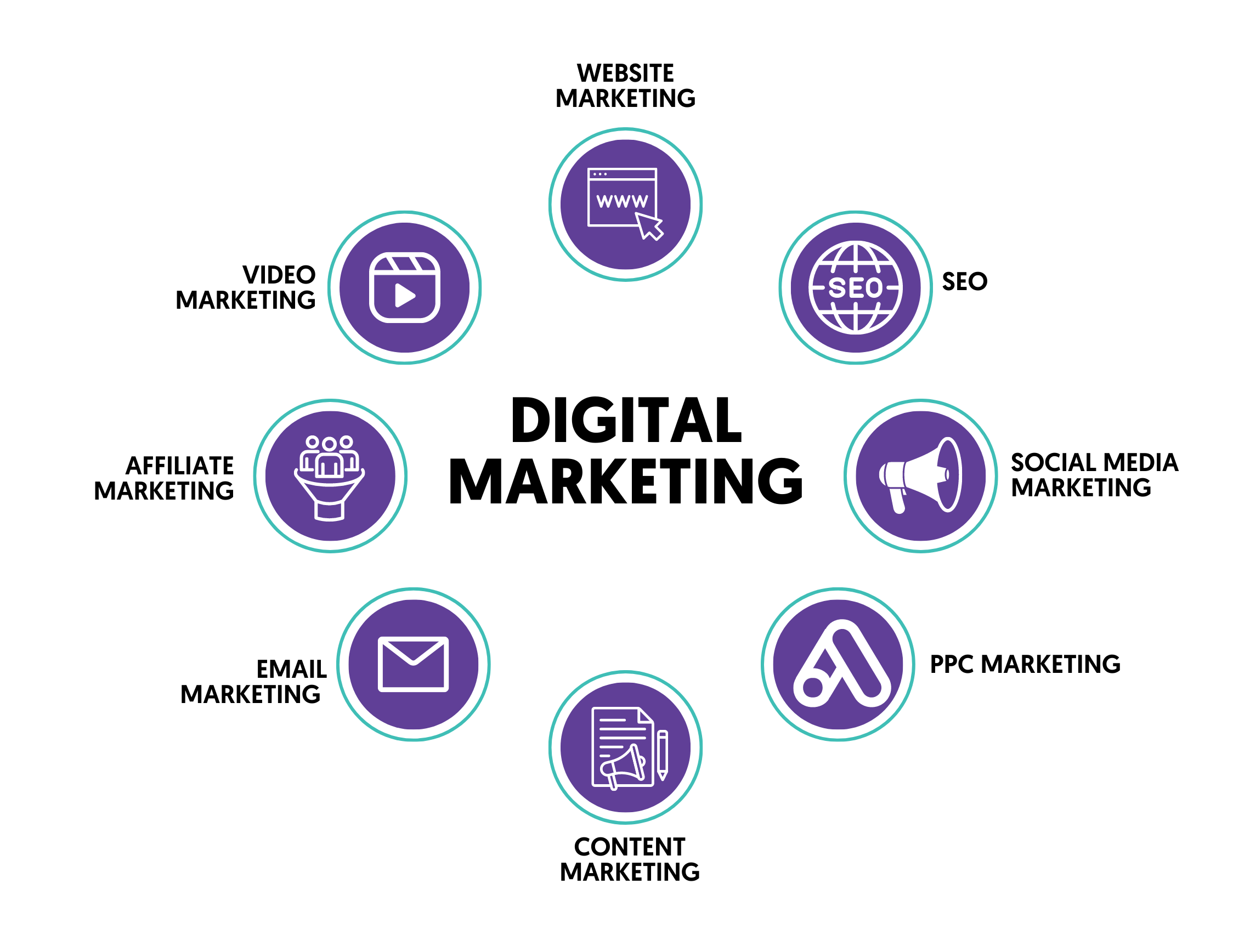
To understand the purpose of each channel, we will use an excellent article from Coursera that breaks them down one by one.
What Is Digital Marketing? Key Channels, Examples, and ...
The article 'What Is Digital Marketing?' by the Coursera Staff provides clear and concise descriptions of the most important digital marketing channels. It's a great reference for building your foundational knowledge.
Please read the section titled '7 digital marketing channels'. As you read about each one, try to think about its primary purpose in your own words. For instance, is it about being found, building relationships, or direct promotion?
After reading that section, let's quickly review and organize these channels to solidify your understanding.
1. Search Engine Optimization (SEO)
- What it is: The practice of optimizing your website and content to rank higher in search engine results (like on Google), for free.
- Goal: To attract "organic" (unpaid) traffic from people actively searching for information, products, or services related to your business.
- Example: A pharmacy writing a detailed blog post on "managing seasonal allergies" so that it appears on the first page of Google when someone searches for that topic.
2. Pay-Per-Click (PPC) Advertising
- What it is: Placing ads on search engines or websites and paying a fee each time your ad is clicked. A common form is Search Engine Marketing (SEM), which refers to paid ads on search results pages.
- Goal: To get immediate, targeted traffic to your website. You are essentially buying visits rather than earning them organically.
- Example: The same pharmacy paying to have an ad appear at the very top of the Google search results for "allergy medicine delivery."
3. Social Media Marketing
- What it is: Using social media platforms (like Instagram, TikTok, Facebook, LinkedIn) to build your brand, engage with your audience, and drive traffic to your website. This is the area you're especially interested in!
- Goal: To build a community, create brand awareness, and interact directly with current and potential customers.
- Example: A pharmacy sharing tips on Instagram for staying healthy during flu season, running a poll on Facebook about health topics, or posting videos on TikTok showing how to use a new health gadget.
4. Content Marketing
- What it is: Creating and distributing valuable, relevant, and consistent content (like blog posts, videos, infographics, or podcasts) to attract and retain a specific audience.
- Goal: To build trust and authority with your audience by providing them with useful information, not just direct sales pitches. SEO is often a major part of a content marketing strategy.
- Example: A pharmacy creating a downloadable PDF guide on "Understanding Your Prescriptions" that customers can get by providing their email address.
5. Email Marketing
- What it is: Sending targeted messages to a list of subscribers via email.
- Goal: To nurture relationships with potential customers (leads) and keep existing customers engaged by sending them promotions, newsletters, or company updates. It's a very direct and often highly effective channel.
- Example: A pharmacy sending a weekly newsletter with health tips, new product announcements, and exclusive discounts to people who have signed up.
6. Affiliate & Influencer Marketing
- What they are: These are related forms of partnership-based marketing.
- Affiliate Marketing: You partner with individuals or companies ("affiliates") who earn a commission for every customer they send your way.
- Influencer Marketing: You collaborate with individuals who have a large following on social media ("influencers") to promote your product to their audience.
- Goal: To leverage the trust and reach of others to promote your brand.
- Example: A skincare brand providing a unique discount code to a beauty influencer on Instagram. The influencer earns a percentage of every sale made using their code.
Test your understanding!
A new local pharmacy wants to achieve two main goals with digital marketing:
- Immediately attract customers who are actively searching online for a "pharmacy open late near me."
- Build a long-term relationship with the local community by providing helpful health information and updates.
Which digital marketing channel would be best suited for each goal?
Show answer
-
For the first goal (immediately attracting active searchers), Pay-Per-Click (PPC) Advertising would be the most effective channel. The pharmacy could run ads on Google that target users searching for those specific keywords in their local area, ensuring they appear at the top of the results right away.
-
For the second goal (building a long-term community relationship), Social Media Marketing and Content Marketing would be ideal. They could use social media to post daily health tips and engage with followers, and use content marketing (like a blog on their website) to provide more in-depth answers to common health questions, establishing themselves as a trusted local resource.
Conclusion
In this lesson, we've established the foundational knowledge for your journey into digital marketing.
Key Takeaways:
- Digital Marketing is the use of online channels to promote a brand and connect with customers.
- It's not just one thing, but a collection of distinct channels, each with a specific purpose.
- The primary channels include SEO, PPC, Social Media Marketing, Content Marketing, Email Marketing, and partnership-based strategies like Affiliate and Influencer Marketing.
You now have a "map" of the digital marketing landscape. You can see that your interest, social media, is a vital piece of a much larger puzzle. Understanding how it interacts with other channels—like using content on social media or driving social media followers to an email list—is the key to a powerful strategy.
In our next lesson, we will explore the marketing funnel. This concept will help you understand the customer's journey from first hearing about a brand to becoming a loyal customer, and how to use the channels we learned about today to guide them through that journey effectively.