Welcome back! In our previous lesson, we traced the journey a community takes through its lifecycle, from inception to maturity. This gave us a "macro" view of the when and how a community evolves. Now, we'll zoom in on the fundamental ingredients that make a community thrive at every stage of that journey.
This lesson is dedicated to answering a crucial question: What do successful online communities have in common? We'll explore the core characteristics that separate a vibrant, self-sustaining community from a quiet, inactive group. You'll learn that success isn't accidental; it's the result of intentionally building a space with a clear purpose, a strong culture, and a focus on genuine human connection. Understanding these foundational traits will be essential as we move on to building your own community strategy.
To start, let's consider the overall health of a community. Just as a doctor assesses multiple vital signs, a community manager must look at several interconnected components.
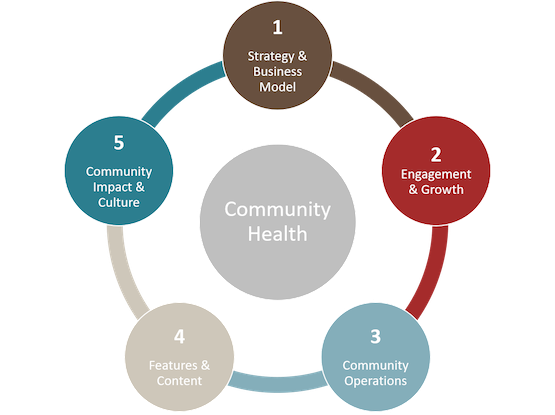
This "Community Health Wheel" illustrates that a successful community is a system where strategy, operations, content, and culture all work together. The characteristics we'll discuss today are the lifeblood flowing through this system, making it healthy and resilient.
1. A Clear, Shared Purpose: The "Why"
The single most important characteristic of any successful community is a clear and compelling shared purpose. It's the North Star that guides every decision and the magnet that attracts the right people. Without a shared "why," a group is just a collection of individuals. With one, it becomes a unified force.
In her TEDx talk, community builder Sophie Zechmeister emphasizes that before you build anything, you must start by defining your purpose.
A DIY Guide In Building Community | Sophie Zechmeister | TEDxDonauinselSalon
Watch this short segment from "A DIY Guide In Building Community" to understand why purpose is the essential first step.
Pay close attention as she discusses the importance of answering the questions "Why does your community exist?" and "Why should I join?".
Having a purpose is one thing; articulating it clearly is another. A vague mission statement won't resonate. Community expert Tom Ross offers a brilliant method for honing your value proposition, which he calls the "podcast test."
How To Build An Online Community (Complete Guide w/ Tom Ross)
In this clip from his comprehensive guide, Tom Ross explains how to craft a value proposition that is concise, confident, and effective.
Watch from the start as he contrasts a "word salad" value proposition with a clear, effective one. Notice how a strong value proposition allows potential members to immediately self-identify and understand the benefit.
For the Web3 projects you're involved with, this is critical. A community's purpose isn't just "to support this token." It might be "to connect developers building on our protocol" or "to empower artists to launch their first NFT collection." A clear purpose provides intrinsic motivation beyond financial speculation.
2. An Intentional Culture: The "Vibe"
If purpose is the "why," culture is the "how." It's the collection of shared values, expected behaviors, and unwritten rules that define the community's atmosphere or "vibe." A strong, positive culture doesn't happen by accident; it must be intentionally designed and nurtured.
Tom Ross provides an excellent breakdown of what community culture is and how to begin shaping it.
How To Build An Online Community (Complete Guide w/ Tom Ross)
This segment is a masterclass in thinking about and building community culture.
Watch this section on culture, starting at the definition. Pay close attention to his exercise of defining both the traits you want in members and the traits you don't want. His Cobra Kai vs. Miyagi-Do analogy is a powerful illustration of how two groups with the same goal (karate) can have vastly different cultures.
But how do you translate abstract cultural traits like "supportive" or "inclusive" into tangible reality? This is where the "3 R's" from Sophie Zechmeister's TEDx talk provide a practical framework: Rituals, Rhythm, and Rules.
A DIY Guide In Building Community | Sophie Zechmeister | TEDxDonauinselSalon
This part of the talk offers three concrete tools for building the culture you want.
Watch these three consecutive segments: Rituals: These are the shared experiences, like onboarding ceremonies or annual events, that create common bonds. Rhythm: This is the predictable cadence of events, like a weekly AMA or a monthly newsletter, that creates stability and a sense of belonging. Rules: These are the explicit guidelines that make the space feel safe and welcoming for everyone, especially new members.
Think about your small WhatsApp group. A simple ritual could be celebrating when a member shares a success. A rhythm might be asking a specific question every Friday. And clear rules about spam or self-promotion make everyone feel more comfortable participating.
3. Active Engagement & Meaningful Connection: The "What"
A community with a clear purpose and great culture still needs one more thing: interaction. A successful community is not a static library of information; it's a dynamic network of people helping and connecting with one another. Your job as a community manager is to facilitate this by providing tangible value.
Tom Ross breaks this value down into four key types. A great community offers its members opportunities for:
How To Build An Online Community (Complete Guide w/ Tom Ross)
This framework is incredibly useful for thinking about the kinds of activities and content you should offer to drive engagement.
Watch this segment to learn about the four types of value: Help, Action, Learning, and Connection. Consider how you could provide each of these within a community you manage.
- Help: A space to ask questions and get support (e.g., a #support channel on Discord).
- Action: Structured programs that encourage progress (e.g., a "30-day content challenge").
- Learning: Access to expertise (e.g., workshops, courses, expert AMAs).
- Connection: Opportunities for members to build genuine relationships (e.g., virtual coffee chats, interest-based subgroups).
By focusing on delivering these four types of value, you create a space that members want to return to, participate in, and contribute to.
Putting It All Together
We've explored purpose, culture, and engagement as the pillars of a successful community. The marketing platform Higher Logic synthesizes these ideas into a simple, memorable model.

These four points neatly summarize what we've learned:
- Grow from Shared Purpose: This is the "why" we started with.
- Vibrant & Multi-Dimensional: This is the result of a strong culture and providing all four types of value (Help, Action, Learning, Connection).
- Thoughtfully Moderated: This is achieved through clear "Rules" and an intentional culture that is actively upheld.
- Built for Engagement & Communal Support: This is the core function of the community, facilitated by the community manager.
To solidify your understanding, please read the section of the Higher Logic article that details this framework.
What Is An Online Community? Explore The Basics & Benefits
This article provides a concise summary of the core characteristics we've been discussing, using the framework from the infographic above.
Please read the section 4 Characteristics of Great Online Communities. As you read, connect each of the four points back to the deeper concepts of purpose, culture (including rituals, rhythm, and rules), and the types of value we've explored.
Conclusion
In this lesson, we've identified the essential DNA of successful online communities. It's not about platform features or the number of members, but about the quality of the experience.
Here are your key takeaways:
- Successful communities are built on a clear, shared purpose that is articulated concisely.
- They cultivate an intentional culture through leadership and tangible structures like rituals, rhythm, and rules.
- They foster engagement and connection by providing members with real value in the form of help, action, learning, and connection.
- These characteristics are interconnected and work together to create a healthy, vibrant, and sustainable community.
We've now covered the community lifecycle ("when") and the characteristics of success ("what"). The next logical step is to understand the people who make it all happen: the members. In our next lesson, we will explore the core human motivations for why people join, stay, and participate in communities. This psychological understanding will be the key to applying everything we've learned so far.